
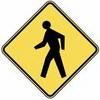
 Every year an average of 52 pedestrians are killed and 2.400 are injured by collisions in B.C. These incidents typically take place at night or when visibility is poor. While there is no law requiring that pedestrians take steps to make themselves more visible to drivers in times of low visibility it simply makes sense to protect yourself when crossing or walking along the road.
Where To Walk
Pedestrians need to remember that they must not walk on the roadway if a sidewalk is present. If there is no sidewalk, they must walk on the left facing oncoming traffic. It may be dangerous, but you are entitled to use both the extreme left edge of the roadway or the shoulder. Of course, if the shoulder is available, you would be foolish to insist on using the edge of the roadway or traffic lane.
The Driver's Duty to Pedestrians
Drivers must exercise due care to avoid collision with a pedestrian who is on the highway. Remember, a highway includes both the extreme left edge of the roadway and the shoulder.
The Pedestrian's Duty to Drivers
Just as drivers are required to take reasonable care to anticipate apparent potential hazards arising even from irregular or illegal conduct on the part of pedestrians, pedestrians must take reasonable care to anticipate equivalent conduct on the part of drivers. The duties of drivers and pedestrians are symmetrical; each owes an equivalent duty; Liston v. Striegler.
Making Yourself Visible to Drivers
What's the best way for a pedestrian to be seen while walking at night? Light coloured clothing? A traffic vest? The right answer is "none of the above." If you really want to be safe the buzzword is Biological Motion.
Reflectors at shoulders, elbows, wrists, waist, knees and ankles are noticed three times further away than a person wearing only light coloured clothing. The motion of the reflectors appears to be readily identifiable by drivers as a pedestrian's movements and are eye catching. It is said that an observer can even judge if the wearer of the reflectors is a male or female just by studying their motion.
If you are going to be walking on or beside the highway at night, consider purchasing and using reflective banding for your clothing. It's a small price to pay to avoid becoming a statistic.
I live in a semi rural area on south Vancouver Island where sidewalks are virtually nonexistent and pedestrians walk along the shoulders or edge of the roadway. I am contiually astounded by the number of them (more than half) who do not follow the simple rule of walking on the left side facing oncoming traffic.(night or day)
I have to wonder, do they not know it's an actual law,or are they simply oblivious to the reasons for doing so? Are they really willing to put their absolute trust in drivers (distracted or otherwise) to avoid hitting them if they stray a little too far out fom the shoulder or edge of the roadway?
- Log in to post comments
In the Hong Kong driving guide I have from a few decades back, the first 20 pages are devoted to telling pedestrians how they should behave.
In the UK Highway Code, it's clearly indicated that pedestrians should walk facing traffic, when not on a sidewalk/pedestrians.
In BC? A few tips for drivers to look out for pedestrians is about it. I guess that they don't expect pedestrians to need to know the law, or how to behave in a safe manner.
As for pedestrians being willing to put their absolute trust in drivers ... they do, it's ridiculous! And worse now with the massive use of cellphones.
- Log in to post comments
But if a pedestrian doesn't have the inclination to read the Motor Vehicle Act (fascinating though it is), how are they supposed to know this?
- Log in to post comments
Not likely taught in schools. Hopefully parents provide the example.
- Log in to post comments
I grew up in Toronto in the 60's and remember "Elmer the Saftey Elephant" in elementary school - there was even a flag. Kids were taught basic traffic saftey. Pretty sure no such program exists today.
- Log in to post comments
Don't know when they disappeared but there use to be signs on highways when leaving every small community that advised you "Walk on left facing Traffic". Even remember a few with a picture of a vehicle coming towards a person walking. Probably when the adoption of International signage started.
Then whenever you hit a section with a passing lane would be a sign "Keep Right except to Pass".
Why is it so many signs with common sense messages disappeared and now the only one enforced are the speed limit signs? Could it be the highway department figured if there was going to be no enforcement why waste the money? Will just post what the police will enforce?
- Log in to post comments
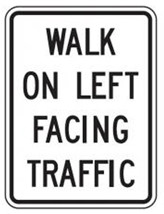
These types of signs are needed now more than ever, as most pedestrians I see walking along the road side use little or no common sense at all. It's not just adults, as they often have children with them - so they too are being led to believe it's okay to walk on the right with your back to oncoming traffic. No enforcement that I know of.
- Log in to post comments
- Log in to post comments
Pedestrians, Protect Yourselves!