
Misbehaviour at the Merge
- Read more about Misbehaviour at the Merge
- 6 comments
- Log in to post comments
 Question: I am concerned about an intersection that has an acceleration lane to allow traffic turning left from a stop sign to merge with through traffic. A driver in the through lane decided that he had to be first and I had to brake to avoid a collision when we reached the merge point at the same time.
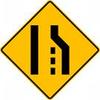 There is probably nowhere that the unofficial rules of the road are "enforced" by other drivers like that of the line up at lane closures. You know, the long line up of traffic that forms on one side of the highway immediately after drivers pass the lane closed ahead advisory signs.
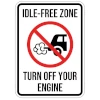 I think leaving a vehicle running, sometimes without the driver in it, while parking in a public place by should be a fineable offence under an anti-idling law. It has become so common now and is especially toxic when the vehicle is a large truck. Would you write about this please?
 I've always wondered about the driver in the far left lane as I used the acceleration lane to join traffic already on the freeway. Would they change lanes to the right while I was trying to merge with the flow of fast moving traffic by moving into the same lane from the left?
 I saw many things over the two decades that I spent in full time traffic enforcement. Some of those things left me shaking my head wondering why the driver ever thought their vehicle was still driveable! If you don't value the life of other road users, surely you value your own.
 The question this week revolves around vehicle noise in quiet neighbourhoods. Why don’t the municipalities do more about it asks my correspondent. This may be a case of the squeaky wheel not getting the grease!
 Question: I was stopped by a motorcycle officer over a 60 kph bridge. I was going over the posted limit and unaware of the excessive speed consequences. The officer said that he was pacing me and I was "pulling away from" him. I was asked initially how fast I thought I was going and ignorantly and mistakenly guessed 110.
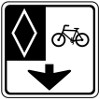 Question: I have been driving home on Rupert Street in Vancouver lately and there are some lane markings I am not clear about. Between 12th Avenue and about Kingsway there is a narrow right hand lane that has a bicycle and a white diamond, there is no other signage. Are motorcycles allowed to use this lane because they regularly do.
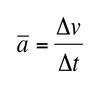 You may be able to disregard the rules in the Motor Vehicle Act and survive, but disobeying the laws of physics when you drive will eventually result in a collision.
 If you blow a warn, which means having a blood alcohol content (BAC) between 60 and 90 mg%, it will trigger an Immediate Roadside Prohibition (IRP) for a driver today. This could also apply to the operators of e-bikes and e-scooters as well.