
Who Goes First at a 4-Way Stop in BC?
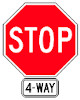 Who goes first at a 4-way stop? The basic rule seems simple: first to stop, first to go. However, when two or more drivers stop at about the same time, things become more complicated. Do you know who should have the right of way?
 No, most often stopping behind another car at a stop sign does not count as your legal stop.
 When waiting at a red light, how much space should you leave between your vehicle and the car ahead? A common rule of thumb is to ensure you can see the rear tires of the leading vehicle touching the pavement. However, when a multi-vehicle chain-reaction accident occurs, failing to leave a wide gap does not automatically make you legally liable for the damage.
 Being stopped by the police is a high-stress moment. In my years on patrol, I saw it all: drivers slamming on their brakes in the middle of a live lane, and others who drove for kilometres, totally oblivious to the light show behind them.
 What is the purpose of completely coming to a stop at a 3 or 4 way stop when there are no vehicles or pedestrians near the intersection? A rolling stop should be sufficient, as MOST drivers including professional drivers never completely stop at stop signs. There are at least 3 good reasons for NOT coming to a complete stop. I cannot think of one good reason for coming to a COMPLETE stop.
 I am occasionally asked about the practice of left foot braking. The usual justification given for this is that the brakes may be applied more quickly because the left foot is ready while the right foot is busy with the accelerator pedal. While there are different schools of thought on whether this is appropriate for highway driving it may not be a good idea for the average driver.
 Would you believe me if I told you that the positioning of a stop sign at an intersection has nothing to do with where you must stop? Yes, the sign tells you that you must stop, but the markings on the roadway, or lack of them, tell you where the stop has to take place. There are four possibilities for a driver to consider.
 I have noticed many drivers stopping at a red light several feet behind the car in front. Having asked my daughters who had recently passed their driving exams about this and both told me that their instructor had told them, even when stopped, they must leave at least one car length distance behind the car in front.
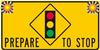 Kate asks “When your light is green at the intersection ahead but above you the advanced yellow overhead warning lights have begun to flash, should you be preparing to stop for that green light?”