
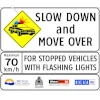
 B.C.'s slow down move over law is now more than 15 years old. Many drivers continue to fail to slow down and move over when possible, putting the safety of roadside workers at unnecessary risk. A BCAA survey suggests that 70% of drivers are still unsure of what to do.
See, Think, Do
Our provincial Learn to Drive Smart guide speaks of the See, Think, Do method, and that's exactly what is needed in these situations. You have to see the lights of the emergency vehicles, think that an action may be required of you and do plan for and then take the required action.
Slow Down Move Over Cooperation
When the road is busy, all drivers in the vicinity of stopped emergency vehicles have to co-ordinate and cooperate in order to be successful.
My own experience shows that few drivers plan ahead. I watched a police vehicle light up and disappear from view ahead of me. I was in the right hand lane of the two northbound lanes so I slowed and anticipated that I might find them on the shoulder ahead.
Sure enough, I found them stopped in a corner within a short distance. No one else slowed and no one would make room, despite my signalled request, to allow me to move over. I couldn't stop as it would likely mean being hit from behind by someone driving at 90+ km/h.
I slowed right down, moved as close as I dared to my left and crossed my fingers. Thankfully, it all worked out!
Penalties for Failing to Slow Down Move Over
A violation ticket for either of these offences costs a driver $173 and 3 penalty points.
Slow Down Move Over Video
Learn More
- The Law in BC
- Investigating Factors Influencing Drivers' Behaviour and Compliance
- BCAA Survey - May 2025
Share This Article
- Log in to post comments
Comments
On Thursday morning I was driving to Nanaimo (with a young grandchild in my car) and somewhere around Cook Creek there was a black vehicle with several flashing lights – possibly 6? – stationary at the side of the road. I assumed it to be a police vehicle of some kind. The road was not particularly busy and I was in the curbside lane. As I approached, traveling at the posted 110 kph. I gradually reduced my speed, checked my mirrors and moved into the outer lane so that I was traveling at 70 kph. before I drew alongside the vehicle. As I passed this vehicle with its lights all flashing I could see in front of it (therefore it was not possible to see the person until I was level with the vehicle) what appeared to be a female police officer walking in front of the vehicle, taking photographs into the ditch.
However, at that point I had a large 4x4 truck bearing down on me from behind in an aggressive manner and clearly the man driving it was ignorant of the law and just saw me as a nuisance to his progress. When we had passed the stopped police vehicle I resumed my speed and moved back to the other lane as he roared past me, clearly trying to make a point. It occurred to me later that he might have tried to solve his angry situation by passing me on the inside which could have had catastrophic consequences.
I have tried in many ways to be sure that people I know are aware of this law and the reason for it, but all too many drivers seem to be unaware and therefore create even more potentially dangerous situations. Is there any more obvious way to ensure that motorists obey this law? A few signs posted on the highway are not enough.
- Log in to post comments
Something I have practiced myself for many years (since before the move over law existed) as well as taught many others; when I see an emergency vehicle stopped on the side of the road I signal left, slow down and move over only half a lane, straddling the center line and put my right signal back on. Too many times prior to this I had been passed on the right between myself and the emergency vehicle (potentially causing a serious incident) so to stop this from happening I block both lanes temporarily, taking that option away from drivers following me that aren't paying enough attention ahead. I feel this is the safest way to handle this situation.
- Log in to post comments
Checkride, I'm with you on this. Sometimes, lane-straddling is the smart solution and never mind the mighty Motor Vehicle Act.
It may be useful for trucks and buses making tight turns, needing to physically block the 2- or 4-wheelers from getting inside of them as they set up; and, I'll often do this on a straight highway when there's a cyclist ahead and I just want to give them some room as I pass.
No cop is going to complain about a driver who is lane straddling at 70 km/h, in order to protect them; maybe they'll even chase down that pickup truck driver for following too close? OK, I can dream ...
- Log in to post comments
Too Many Drivers are Unaware