
Limited-speed motorcycles (LSMs) offer an alternative to conventional motorcycles for people who want inexpensive, relatively low-powered transportation. In British Columbia, they have a particular legal status: you can operate one with a regular passenger vehicle driver's licence without obtaining a Class 6 motorcycle licence.
However, not every small motorcycle, moped or electric scooter qualifies. The vehicle must meet specific requirements to be classified as a limited-speed motorcycle.
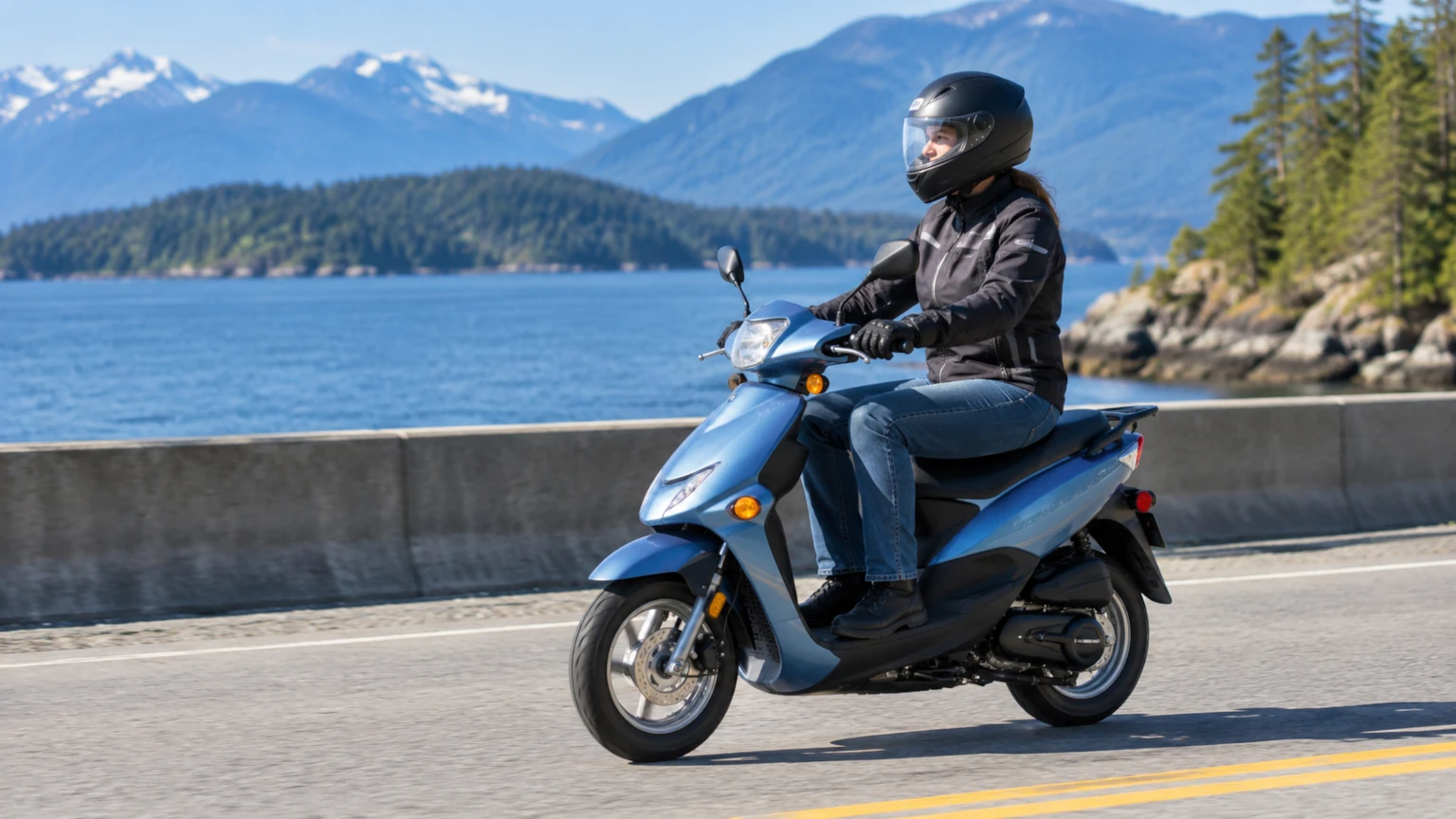
What Are Limited-Speed Motorcycles?
What are the qualifiers for limited-speed motorcycles? They must meet all of the following criteria:
- A motor with a piston displacement of not more than 50 cc, or a power source that produces a maximum of 1.5 kW.
- A power drive system that does not require the operator to use a clutch or shift gears after the drive system is engaged.
- A maximum attainable speed on level ground, with or without pedals, of 70 km/h.
- A maximum weight of 95 kg, excluding fuel or batteries used to store energy for vehicle propulsion.
- Wheels with a diameter of 254 mm or more.
A vehicle that does not meet every one of these requirements does not qualify as a limited-speed motorcycle.
How Do You Know If a Motorcycle Qualifies?
Meeting the physical requirements is not enough. A motorcycle offered for retail sale in Canada must also comply with the applicable Canadian Motor Vehicle Safety Standards (CMVSS).
Look for the permanently affixed Canadian Motor Vehicle Safety Standards compliance label. A seller's description is not proof that a vehicle can legally be operated on public roads.
This is particularly important when considering an imported vehicle, an inexpensive electric motorcycle or a device advertised as a street-legal scooter.
Before purchasing, confirm its eligibility for registration and insurance with ICBC or an Autoplan broker.
What Driver's Licence Do You Need?
You do not need a Class 6 motorcycle licence to operate a qualifying limited-speed motorcycle in British Columbia.
The provincial government specifies that any class of licence is acceptable except a Class 5 or Class 7 learner's licence.
This means that a driver with a Class 5 licence or a Class 7 novice (N) licence can operate a limited-speed motorcycle. A Class 7 learner (L) driver cannot.
If you are a novice driver, the restrictions attached to your Class 7 licence still apply.
Registration and Insurance
A limited-speed motorcycle is a motor vehicle, not a bicycle. It must be registered, licensed and insured for road use in British Columbia.
You must display the appropriate licence plate and carry the required insurance. The fact that a vehicle is electric rather than gasoline-powered does not exempt it from these requirements.
ICBC provides information about mopeds and scooters, including registration and insurance.
If you are considering purchasing a used or imported machine, establish that it can be registered and insured before handing over your money.
Helmet Requirements
Operators and passengers on limited-speed motorcycles must wear an approved motorcycle safety helmet. The helmet must meet one of the safety standards recognized by British Columbia:
- DOT (Federal Motor Vehicle Safety Standard No. 218)
- Snell Memorial Foundation M2005, M2010, M2015 or M2020
- United Nations Economic Commission for Europe (ECE) Regulation No. 22
The helmet must display the appropriate certification label. A bicycle helmet is not an acceptable substitute.
The motorcycle operator is responsible for ensuring that passengers under 16 years of age wear an approved helmet. An exception applies to Sikh persons with unshorn hair who wear a full turban.
See ICBC's helmet and seating laws for further information.
Where Can You Ride?
Limited-speed motorcycles are motor vehicles and must be operated on the roadway. They are not permitted in bicycle lanes, on multi-use paths or in other places where motor vehicles are prohibited.
A limited-speed motorcycle must normally be operated on the roadway, not the highway shoulder. Section 150(2) of the Motor Vehicle Act requires drivers travelling below the normal speed of traffic to use the right-hand lane available to traffic or travel as close as practicable to the right-hand curb or edge of the roadway. The Act defines the roadway as excluding the shoulder. An exception applies where a shoulder has been specifically designated for LSM use by signs.
This is particularly important on highways with posted speed limits of 80 km/h or higher. A limited-speed motorcycle cannot attain more than 70 km/h, so its rider may be travelling considerably more slowly than surrounding traffic. Moving onto the shoulder to avoid holding up other drivers is not a legal or safe solution.
If you are not comfortable riding in the traffic lane with faster-moving vehicles, choose an alternative route with a lower speed limit rather than using a highway that you cannot comfortably travel on. Plan your journey around the capabilities of your motorcycle and your own comfort level.
Some designated freeway sections have minimum-speed restrictions. Section 19.07 of the Motor Vehicle Act Regulations prohibits vehicles incapable of maintaining 60 km/h on level road from using the highways listed in Schedule 1. Check whether your vehicle and intended route meet the applicable requirements before setting out.
Limited-Speed Motorcycles Are Not Electric Bicycles
Some electric motorcycles and scooters look very much like electric bicycles, but their legal requirements are quite different.
A motor-assisted cycle (e-bike) must meet the requirements of B.C.'s Motor Assisted Cycle Regulation. Among other things, it must have functional pedals and an electric motor that meets the prescribed power and speed limits.
A limited-speed motorcycle does not have to be pedal-powered. However, it must meet the LSM definition and federal vehicle safety requirements, and it requires a driver's licence, registration and insurance.
Do not assume that an electric vehicle is an e-bike simply because it has pedals or resembles a bicycle. Its actual design and compliance with the applicable regulations determine how it is classified.
Learn to Ride Before You Buy
A limited-speed motorcycle may be less powerful than a conventional motorcycle, but it is still a motorcycle. Its small size and relatively low maximum speed do not eliminate the risks associated with riding in traffic.
Motorcycle handling is different from bicycle handling. Steering, braking, cornering and maintaining balance at low speeds all require skills that benefit from proper instruction and practice.
Consider taking a recognized motorcycle training course before riding on public roads. Wear protective clothing, gloves and suitable footwear, and make yourself as visible as possible to other road users.
Learn More
- Log in to post comments