
 Many of us have been driving for decades. We’ve mastered parallel parking, survived travelling during winter storms, and navigated heavy highway traffic. But let me ask you a quick question: when was the last time you had to back up in a perfectly straight line for 100 feet?
I recently watched someone try this, and it turned into a slow and steady drift to the right that took them off the driveway.
It turns out that reversing straight is one of those skills that rusts over time. Our cars have changed, our necks might be a little stiffer than they used to be, and modern backup cameras can sometimes confuse our depth perception.
If backing up makes you break a slight sweat, you are not alone. Let’s break down why it is tricky and how to nail it every single time without throwing out your back.
Why Reversing Feels So Unnatural Now
When we drive forward, the front wheels steer and the back wheels follow. When we go into reverse, that dynamic flips. The rear of your car becomes the front.
Because the steering wheels are now in the back of your path of travel, every tiny movement of the steering wheel is magnified. Turn the wheel just an inch too far, and the car swings out wildly.
Add in modern vehicle design—which features thicker roof pillars and smaller rear windows for safety—and visibility is much tougher than it was in the cars we drove in the 70s and 80s.
The 4 Steps to a Perfect Reverse
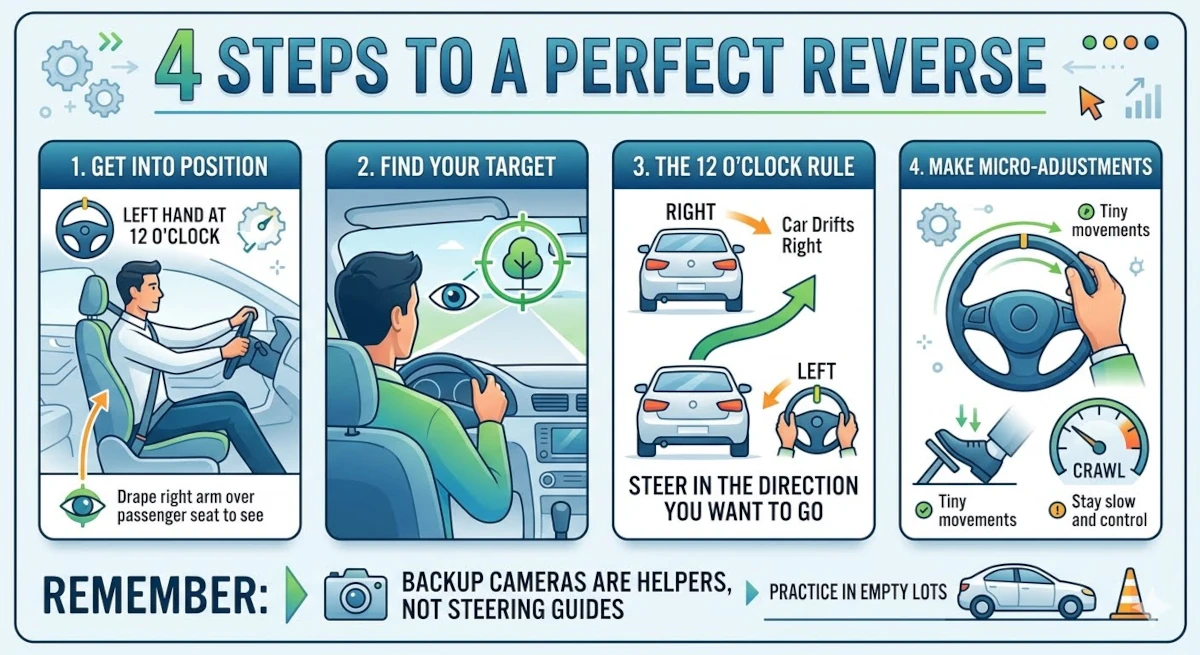
If you want to back up like a pro, forget about just staring at your dashboard screen. Try this classic, reliable method instead:
- Get Into Position: Shift into reverse and brace your body. Place your left hand at the very top of the steering wheel (the 12 o’clock position). Shift your weight onto your right hip and drape your right arm over the passenger seat. This naturally rotates your torso so you can see out the back window.
- Find Your Target: Don't look at the ground right behind your bumper. Look out the rear window at a distant object directly behind you—like a tree, a pole, or a distant parked car.
- The 12 O’Clock Rule: Here is the secret to the one-handed grip: move the wheel the way you want the back of the car to go. If the rear of the car is drifting to the right, move your hand slightly to the left to correct it.
- Make Micro-Adjustments: Treat the steering wheel like a dial, not a handle. Move it in tiny fractions of an inch. If you over-correct, you will start snake-tracking. Slow down, keep your foot hovering over the brake, and crawl backward.
What About the Backup Camera?
Backup cameras are wonderful inventions for spotting low obstacles, pets, or pedestrians directly behind your bumper. However, they are terrible for steering in a straight line over long distances because they distort your peripheral vision.
Think of your backup camera as a secondary helper. Use your eyes and your mirrors to guide your path, and use the camera strictly to verify that the path is clear of immediate hazards.
Give It a Quick Tune-Up
The next time you pass an empty parking lot on a Sunday afternoon, pull in. Find a painted line, line your car up with it, and practice backing up along it for 50 or 100 feet.
It takes about two minutes, protects your fenders from parking lot poles, and keeps your driving skills as sharp as ever.
How did you do on your last reverse challenge? Pass this guide along to your fellow drivers and spark the conversation!
- Log in to post comments
Comments
I learned to drive on a 1Ton pickup so too back up one only had your mirror. I say mirror as mirrors on left and right was not the way pickups were sold in those days.
I always back into parking spots in parking lots as it is easier with longer vehicles to back in than to go in forward due to what you explained with how little movement of the wheel.
I have never used the method of looking out the back window and with so many people driving SUV's and pickups I feel this method should no longer be taught.
- Log in to post comments
Reversing