
 Whenever I am driving on a highway with more than one lane for my direction of travel I can expect multiple drivers to make an unsafe lane change in front of me. This robs me of the space cushion that I have established and requires me to drop back to regain it. When the roads are covered in slush this type of lane change can have significant risk for the driver behind.
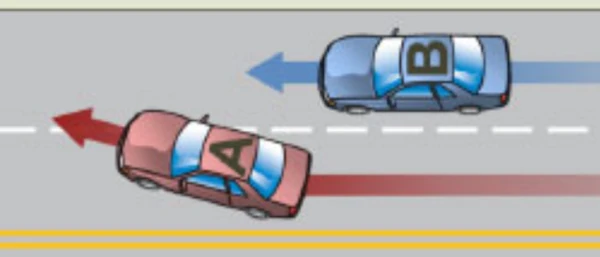
Unsafe Lane Change Crash
Peter Link was driving to White Rock from Richmond on an evening with 2 to 3 inches of new snow. On highway 99 between the highway 10 and highway 91 exits he was passed by an unidentified SUV. The SUV moved into Link's lane after passing at such a short distance that his windshield was completely covered by snow thrown up by the SUV's wheels making it impossible to see.
Mr. Link braked, spun out of control and collided with the cable barrier in the centre median.
The Law on Lane Changes
The Motor Vehicle Act forbids changing lanes in front of another driver in an unsafe manner:
157 (1) Except as provided in section 158, the driver of a vehicle overtaking another vehicle
(b) must not cause or permit the vehicle to return to the right side of the highway until safely clear of the overtaken vehicle.
159 A driver of a vehicle must not drive to the left side of the roadway in overtaking and passing another vehicle unless the driver can do so in safety.
45 traffic tickets were issued in 2024 for an offence under section 157(1)(b) MVA.
Determining Liability for the Crash
Mr. Link took legal action against the unidentified driver and ICBC for damages that he suffered because of the crash.
Justice Ball found that:
[20] There is, in my view, a very heavy onus on the driver of an overtaking vehicle to make sure that passing can be done in safety; particularly in poor road and weather conditions. The driver of the SUV in this case did not respect the circumstances that the standard of care dictated. That driver was in clear breach of the standard of care.
[21] Mr. Link did not voluntarily accept the risk that another driver on the highway would fail to pass him in safety. As for causation, I am satisfied that, as in Rowe, the unsafe pass “precipitated a chain of events” which culminated in Mr. Link’s accident. The driver of the SUV “roared right by” Mr. Link and “a big rooster tail of snow completed covered [the] windshield”. This caused Mr. Link to lose complete visibility, and he tapped his brakes because he could not see. The Link Vehicle then spun out and hit the median. I find, in the circumstances, that the driver of the SUV caused the accident.
ICBC will be responsible for settling the claim.
Learn More
Share This Article
- Log in to post comments
Comments
I too always spin out and hit the median when I tap the brakes on the highway driving at 40-60km/h.
And while the written accounts can in-fact be the reality of what happened, the mysterious SUV cannot be the sole blame.
If a driver taps brakes and enters spin - that means:
a) Steering was also involved
b) Brakes force is spread unevenly (i.e. the rear brakes are not engaging)
Seems to me that there is more to the story, but one thing is clear - ICBC will reimburse this driver and the funds will come from our collective premiums - and if I'm one of the drivers to pay for the replacement vehicle, I would've liked to have seen assurances that all aspects of this loss were investigated, and that the driver will not continue to get vehicles written off at no cost every time a "rooster tail of snow" (seriously - that doesn't even happen in the worst of snowed in highways) lands on their windshield.
- Log in to post comments
Cannot agree with everything "Outrageous" says. Completely agree with the court's decision.
Given the proximity to the ocean, that would certainly have been a rooster tail of slush - not powder snow.
There are certainly drivers who are and will remain ignorant of the effect of heavy braking in slushy conditions. Are we to insist - rather than recommend - that they stay off the roads during adverse conditions? Certainly not. The driver could have been frightened enough to jam on his brakes.
Perhaps it was one of the ubiquitous front wheel drive cars, whose front brakes will stop wheel rotation before the rear brakes do.
The mysterious driver of the SUV was 100% to blame for our premiums to have been used to compensate that - and future innocent drivers - who may simply not have the choice to stay off the highway. That is one of the raison d'etre of car insurance.
- Log in to post comments
If you take the time to read through the circumstances of the case, there's no doubt that the overtaking driver, barreling past in the adjacent lane, triggered the collision.
Would this have happened to me, if I had been Mr Link? Probably not. I would have seen it coming; and besides, after more than 40 years of driving through every winter condition this country can throw at us, from so-called black ice in Alberta to extreme snow cross-winds near Revelstoke to white-out blizzards in Winnipeg to driving around the lakehead of northern Ontario in January, I've seen it all. And on the highway, I don't drive slowly unless I have to.
But in BC, we're wise to remember that it's twice as slippery at -1 as it is at -20. And if you're not confident and competent behind the wheel, then whether you tap the brake or hit it hard - whether you have the 'feel' of where you're headed, and your steering response - is largely dependent on training and experience.
Mr Link was doing his best to maintain safe control in a shared environment, in a way that corresponded, in terms of lane use and speed, to 99% of those around him. The fool who overwhelmed him in his truck, without regard for those sharing the highway, caused this crash; not the driver who was doing his best to maintain the safety of himself and his passenger.
- Log in to post comments
Gentlemen, both of your replies are inconsistent with the facts as they were presented in the case:
a) Mr. Link didn't jam on the brakes - it is described as a light tap (para 5)
b) Mr. Link saw the approaching vehicle in advance (para 5)
I question the existence of the conveniently mysterious black SUV.
It is a very difficult situation, I understand that another road user could cause one to lose control with-out direct contact. But I also understand that a head gasket repair can run up to $4k and it isn't too difficult to write off a modernish car without too much physical pain ;)
Certainly I voluntarily accept the personal responsibility to overtake responsibly and I strive to make my manoeuvrings with the least impact on other road users. And I think the purpose of this post here is to highlight the responsibility on the driver to execute their passes in a respectful and caring matter.
- Log in to post comments
We do a lot of trips between Merritt and Kamloops on the Coq and this kind of bad lane change is the worst that we always see on this highway - so many bad drivers pass us and then quickly pull back in front of us completely covering our windshield with slop off the road making it very hard to see the road ahead.
If any of these unsafe drivers are ever caught doing these unsafe lane changes it should be mandatory for them to take a safe drivers test that includes unsafe lane changes. In most cases when they pass and want to pull right back in front there is no reason why they can not stay in the passing lane for a safe distance.
- Log in to post comments
This is a good reminder to me and other motorists to be conscious of those around and how our actions have a consequences for others.
- Log in to post comments
Undoubtedly a Righteous Decision!