
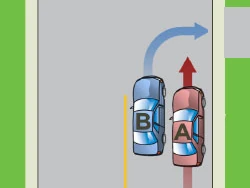
 Making a wide right turn is a poor driving practice that can result in a collision. Right turns must be made as closely as is practicable to the right hand edge of the roadway. Swinging left immediately before the turn is contrary to your signal and can confuse drivers and cyclists following behind you.
The case of Tang v Rodgers is an example of what can go wrong in this situation. It decides the liability for a collision that occurred when Pang Chu Tang did this before turning into his driveway and Daniel Rodgers tried to pass him on the right.
Mr. Tang
This incident occurred on East 33rd Avenue near the intersection of Commercial Street in Vancouver. Mr. Tang was driving westbound and intended to turn right into his driveway. He says that he slowed down, checked for traffic and began his turn. He was hit on the right side
According to a witness, he slowed down and put his left turn signal on, moving to the left side of his lane. Traffic following behind thought that he intended to turn left and began to pass by on the right.
Mr. Tang switched his turn signal from left to right and began to make his right turn, colliding with a car driven by Mr. Rodgers.
Mr. Rodgers
Mr. Rodgers was driving directly behind Mr. Tang and wondered what he was doing. He concluded that Mr. Tang did not know what he was doing and because he was moving at about 10 km/h Mr. Rodgers began to pass on the right. When he reached a point where the front of his vehicle was at about mid way along Mr. Tang's vehicle, Mr. Tang turned right and they collided.
Wide Right Turn vs Pass on Right
Justice Brown found both drivers at fault. Mr. Tang for not being in the correct position to make a right turn and Mr. Rodgers for making an unsafe pass on the right.
He assessed liability at 75% for Mr. Rodgers because passing on the right was more dangerous than Mr. Tang's wide right turn.
Learn More
- Read the Reasons for Judgement - Tang v Rogers
- Section 158 MVA - Passing on the Right
- Section 167 MVA - Right Turn not at Intersection
Share This Article
- Log in to post comments
Comments
I take a bit of a different view than Justice Brown in Tang on her interpretation and application of the law to Mr. Tang.
I Google Mapped the portion of East 33rd at issue. GM shows that on East 33rd at Beatrice going westward from Victoria Drive there is a house on the north corner facing Beatrice and then 2 houses facing 33rd before the lane. There is only one house between the lane and Commercial Street. That house is Mr. Tang’s at 1821 East 33rd [para 16]. His house has a driveway 2 vehicles wide. Parking is permitted on the north side of 33rd from the lane immediately after Victoria Drive. At a point opposite Mr. Tang’s driveway there is a single yellow line, beginning at the end of two separated yellow lines extending and narrowing from the end of the concrete barrier dividing the east and westward travel lanes.
There is only one lane in each direction on 33rd. Based on the definition of laned roadway provided in section 119 of the Motor Vehicle Act, that portion of East 33rd is not a laned roadway: "laned roadway" means a roadway or the part of a roadway that is divided into 2 or more marked lanes for the movement of vehicular traffic in the same direction. East 33rd at this location only has one marked lane in each direction, not two and is, by definition, not a laned roadway.
Therefore, section 158(1)(b) does not apply on the facts. It applies on a laned roadway. Nor do the other two exceptions in section 158 apply. With no applicable exceptions, section 158 prohibits passing on the right. If no driver had the legal right to pass on Mr. Tang’s right at that location in those circumstances, I see no obligation on Mr. Tang to do a right check on turning except for a pedestrian on the sidewalk that creates a danger crossing the sidewalk. It may be prudent to do so, but a driver is not legally required to do so.
I have not researched any judicial interpretation of section 158(1)(b).
That does leave the issue of Mr. Tang not complying with s.167 of the MVA. One could rightfully draw the conclusion from the Reasons that there was no vehicle parked in any approaching proximity to Mr. Tang’s house or Mr. McLean would not have been able to pass Mr. Tang on the right at that location. So Mr. Tang could have “practicably approached the right-hand curb” to make that right hand turn into his driveway. But given the interpretation I have given to section s. 158(1)(b), it strikes me that assigning 25% fault to Mr. Tang is unjust. He would not expect a vehicle to illegally pass him on the right.
The case does illustrate the need to always signal well enough in advance to give others on the roadway notice of the driver’s intention. I don’t think Justice Brown addressed section 170 specifically, but in para 22, says Mr. Tang only turned his right signal on immediately before the accident. I seem to recall there is a section of the MVA or MVAR of the requirement to have at least 3 blinks when signalling (it may be in respect of changing lanes) but it may have just been in a case I read. Section 170 requires only the need to signal continuously [subjectively] for sufficient distance. I suppose ‘sufficient distance’ is dependent on the speed of the vehicles. The faster the speed, the further the distance required. Most cars of recent vintage have turn signals that by holding the signal arm, clicks for three blinks. I would think that 3 blinks would be a minimum under section 170 before turning.
- Log in to post comments
I Have a Different View