
Quick Answer: A green light allows you to proceed—but only when it is safe. Before entering the intersection, pause briefly, scan left, right and left again, and confirm the intersection is clear.
Many drivers waiting at a red light become completely focused on the traffic signal. The instant it turns green, they accelerate without checking for hazards first. Having the right of way is important, but relying on it without looking can lead to a serious collision.
Why a Fresh Green Light Can Be Dangerous
The greatest risk when your light first turns green is from drivers who fail to stop for their red light. Some accelerate to beat the yellow and misjudge the timing, entering the intersection after their signal has turned red.
Another common hazard is an oncoming driver who entered the intersection legally to wait for a left turn and is still clearing the intersection after the signal changes.
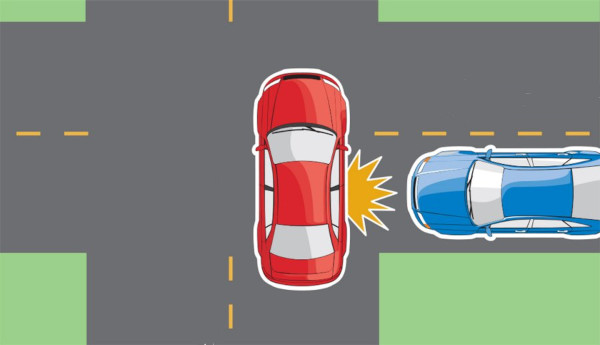
If you enter immediately without looking, the result can be a broadside, or "T-bone," collision. Side-impact crashes frequently cause severe injuries because there is much less protection for occupants on the side of the vehicle.
What to Do When the Light Turns Green

When the signal changes:
- Pause briefly before moving.
- Yield to any vehicle that is still lawfully clearing the intersection.
- Look left.
- Look right.
- Look left again.
- Confirm that cross traffic has stopped before accelerating.
This simple 180-degree scan takes only a moment but gives you time to detect drivers who ignore the red light or other unexpected hazards.
Use the Same Habit at Every Intersection
The left-right-left scan should become routine whenever you enter an intersection, even if your light has been green for some time. Drivers can still run red lights, emergency vehicles may be approaching, and other road users can make unexpected mistakes.
The same observation technique also applies at uncontrolled intersections or where cross traffic is stopped by stop signs. Never assume that another driver has seen you or will obey the rules.
Don't Let Other Drivers Rush You
Some motorists expect the first vehicle in line to move the instant the light changes. Ignore the pressure. Taking a second to confirm that the intersection is safe is far better than entering into the path of a vehicle that fails to stop.
Right of way does not prevent collisions. Careful observation does.
Pedestrians Should Look Too
Pedestrians also benefit from a left-right-left scan before stepping off the curb. Drivers making right turns on a red light often concentrate on traffic approaching from the left and may not notice someone entering the crosswalk from the right.
A few extra seconds of observation can prevent a serious collision for everyone using the intersection.
Learn More
- Stale green lights and when to stop at a yellow signal
- The concept of right of way and why it requires yielding
- Factoring in safety when driving
If you found this information useful, it may help other drivers avoid a collision when approaching a fresh green light.
- Log in to post comments
Comments
I'm one of those that you would say charges off as soon as the light changes.
What I don't understand is why people sit there and don't pay attention to what the traffic is doing. The vehicles that have the green do get an amber light telling them the sign is going to change. If the first car has stopped there is a very good indication he is not suddenly going to accelerate and proceed through. While your checking out the first vehicle look at those following. If they are stopping you are probably safe. Then check the traffic on the right. If the same situation is there you should be safe when the green light comes on. Depending on the speed of the road you have between 3 and 6 seconds from the time the amber turn before it goes to red. You do have to pay attention to what the traffic on the green are doing yet there is always that period of grace. Vehicles don't magically stop when the light turns red. These drivers are no different than you and react to the amber. By time the light turns red they should be stopped. Another consideration is the people already in the intersection waiting for a break to turn left. If these vehicles are going to interfere with you starting off they have the right of way.
Now I don't know about the rest of you but I have what is called peripheral vision. So even though after I have checked the traffic both ways and turn my head back to looking forward I can still see the vehicles that are stopped. If they were to suddenly start moving I would notice.
When I am stopped at a traffic light and especially when I am the first vehicle and turning left you are always left with that uncertainty. Does the driver want me to turn in front of him, has he fallen asleep, or why is he sitting there?
What it comes down to is it is ridiculous for a vehicle to be sitting there doing nothing when the cross traffic has been stopped for a few seconds. Pay attention.
- Log in to post comments
I was stopped at an intersection crossing Hwy. 1 in Salmon Arm a week ago. When the light turned green, even though I was the only one at the intersection, I hesitated a second or two before proceeding. Thank goodness I did because a car blew right through the red light and I would have been t-boned on the passenger door. Scary!!
- Log in to post comments
As a former 1st responder. i preach ”1st in, 1st dead” when it comes to intersection safety. The other thing that continues to amaze me, while sitting at intersections, is how many people focus on the lane they're driving into, which is the safest, as traffic is moving away from you, and not on the other lanes, which, potentially are all lethal!
- Log in to post comments
Just because you can, doesn't mean you should.
Sure, the green light means you can choose to go. Just like the pedestrian signal means you can choose to walk.
At one time, in Driver Education classes, the advice was to count to three after the light turned green. But what if the driver on the cross-street (who may be messing with their phone, or having a medical emergency) zooms into you on the count of five ... eh?
What amazes me is how unthinkingly, drivers and/or pedestrians rely entirely on everybody else doing the 'right thing' all the time, despite the evidence all around that this isn't how many of them behave?
I've only been in one intersection crash in my life, one night back in 1975 in Winnipeg, when some drunk in a '66 Chevy came flying up a one-way street the wrong way and hit my Galaxie so hard on the right rear (I had floored the gas when I saw him in my peripheral vision) that my car actually spun twice on the way out of the intersection. To this day, I still need to see a chiropractor once in a while. And to this day, I even glance the wrong way when crossing one-way streets. Glad I hit the gas though, or me and the passenger probably wouldn't have survived.
And though I don't want to send this off topic, the people who scare me the most out there are young mothers, pushing their babies in prams, who cheerfully head across the crosswalk whilst engaged with their mobile phones, without ever a backward glance to ensure the safety of their child.
It's interesting how people behave, like they're conditioned to commands. But they would have a better chance of survival if they used their brains, and the eyes in their heads.
Maybe god is watching over you, or maybe it's Darwin, actually ...
- Log in to post comments
That's why we now have red light cameras at 140 intersections in BC, dishing out thousands of tickets (it's alarming, really, how many drivers run the red).
The actual risk of being hit by some vehicle driving against the red are higher than most people seem to realize.
- Log in to post comments
Pay Attention!