
I've had readers ask me about glasses with yellow lenses that are marketed as night driving glasses. The claim is that the yellow tint reduces glare and increases contrast, making it easier to see in darkness.
The idea sounds reasonable, but research does not support the claim that these glasses improve your ability to see hazards at night. They may change the appearance of what you see or make bright lights seem more comfortable, but that is not the same thing as improving your visual performance.
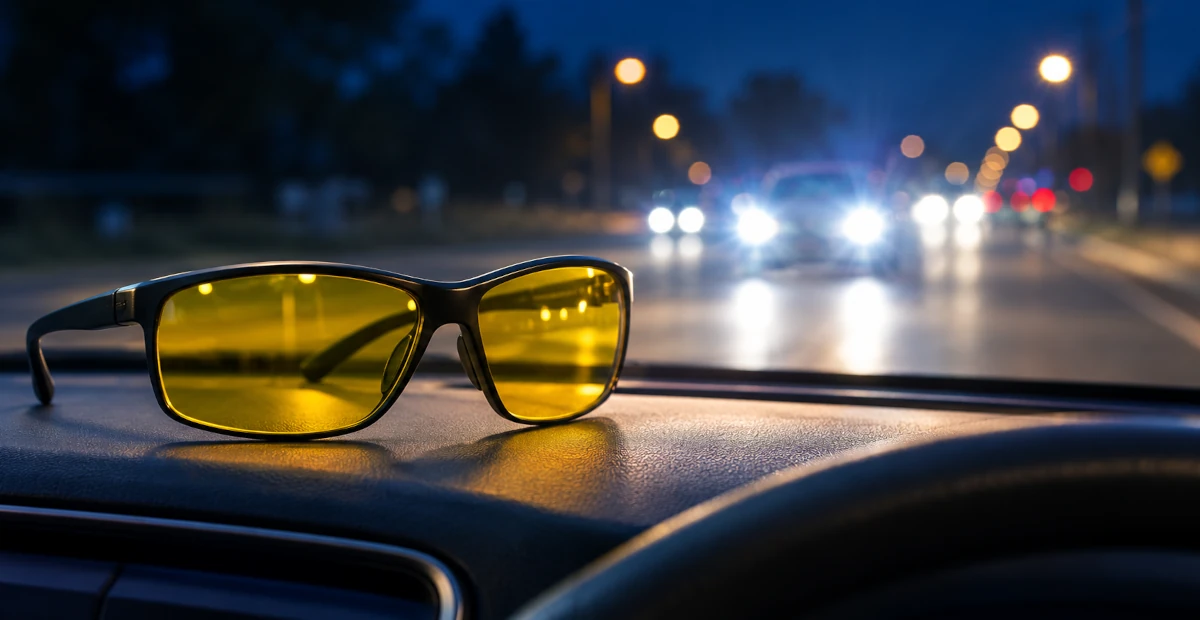
Yellow Lenses Don't Improve Night Vision
Yellow-lens night driving glasses have been marketed for decades with claims that they improve nighttime visibility and reduce the effects of glare from oncoming headlights. However, there has been little scientific evidence to support those claims.
A 2019 study published in JAMA Ophthalmology provides a useful test of the idea. Researchers compared three commercially available yellow-lens night driving glasses with clear lenses while participants drove simulated night-time scenarios. The tests included conditions both with and without simulated glare from oncoming headlights.
The study involved 22 participants, including a small group of older participants. The researchers measured how quickly participants detected pedestrians and found that the yellow lenses did not improve pedestrian detection. They also did not reduce the effect of headlight glare on pedestrian detection. In fact, response times were slightly longer with the yellow lenses, although that difference was not statistically significant.
The researchers concluded that their results did not support using yellow-lens night driving glasses to improve pedestrian detection or reduce the effects of headlight glare. The study was conducted in a driving simulator and was relatively small, so it does not answer every question about night driving, but it directly tested the claims made for these products.
Why Can They Seem to Help?
There is an important difference between comfort and visual performance. Yellow lenses filter some of the shorter-wavelength light entering the eye. This can change the appearance of the scene and may make bright headlights feel less uncomfortable.
The problem is that reducing the amount of light entering your eyes does not necessarily make it easier to see something that is poorly illuminated. A road, pedestrian or cyclist that appears more comfortable to look at is not necessarily easier to detect.
In other words, feeling that you can see better is not the same as actually seeing better.
What About Headlight Glare?
Glare can be a significant problem when driving at night. The Canadian Association of Optometrists notes that sensitivity and intolerance to glare increase with age. It also identifies increased sensitivity to oncoming headlights and difficulty with night driving as symptoms that can occur with cataracts.
Yellow lenses are sometimes promoted as a solution to this problem, but the 2019 study found that they did not reduce the effect of simulated headlight glare on pedestrian detection.
If glare is becoming a problem for you, it makes more sense to have your vision checked than to assume that a coloured lens will solve the problem. The Canadian Association of Optometrists recommends regular eye examinations and notes that an optometrist can help determine an appropriate solution for glare.
Older Drivers and Night Vision
Night driving can become more difficult as we age. The Canadian Association of Optometrists notes that sensitivity to glare increases with age and that conditions such as cataracts can cause increased sensitivity to oncoming headlights and trouble with night driving.
That makes it particularly important not to mistake a change in comfort for an improvement in vision. If you are finding night driving increasingly difficult, an eye examination can help determine whether there is a correctable vision problem or an eye condition contributing to the difficulty.
What Should You Do?
Rather than buying yellow-lens glasses specifically for night driving, start with the basics:
- Keep your prescription glasses up to date if you need corrective lenses for driving.
- Keep your windshield clean, both inside and outside. Dirt and streaks can scatter light and increase glare.
- Keep your headlights clean and make sure they are properly aimed.
- If glare or difficulty seeing at night is becoming a problem, have your eyes examined.
- Don't assume that a yellow tint will improve your ability to see hazards simply because the view appears more comfortable.
The Canadian Association of Optometrists also advises that special-purpose and cosmetic-tint sunglasses are not recommended for driving. Its guidance notes that lenses should not be so dark that they reduce vision.
The Bottom Line
Yellow night driving glasses may change the way the road looks and may make bright lights seem more comfortable, but there is no good evidence that they help you detect hazards better at night. A controlled study using commercially available yellow lenses found no improvement in pedestrian detection, with or without simulated headlight glare.
If you are having trouble seeing at night, don't try to solve the problem by putting a yellow filter in front of your eyes. Make sure your prescription is appropriate, keep your windshield and headlights clean, and talk to your optometrist if night vision or glare is becoming a problem.
Learn More
- Log in to post comments
Comments
Undoubtedly, any glasses that reduce the amount of light getting to your eyes are going to impair your vision at night.
But it should be recognized that they can indeed enhance contrast in overcast or foggy conditions; photographers using black + white film have used yellow filters for this purpose for years, and many skiers and marksmen will take advantage of goggles or glasses with this type of lens also.
- Log in to post comments
I got my first pair around 1980 and was living in Vancouver at the time. I found on wet rainy nights that they did improve my vision. They reduced the glare and made it easier to see the lines. Now living in the interior I mainly use them when meeting a vehicle with blinding lights. I do not wear them all the time.
Then in certain daylight conditions they help with the contrast.
The tint is very light and I definitely find they improve my night vision under certain conditions.
- Log in to post comments
I Can See Clearly, Now