
New drivers in British Columbia need to understand that the rules for using electronic devices while driving are stricter than they are for fully licensed drivers. In particular, Class 7L and Class 7 drivers cannot use the exceptions that permit fully licensed drivers to use certain electronic devices hands-free or under specified conditions.
If you are a new driver, the simplest rule is this: leave your electronic devices alone while you are driving.
What is an electronic device?
The law is broader than a prohibition against texting. An electronic device includes a hand-held cellphone or other hand-held electronic device with a telephone function, a hand-held device capable of sending or receiving email or other text-based messages, and prescribed types of electronic devices.
The regulations specifically include devices such as GPS navigation systems, hand-held electronic devices capable of processing or computing data, hand-held audio players, hand microphones and televisions.
So the rule for a new Class 7 driver is not simply "don't text." It is much broader: don't use an electronic device while driving.
What does "use" mean?
Under section 214.1 of the Motor Vehicle Act, "use" includes:
- holding the device in a position where it may be used;
- operating one or more of the device's functions;
- communicating orally by means of the device; or
- taking another action prescribed by regulation.
The regulation specifically provides that watching the screen of an electronic device is also using it.
You therefore do not have to send a text message or make a phone call before the electronic-device rules become relevant.
What are the rules for Class 7L and Class 7 drivers?
A person driving under a Class 7L or Class 7 licence cannot use the exceptions that allow other drivers to use certain electronic devices while driving.
This means a Class 7L or Class 7 driver cannot use:
- a cellphone hands-free;
- a GPS for navigation;
- a qualifying hand microphone; or
- a hand-held audio player under the regulatory exception.
Section 6 of the Use of Electronic Devices While Driving Regulation specifically provides that the exceptions for these devices do not apply to a person driving or operating a motor vehicle under a Class 7 or Class 7L licence.
This means that connecting a cellphone to your vehicle by Bluetooth, mounting it on the dashboard or putting it on speaker does not make its use legal for a Class 7L or Class 7 driver.
Can I use my cellphone at a red light?
No.
A red light is not a parking place. The electronic-device prohibition applies while you are stopped in traffic, including at a red light.
In R. v. Hrynyk, a driver stopped at a red light put her vehicle in park and used both hands to operate her cellphone. The traffic court found her not guilty, but the decision was appealed. The B.C. Supreme Court concluded that she had used an electronic device while operating the motor vehicle and ordered a new trial. The Crown subsequently stayed the proceedings.
The practical lesson is simple: don't use your cellphone while waiting at a traffic light.
When can a new driver use an electronic device?
There are limited exceptions to the basic prohibition.
The prohibition does not apply when the motor vehicle is safely parked off the roadway or is lawfully parked on the roadway and not impeding traffic.
There is also an emergency exception allowing an electronic device to be used to call or send a message to a police service, fire department or ambulance service about an emergency.
Simply stopping temporarily in traffic does not make a vehicle "parked" for this purpose.
What about Class 8 and 8L motorcycle riders?
The special restrictions in sections 7 through 10 of the electronic-device regulation apply to Class 7 and 7L drivers. They do not exclude Class 8 or 8L riders.
This means that the regulatory exceptions for hands-free telephone use, GPS, qualifying hand microphones and hand-held audio players are available to Class 8 and 8L riders, provided the requirements of the applicable exception are met.
Motorcycle riders should remember, however, that these exceptions have conditions. For example, a GPS must be used in accordance with the regulatory requirements, and a hands-free telephone must meet the requirements for hands-free use.
What about Apple CarPlay or Android Auto?
Modern vehicles can connect a cellphone to the vehicle's infotainment system and provide telephone, messaging, navigation, music and other functions through a dashboard display or voice controls.
Connecting your phone to the vehicle does not by itself create an exception to the law.
For a Class 7L or Class 7 driver, the hands-free telephone and GPS exceptions are not available. A connected cellphone therefore cannot simply be treated as a permitted hands-free device.
The important question is not whether the vehicle has CarPlay or Android Auto. It is whether the driver is using an electronic device in a manner permitted by law.
What about music?
The regulations provide an exception that permits a fully licensed driver to use a hand-held audio player under specified conditions. That exception does not apply to Class 7L or Class 7 drivers.
This means a Class 7L or Class 7 driver should not operate a cellphone, portable music player or other electronic device to select, change or control audio while driving.
What about earbuds or headphones?
An earbud does not create a hands-free cellphone exception for a Class 7L or Class 7 driver.
The regulations contain specific provisions concerning an earpiece used with a permitted hands-free telephone function. Since that exception does not apply to Class 7 or Class 7L drivers, wearing an earbud does not make cellphone use legal for a new Class 7 driver.
Can I use a two-way radio?
The regulations contain an exception for the use of a qualifying hand microphone by drivers who meet the requirements. That exception does not apply to Class 7L or Class 7 drivers.
A Class 8 or 8L motorcycle rider is not excluded from this exception, but the hand microphone must meet the regulatory requirements.
R. v. Shelford provides an example involving a company driver and a two-way radio.
What about the vehicle's touchscreen?
Not every form of distracted driving is an electronic-device offence.
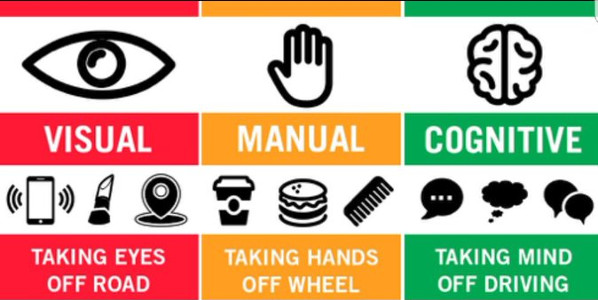
Distracted driving is the broader safety issue. Looking away from the road, dealing with passengers, eating, adjusting controls or interacting with a vehicle's display can all distract a driver even when the particular activity does not fall within the electronic-device offence.
This has become increasingly important as vehicle manufacturers move more controls onto large touchscreens. A driver may have to look away from the road to find and operate a function that once had a simple physical button or switch.
I've discussed that problem in Physical Controls Required.
Whether or not a particular activity is an electronic-device offence, the safety lesson is the same: your attention belongs on driving.
What have the courts said?
The courts have considered a number of situations that help explain what the electronic-device law means in practice.
- R. v. Rajani: a cellphone supported in the driver's lap was found to constitute holding the device in a position where it could be used. The conviction was upheld by the B.C. Supreme Court and later by the B.C. Court of Appeal.
- R. v. Hrynyk: putting a vehicle in park while stopped at a red light did not prevent the court from finding that the driver had been operating the vehicle when she used her cellphone.
- R. v. Bleau: the court considered whether a cellphone sitting in a cupholder and playing a podcast constituted use of an electronic device. The case illustrates that the precise facts and meaning of "use" matter.
- Novice Drivers and Cell Phones: a recent Class 7 case demonstrates that the restrictions on novice drivers are considerably stricter than those applying to fully licensed drivers.
What happens if a new driver is caught?
The current penalty for using an electronic device while driving is a $368 fine and four driver penalty points.
For a driver in the Graduated Licensing Program, there can also be consequences for the driver's licence. A conviction for using an electronic device may result in a driving prohibition under the Driver Improvement Program.
That makes using a phone or another electronic device while driving a particularly poor choice for a new driver. The consequences can extend well beyond the ticket itself.
The simplest rule for new drivers
You don't need to memorize a long list of electronic devices or try to determine whether a particular feature is covered by one of the exceptions.
If you are a new Class 7 or 7L driver, don't use an electronic device while driving.
No texting. No cellphone calls. No GPS. No hands-free cellphone use. No manipulating a music player. No checking the screen. No picking up the phone at a red light.
If you are riding under a Class 8 or 8L licence, the regulatory exceptions are available to you, but only when you comply with their specific requirements.
If you need to use an electronic device, park safely and legally before using it.
Learn More
- Log in to post comments
Comments
I'll give you my take on this, based on many years of experience in driver training and evaluation employment.
When studies were done - and they were many and various, and independent of political influence - it was clearly demonstrable that electronic devices were a driver distraction. Interactive devices in particular, anything with a screen for sure, audio connection also. Skype bad, listening to an AM radio traffic report definitely not so much.
Some of these studies determined that collisions caused (at least in part) by driver distraction using hands free devices were as likely to occur as when using something like a hand held cellphone. But trying to instantly force everybody to 'hang up and drive' when many were already habituated to using their vehicle as some kind of mobile office probably wasn't going to be successful.
But it was clearly evident that inexperienced drivers - those with a Learner license or within their two-year probationary Novice period - were least able to balance the mental task load of processing and prioritizing incoming information. There's nothing new, here. The more time you spend engaged in something, the less of your brain you're occupying with what you're doing. When you learned to walk, though, you were pretty much on task overload figuring out the whole balance thing, and putting one foot ahead of the other. Now, you don't even think about it (be thankful for proprioception, it's your true 6th sense).
It was also clearly evident that inexperienced drivers (see above) were disproportionately over-represented in crash statistics. Highest cause of death amongst young males. So how do you 'fix' that? To many in governance, a high crash rate amongst 16 - 20 year olds would indicate that the instant solution would be to raise the driving age. Problem is, statistics don't support this; jurisdictions that allow a younger age to obtain the Leaner license (though remaining unable to gain their full driving privilege any sooner) actually have lower crash rates amongst their same age group several years on. Places like Alberta. And Denmark. Fact is, people who learn to drive when they're 30 are as much of a risk at 32 as they will be at 92, if they make it that far. But if they get to 40 in one piece then they're probably as safe as anybody, even those who learned to drive at half their age.
Forgive me, I probably digress.
The whole thing is, the crash rate amongst inexperienced drivers cannot be reduced by raising the driving age. But it can me reduced by restrictling the conditions under which the new driver is allowed to operate the vehicle. So part and parcel of the whole GLP Program includes the restrictions on electronic devices. And quite frankly, I think this is an intelligent measure on the part of ICBC, to reduce the risk to everybody, not least the new driver.
The daughter of a friend of mine, driving on her 'N' license, was stopped at a red light. A police officer in a marked vehicle who was stopped in the adjacent lane saw her pick up her phone, and pulled her over moments later; her license was suspended for several months as a consequence. She claimed she was just checking the time. I'm afraid I have no sympathy for that young woman, because the fact is, there was a clock on the dashboard and she wasn't aware that she was stopped beside a cop. Duh. Get your cranium out of your rectum, eh? Sorry if that sounds a bit harsh.
I'm interested by the independent governance of motorcycle riders, wasn't aware of this before.
Strictly speculation on my part, but I would guess there are a couple of reasons behnd this. For one thing, an 'L' Class 8 motorcyclist could not take his/her practical Road Test without contravening his/her license restrictions; these require a radio connection between the rider and the Driver Examiner in the following vehicle. (If you think this sounds goofy, well it's true; you know all those Driving School cars you see with 'L' and 'N' signs on them? Totally unnecessary if the car is properly marked with 'Student Driver' signs and they're accompanied by a Licensed Instructor. But they have to have an 'L' on the back during their Road Test with a Driving Examiner, in order to meet their license restrictions.)
The other practical reason for allowing audio input through the helmet would be that whether it's Bluetooth interaction, or GPS navigation instruction, it's safer than having the rider looking down at a screen in the middle of the handle bars.
- Log in to post comments
When it comes to banning things and actions, the flip-side is the implied permission to subject yourself to every other distraction.
What is more dangerous:
1) Cruising down the freeway in the right lane having a casual conversation with your left hand
2) Cruising down the freeway making a sandwich?
1) Cruising down the freeway keeping 10 seconds following distance and checking the GPS route
2) Cruising down the freeway keeping the little Johny from pulling little Stacey's hair out?
1) Going through town at 50km/h and switching songs on the iPhone by pressing on-screen
2) Going through town at 50km/h and flipping through the 250 CD binder looking to play one particular song?
All the examples under 1 are specifically illegal and all the examples under 2 are not specifically illegal but are unsafe.
Distracted driving is a failure to focus on the driving task at hand when the situation requires more attention than you have had allocated. With proper foresight and eyes up technique distracted driving would be a non-issue.
Sometimes I think that too many drivers have said that they crashed because they were on their cellphone, so that now we have such ludicrous legislation.
But how do you put in to law a basic principle of "Don't be stupid, stupid"?
- Log in to post comments
It's about processing ability - and priority