
Winter tire season is almost here. Starting October 1, 2026, winter tires (or chains, for commercial vehicles) become mandatory on most BC highways — and the rules stay in effect until either March 31 or April 30, 2027, depending on the route. If you drive outside the Lower Mainland or Greater Victoria at any point this winter, it's worth checking now rather than getting caught out at a highway checkpoint or, worse, in a ditch.
Do You Actually Need Them?
If you stay close to home in the Lower Mainland or southeastern Vancouver Island, you may not encounter a designated winter tire route. Outside those areas, however, winter tires are required on most highways. Check the route before you travel rather than assuming that every highway has the same requirement.
Where the Signs Apply
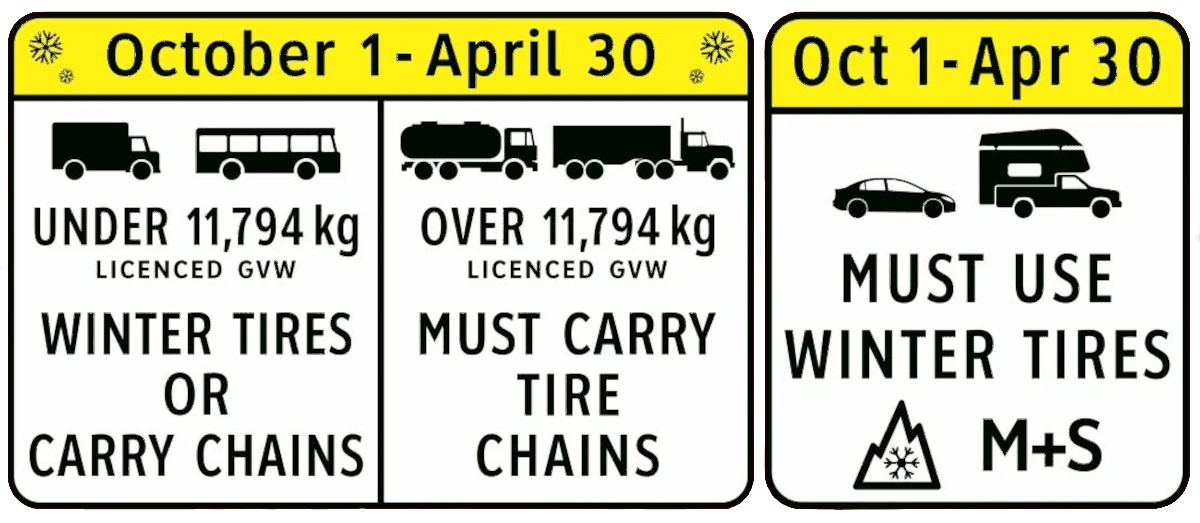
Roadside signs mark the start and end of every designated winter tire or chain-up route. Two sign types apply:
- Passenger and recreation vehicles — winter tires required
- Commercial vehicles — chains or other approved traction devices must be carried where required
Drivers who ignore posted requirements can be fined and turned back until they comply.
The Law
Section 208 of the Motor Vehicle Act sets out the winter tire requirement, and Division 7.162(3) of the Motor Vehicle Act Regulations define what counts. A winter tire must be labelled on the sidewall with either:
- the 3-peaked mountain and snowflake symbol, or
- the letters “M” and “S”
Only the mountain/snowflake symbol identifies a tire that has been tested to a specific severe-snow standard. M+S tires meet the legal definition of a winter tire in BC, but they generally provide less traction than mountain/snowflake tires in severe winter conditions. For a full breakdown of the difference, see our What Does M+S Mean? explainer.
All-weather tires can qualify if they carry the required mountain/snowflake or M+S marking and meet the minimum tread-depth requirement. The name "all-weather" by itself isn't what determines whether a tire meets B.C.'s legal requirements.
Four-wheel drive and all-wheel drive do not exempt a vehicle from the winter-tire requirement. If the route requires winter tires, the vehicle must comply regardless of its drivetrain.
Minimum Tread Depth
Winter tires are considered worn out when they have less than 3.5 mm of tread. Be careful here — the wear bars on most tires only start showing at 1.6 mm, which is the summer tire minimum, not the winter one. Don't rely on eyeballing it; use a tread depth gauge.
Fines
| Violation | Fine |
|---|---|
| No proper winter tires on a designated route | $121 + 2 penalty points |
| Tread depth below the legal minimum | $109 |
Beyond the fine, police can turn you back at a checkpoint until you're compliant — which, depending on where you are, can mean losing your whole trip.
Studded Tires
Studded winter tires are legal on BC highways from October 1 to April 30. Rules on stud count depend on vehicle weight:
- Vehicles under 4,600 kg: up to 130 studs per tire
- Vehicles over 4,600 kg: up to 175 studs per tire
If you use studded tires, the rules require studded tires on the rear wheels before studs may be used on the front wheels. In other words, you can't put studded tires only on the front axle of a front-wheel-drive vehicle.
Buy in Sets of Four
Mismatched tires undermine ABS, traction control, and stability control, all of which assume even grip at all four corners. Use the tire size specified on your vehicle's tire placard or owner's manual. If budget only allows for two new tires, put them on the rear — this improves stability under braking, even on a front-wheel-drive car.
Tire Grade Rating
Every tire sold in North America carries a Uniform Tire Quality Grade (UTQG) rating printed right on the sidewall — something like Traction AA, Temperature B, Tread Wear 250. It's a standardized way to compare tires: Traction is graded AA (best) down to C, Temperature grades how well the tire resists heat build-up, and Tread Wear is a relative number showing how long the tread should last compared to a reference tire. It won't tell you everything, but it's a quick, consistent way to compare two tires side by side before you buy.
A Guide to Tire Choices
Choosing between all-season, true winter, and studded tires comes down to where and when you drive. If you regularly hit snow and ice, all-season tires aren't a good choice — you want the mountain/snowflake symbol. If you plan to run the same tires from May through September, studded tires are off the table, since they're not street-legal outside the October–April window. A tire professional can walk you through the trade-offs for your specific vehicle and driving pattern, and the Automobile Protection Association's tire guide is a good independent resource if you want to do your own research first.
Chain-Up Routes and Maps
The Province publishes maps for each region showing exactly which highways require winter tires or chains, and for how long. Check your route before you go, especially if you're heading over a mountain pass you don't drive often.
Commercial vehicle operators generally must carry chains or an acceptable traction device from October 1 to April 30. The regulation provides specific exceptions for some routes and dates, so commercial drivers should check the requirements for their route.
Ask a Professional
An average passenger car's tires touch the road across an area roughly the size of two adult feet. That's not a lot of surface to bet your safety on — if you're unsure which tire is right for your vehicle and driving pattern, a tire professional can walk you through the trade-offs between winter, all-weather, and studded options.
Rental Vehicles
Planning to rent a car for a winter trip? Don't assume it'll have true winter tires — many rental fleets don't carry them as standard. Confirm with the rental company ahead of time if you're heading somewhere that needs them.
When to Take Them Off
You can keep running winter tires outside of the requirement dates, but it's not a great idea — winter tires wear faster in warm conditions, so take them off once temperatures are consistently above 7°C.
Learn More
- What Does M+S Mean? — explains what the M+S designation actually tells you about a tire and why it is different from the mountain and snowflake symbol.
- Are Your Tires Worn Out? — explains the legal tread-depth requirements and other conditions that can make a tire unserviceable.
- Is the Legal Minimum Tire Tread Depth Enough? — looks at why the legal minimum is not necessarily a good target for safe driving.
- Winter Tire Season Begins — discusses choosing and using winter tires, including the advantages of fitting a complete set of four.
- Log in to post comments
Comments
I'm seeking clarification to find out if winter tires are still required on designated highways when temperatures and forecast indicate it is above freezing (ie +10C) at my destination and the entire route.
- Log in to post comments
Yes. If you are travelling on a highway where winter tires are required by signs, you must comply during the dates shown on those signs, even if the weather forecast is good. The requirements don't change just because the forecast calls for sunshine or mild temperatures.
- Log in to post comments
Clarification on Winter Tire Requirements