
Knowing which way to turn your wheels when parking on a hill is a driving skill that many people learn for their road test and then rarely think about again. Turning your wheels the wrong way can allow a vehicle to roll into traffic if the parking brake isn't applied properly or a mechanical failure occurs. Fortunately, there are only three simple rules to remember when parking on a hill in British Columbia.
Quick Guide: Parking on a Hill
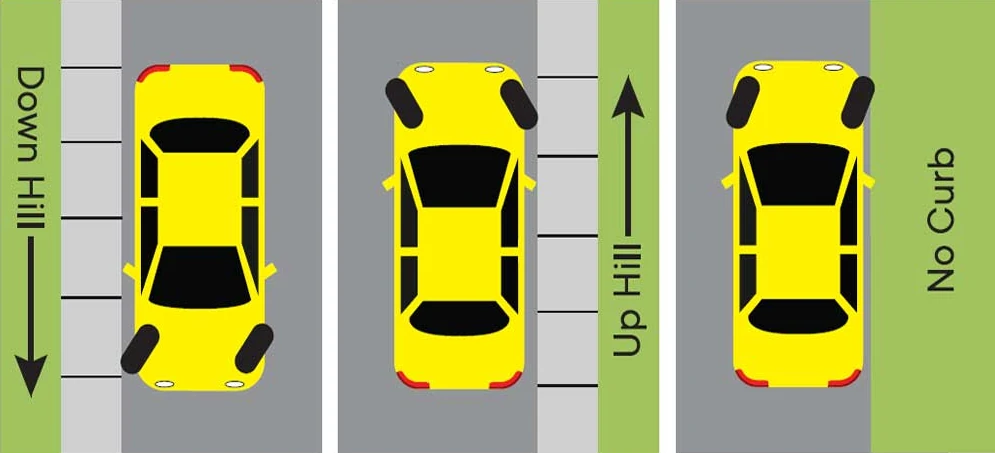
- Uphill with a curb: Turn the front wheels left (away from the curb). Allow the vehicle to roll back gently until the rear of the front tire rests against the curb.
- Uphill without a curb: Turn the front wheels right (toward the edge of the road).
- Downhill with or without a curb: Turn the front wheels right (toward the curb or edge of the road).
Always apply the parking brake (sometimes called the emergency brake or hand brake) before leaving the driver's seat. If you drive an automatic transmission, shift into Park. If you drive a manual transmission, select first gear when facing uphill and reverse when facing downhill.
I Almost Learned the Hard Way
Shortly after I got my driver's licence, I parked my father's truck on a hill and made almost every mistake possible. I left the front wheels pointed straight ahead, didn't put the transmission in Park and forgot to set the parking brake before walking away.
Fortunately, a friend noticed the truck beginning to roll and shouted before it gathered speed. I jumped back into the driver's seat and stopped it before any damage was done. It was an embarrassing lesson, but one I've never forgotten.
Why Turning Your Wheels Matters
Turning your wheels correctly provides an additional layer of protection if your vehicle starts to roll. If you're parked uphill beside a curb, the vehicle will roll back until the tire contacts the curb. If you're parked downhill or on a road without a curb, turning the wheels toward the edge of the roadway helps direct the vehicle toward the edge of the roadway rather than allowing it to continue into traffic.
This simple habit takes only a few seconds and can prevent a runaway vehicle that could damage property or seriously injure someone.
Don't Rely on the Transmission Alone
Many drivers assume that selecting Park is enough to keep a vehicle from moving. Although the parking pawl inside an automatic transmission is designed to hold the vehicle, it should never be the only thing preventing it from rolling. Using both the parking brake and the transmission reduces stress on the drivetrain and provides an extra level of protection if one system fails.
The same advice applies to electric vehicles and hybrids. Regardless of what you drive, always use the parking brake and turn your wheels correctly when parking on a hill.
Finally, remember that when parking beside a curb, British Columbia law requires your vehicle to be within 30 centimetres (12 inches) of the curb.
Frequently Asked Questions
Do I have to turn my wheels when parking on a hill?
Yes. Turning the wheels provides a backup if the parking brake or transmission fails, helping prevent the vehicle from rolling into traffic.
Which way do I turn my wheels when parking uphill with a curb?
Turn the wheels left (away from the curb) and allow the vehicle to roll back gently until the rear of the front tire contacts the curb.
Which way do I turn my wheels when parking downhill?
Turn the wheels right, toward the curb or edge of the roadway.
Should I use my parking brake every time I park?
Yes. Making it a habit to apply the parking brake every time you park helps prevent roll-away collisions and reduces strain on the transmission.
Learn More
- Log in to post comments
Comments
As I parked in Mission today I reflected on two things:
The first is that there were 4 cars backed in to the angled spots. This is a normal 2 lane street with traffic flow in both directions. To my knowledge this is not permitted (similar to parking facing counter flow to traffic when parallel parking).
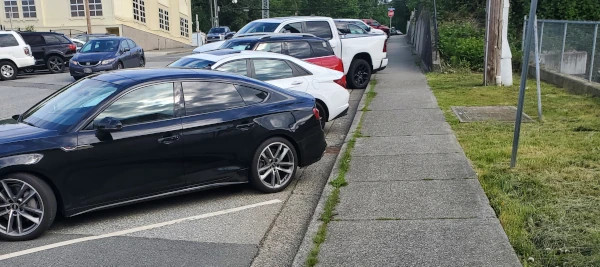
The second, is what direction should I turn my wheels in this scenario. When parking parallel up a hill, with a curb, I turn my wheels away from the curb. This is so that, should the vehicle roll, the front passenger wheel will abut against the curb and stop the roll.
However, with angled parking, if I turn my wheels the same way (to the left), they won't make contact with the curb. If I turn them to the right they won't either.
I choose to turn them left because of the vehicle rolls, while it will roll into the street it should come to a rest horizontally across the lane. If I were to turn them to the right the vehicle would roll out and potentially down the hill.
Other than carrying chocks for these rare occasions, what's the official recommendation? Searching for this only seems to bring up parallel parking scenarios.
- Log in to post comments
Logically, turning the wheels to cause the street end (as opposed to the curb end) of the vehicle to travel uphill would be the choice. The idea is to prevent gravity from being able to accelerate the vehicle.
Missions traffic bylaw says that vehicle parking like this must park substantially in the same direction as the traffic approaches the space. Backing in here is in violation of that.
- Log in to post comments
If I recall correctly, the Act says to always turn your wheels away from traffic, while Learn to Drive Smart recommends turning the wheels towards traffic if parked up hill with a curb, to use the curb as a block.
This is less effective the further away your wheels are from the curb.
- Log in to post comments
Here is the section of the Motor Vehicle Act that you refer to:
191 (2) A driver must not permit a motor vehicle to stand unattended or parked unless the driver has
(b) if the motor vehicle is standing on a grade, turned the front wheels of the vehicle to the curb or side of the highway.
- Log in to post comments
As I parked in Mission today…