
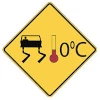
 Spreading rock salt on the highway during or after a weather event melts snow and ice that is already present to improve traction. Spraying brine on the highway before a weather event is preventative maintenance. The salt will already be there to prevent snow and ice from sticking to the pavement surface so it is easier to remove.
What Is Brine?
The liquid applied to highways is typically a salt solution, which is a mixture of ordinary table salt and water at a concentration of about 23% salt and 77% water.
Sometimes the solution will also contain another salt called magnesium chloride or even beet juice.
Beet juice is a byproduct of sugar refining and it works as a corrosion inhibitor as well as helping the liquid stick to the road. It reduces scatter and allows the mixture to work at lower temperatures than salt alone.
It also requires less salt in the solution to have the same effect reducing the effect on the environment.
When is it Applied?
Brine can be applied up to 2 days before the start of bad weather, giving maintenance crews more time to prepare. When applied, the water in the brine evaporates, leaving behind salt that continues to inhibit ice formation for several days, even in the absence of precipitation.
It cannot be applied to wet road surfaces, limiting its use when it is actually snowing or raining.
Better Than Rock Salt
Brine is especially effective on bridges, which freeze faster than regular road surfaces and on roads with sharp corners.
Video Explaining Brine Application
This video from the Mainroad Group, one of B.C.'s road maintenance contractors, explains about the use of brine instead of rock salt.
Learn More
Share This Article
- Log in to post comments
Comments
It's informative and interesting to see the video, and technical information as to how this works. That's pretty salty stuff!
And they make the process look so tidy, with those narrow lines of brine being laid on the road surface directly behind the truck.
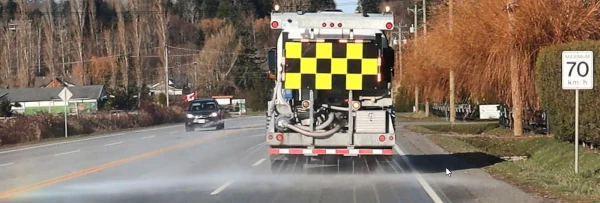
Well, on Wednesday I drove Hwy 19 up from Nanaimo to Courtenay. The temperature was 0 degrees and at that time, a sunny weekend was anticipated (so much for that). But around 4:15pm, looking ahead it was clear that in the left lane there was some sort of official vehicle with bright yellow flashing lights. I would estimate its speed at around 80 km/h with most traffic traveling at 110 km/h+. The brining truck was emitting massive moisture, spraying not just the lane it was in, but using other high power jets of brine to also spray across the adjacent lane to it's right.
Thankfully, traffic was relatively light (but it's remarkable how it becomes a dense mass with a mobile menace like this suddenly encountered). But there was no escaping this mess. I was already running the windshield washers and wipers before I met this airborne guck. Heck, I had just put my van through the deluxe car wash the day before; if there had been any possible way of escaping this horrible mess, I would have found it!
I think the highway contractor needs to seriously re-think how they're going about this. Or be required to do so. Ideally, that brining truck would only be treating one lane of the highway at a time, or if not then it should be in the right (slow) lane spraying to the left. And this would be done late at night with minimal traffic. Plus which, there should have been a warning vehicle running along the shoulder 500 ~ 1000 meters beforehand, cautioning drivers to slow way down and look out for the pending hazard.
Highways contractors receive large amounts of our government funds, and they should be the leaders in road safety. Not part of the problem.
- Log in to post comments
I don't object to the spraying of the road. When you see yellow lights flashing one is to slow down and move over. So I get a bit of spray on my car I would sooner have that than a section of road with nothing.
What I don't like in parts of the province they are not plowing the roads to meet Ministry standards. They rely on the brine or salt to melt the snow and the heavy truck traffic to squish it off the travel portion. So you end up with two tracks going down each lane and a deep pile of snow/slush which is hazardous for lighter vehicles.
Due to under bidding to get the contracts many maintenance divisions do not have the equipment/manpower to properly maintain the roads. You see steep hills with a heavy accumulation of snow that has built up over several hours. Before it gets plowed the next time semi's are spinning out and blocking the road. And if you lay a complaint the Ministry staff in charge of monitoring will come back they are doing the best they can. Which is true but if you only have 3 vehicles to cover hundreds of kilometres of road you lack sufficient equipment.
- Log in to post comments
Reality Check