
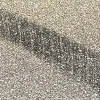
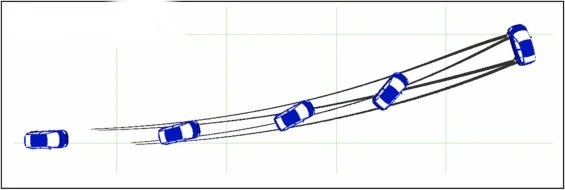
 When a vehicle is in yaw it is rotating around a vertical axis through it's centre of mass. The long, curved yaw marks left by the tires on the pavement were characteristic of this motion. If they were striated and of constantly diminishing radius they were of great interest for collision reconstruction because the vehicle's speed could be determined from them.
Measuring Yaw Marks
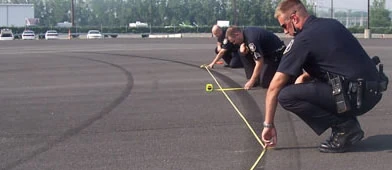
A series of chord and middle ordinate measurements were made of the outside front tire mark at regular intervals starting where the outside rear tire started to track outside of the path of the front tire.
These measurements were used to calculated the radius of the curved tire mark and the series was compared to insure that the radius was continually getting smaller. If so, this was a true yaw and combined with the co-efficient of friction for the road surface, the vehicle speed could be calculated.
Calculating Speed From Yaw Marks
This equation and the method of measuring the yaw was exhaustively tested when I was a collision analyst. We would gather for training sessions, usually on an airstrip somewhere, and one of the senior reconstructionists would induce a yaw in our test vehicle while we measured speed with radar.
The outcome of our calculations agreed closely with the measured speed.
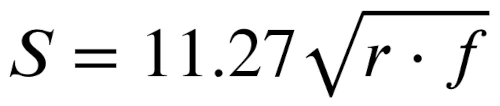
The equation shown calculates the speed in km/h when the marks are made on level pavement. The radius calculated from the chord and middle ordinate measure is "r" and "f" is the co-efficient of friction for the road surface.
The co-efficient of friction was usually determined by skidding the police vehicle at the scene during the investigation of the crash.
It can be adjusted to take into account the slope of the surface when it is not level.
Learn More
- Log in to post comments