
Beefs & Bouquets is a regular feature of the Nanaimo News Bulletin, giving readers an opportunity to sound off about local issues. A recent Beef took aim at heavily loaded trucks:
“To extra heavy trucks lugging their loads through Nanaimo. Getting behind them at intersections is frustrating and dangerous because they don't go with the traffic flow.”
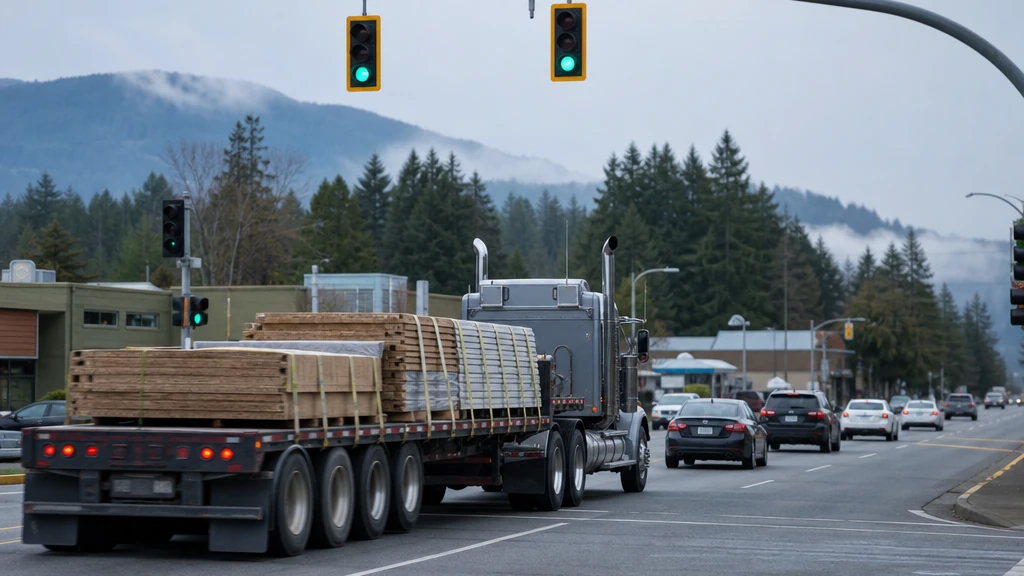
I understand the frustration. You are stopped at a red light, it turns green and the car beside you is quickly approaching the speed limit while the heavily loaded truck ahead of you is still working its way through the gears.
But is the truck driver doing something wrong, or is the complaint based on an unreasonable expectation of how a heavily loaded truck should perform?
Heavy trucks don't accelerate like cars
A loaded tractor-trailer can weigh several times more than a passenger vehicle. Moving all that mass from a standstill takes considerably more effort, and the truck's gearing, engine and drivetrain are designed to move that load efficiently rather than provide the acceleration that we have come to expect from a modern passenger vehicle.
The result is predictable. When the traffic light turns green, the truck may take considerably longer to reach the speed of the surrounding traffic. That does not necessarily mean that the driver is travelling too slowly.
It is also worth remembering that the driver has to consider what is being carried and the conditions around the truck. A heavily loaded vehicle cannot be driven in exactly the same manner as a small car simply because both vehicles are sharing the same road.
What does the law say about driving too slowly?
British Columbia's Motor Vehicle Act does address slow driving. Section 145 says:
A person must not drive a motor vehicle at so slow a speed as to impede or block the normal and reasonable movement of traffic, except when reduced speed is necessary for safe operation or in compliance with law.
Notice the exception. The law does not say that every vehicle must accelerate or travel at the same rate as the traffic around it. Reduced speed may be justified when it is necessary for safe operation.
A truck that is accelerating as quickly as is reasonably possible given its weight, load, road conditions and mechanical limitations is quite different from a driver who simply chooses to travel unnecessarily slowly and holds up everyone behind them.
There is no magic number of kilometres per hour below the posted speed limit that automatically makes a driver guilty of slow driving. The circumstances and the effect on traffic matter.
But what about the danger?
This is where the complaint deserves some attention.
Being delayed behind a heavy truck can certainly be frustrating. The danger, however, may not come from the truck accelerating slowly. It can come from what impatient drivers do in response.
A driver who sees a line of vehicles forming behind a truck may decide that getting around it is worth taking a chance. That can mean changing lanes without enough space, passing where it is prohibited or attempting to squeeze through an intersection before the traffic signal changes.
The fact that the truck is slower does not give the following driver permission to take risks to get around it.
Give the truck some room
A heavily loaded truck taking longer to accelerate from an intersection is normal. What isn't necessarily reasonable is expecting it to perform like a passenger car and then treating the resulting delay as dangerous.
There is another good reason not to crowd a heavy truck while it is accelerating. A large commercial vehicle has different stopping and handling characteristics from a passenger vehicle, and the driver needs room to operate safely.
If you are behind a heavily loaded truck at an intersection, the simplest solution is often the best one: leave some space, be patient and allow the truck to get moving.
If another lane is available and changing lanes can be done legally and safely, you can use it. If not, waiting a few seconds for the truck to accelerate is hardly a hardship.
Learn More
- Log in to post comments