
Short answer: Yes. Under BC's Motor Vehicle Act, an intersection doesn't need painted lines to legally have a crosswalk. If sidewalks exist on either side of the road at that intersection, an "unmarked crosswalk" exists between them — and a pedestrian crossing there has the same protection as someone crossing at painted lines and a sign.
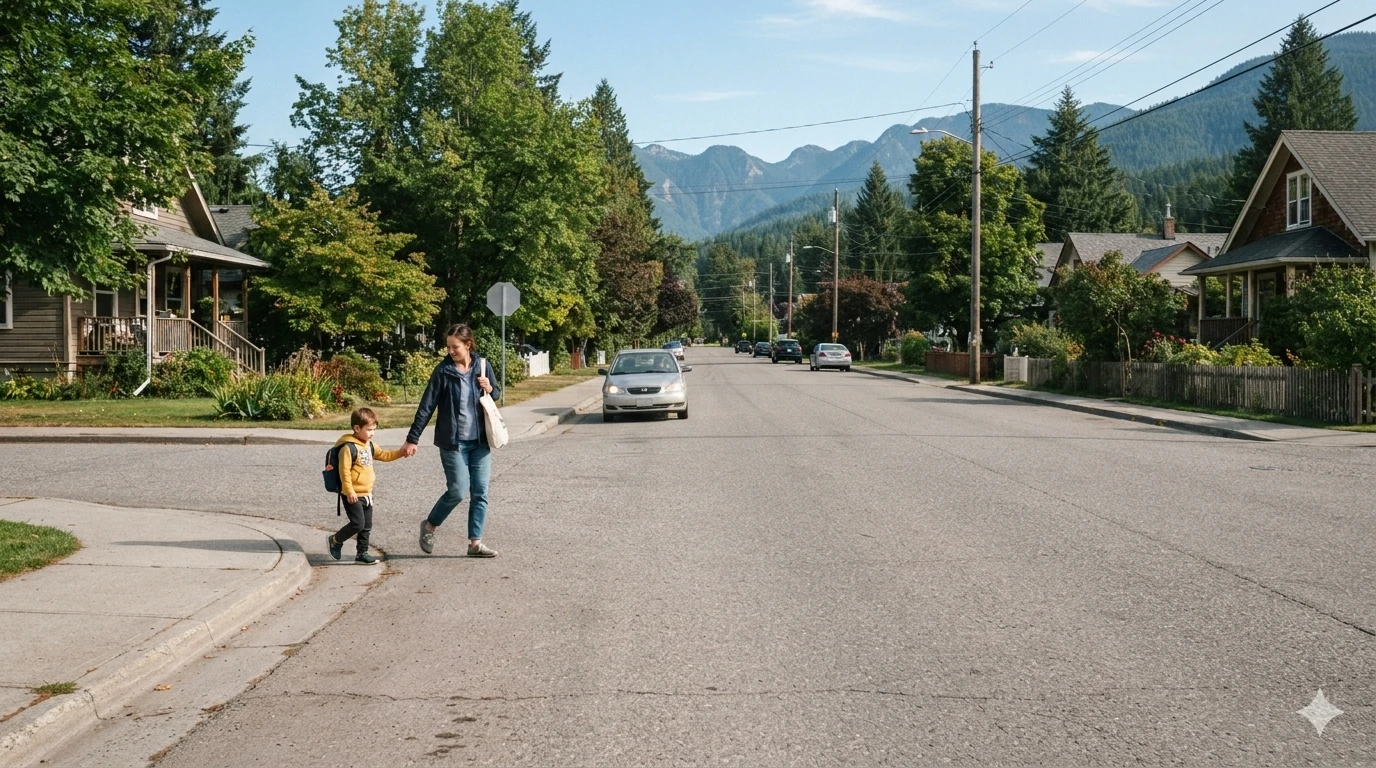
Most drivers only recognize a crosswalk when they see white lines on the pavement. That gap in understanding causes real close calls — including one described below from a reader in Campbell River, where a driver passed on the right just as a mother and child were crossing an unmarked intersection.
What the Law Actually Says
Section 119(1) of BC's Motor Vehicle Act defines "crosswalk" in two parts:
Marked crosswalk (a): a portion of the roadway at an intersection or elsewhere distinctly indicated for pedestrian crossing by signs or by lines or other markings on the surface.
Unmarked crosswalk (b): the portion of a highway at an intersection that is included within the connection of the lateral lines of the sidewalks on the opposite sides of the highway, or within the extension of the lateral lines of the sidewalk on one side of the highway, measured from the curbs, or in the absence of curbs, from the edges of the roadway.
In plain terms: picture the sidewalk lines on either side of an intersection extending straight across the road. The strip of pavement between them is a legal crosswalk, whether or not it's painted.
The Word That Matters: "Sidewalk"
Whether an unmarked crosswalk exists at a given intersection comes down to whether there's a sidewalk there in the first place. The Act defines a sidewalk as:
the area between the curb lines or lateral lines of a roadway and the adjacent property lines, improved for the use of pedestrians.
The key test is whether that strip is improved for pedestrian use — a gravel shoulder or a strip of grass generally won't qualify, but a paved or maintained walkway will. This is also why the same intersection can have an unmarked crosswalk on one approach and not another, depending on which corners actually have sidewalks.
Why This Matters on Rural Highways
This isn't just a downtown issue. Older highway corridors that run through small communities — like the old Island Highway through Campbell River or Qualicum Beach — often have sidewalks and pedestrian crossings without any painted lines or signage. Drivers moving at highway speed frequently don't expect pedestrians to have the right of way there, which is exactly when the danger shows up:
- A driver stops to let a pedestrian cross an unmarked crosswalk.
- A following driver, not recognizing it as a crosswalk, passes on the shoulder or in the oncoming lane.
- The pedestrian is now in the path of a vehicle the stopped driver was shielding them from.
This exact scenario is what prompted the original version of this article: a close call where a passing driver nearly hit a mother and child, then argued afterward that "there was no crosswalk there."
Passing a Stopped Vehicle Is Its Own Offence
Separate from the crosswalk definition, the Motor Vehicle Act (s.179(3)) makes it an offence to pass a vehicle that is slowing down or stopped for a pedestrian — on either side, and whether or not the crossing is marked. A driver who overtakes a stopped car near an intersection can be ticketed for this regardless of how the crosswalk argument plays out.
Are the Rules Different in Town vs. on the Highway?
No. The same definitions apply everywhere in BC — municipal streets and rural highways alike. If sidewalks exist on either side of an intersection, an unmarked crosswalk exists there too, regardless of the posted speed limit or how built-up the area is.
How Pedestrians Can Improve Their Odds
Knowing your rights doesn't guarantee a driver will yield. Pedestrians waiting to cross — marked or unmarked — can make themselves far more visible by pointing across the road: standing facing the direction of travel with an arm held straight out at shoulder height. It's a small signal that removes any ambiguity about intent.
The Bottom Line
An unmarked crosswalk carries the same legal weight as a painted one. The absence of lines or a sign doesn't remove a pedestrian's right of way — it just makes it easier for drivers to miss. Understanding where these crossings exist, especially along older highway corridors with sidewalks but no signage, is one of the simplest ways to prevent a serious collision.
Learn More
- Claiming the Crosswalk — what drivers and pedestrians are each required to do once a crosswalk has been lawfully claimed, unmarked ones included.
- Must Drivers Yield to Pedestrians Crossing Illegally in British Columbia? — how a driver's duty to avoid a collision applies even when a pedestrian is not crossing lawfully.
- Failing to Stop for Pedestrians — what the law requires of a driver approaching a pedestrian in a crosswalk, and what counts as failing to stop.
- Log in to post comments