
In another article, I explained how the Province of British Columbia uses Motor Vehicle Act pilot projects to temporarily change traffic rules and evaluate new transportation ideas before deciding whether they should become permanent. That article prompted an interesting question: If provincial pilot projects are one way to introduce change, how do municipalities sometimes end up with traffic rules or road designs that look very different from those found elsewhere in British Columbia?
The answer is that not every road safety innovation is a Motor Vehicle Act pilot project. Municipalities also have legal authority, granted by the Motor Vehicle Act, to improve road safety and manage traffic on roads under their jurisdiction.
Two Different Paths to Transportation Innovation
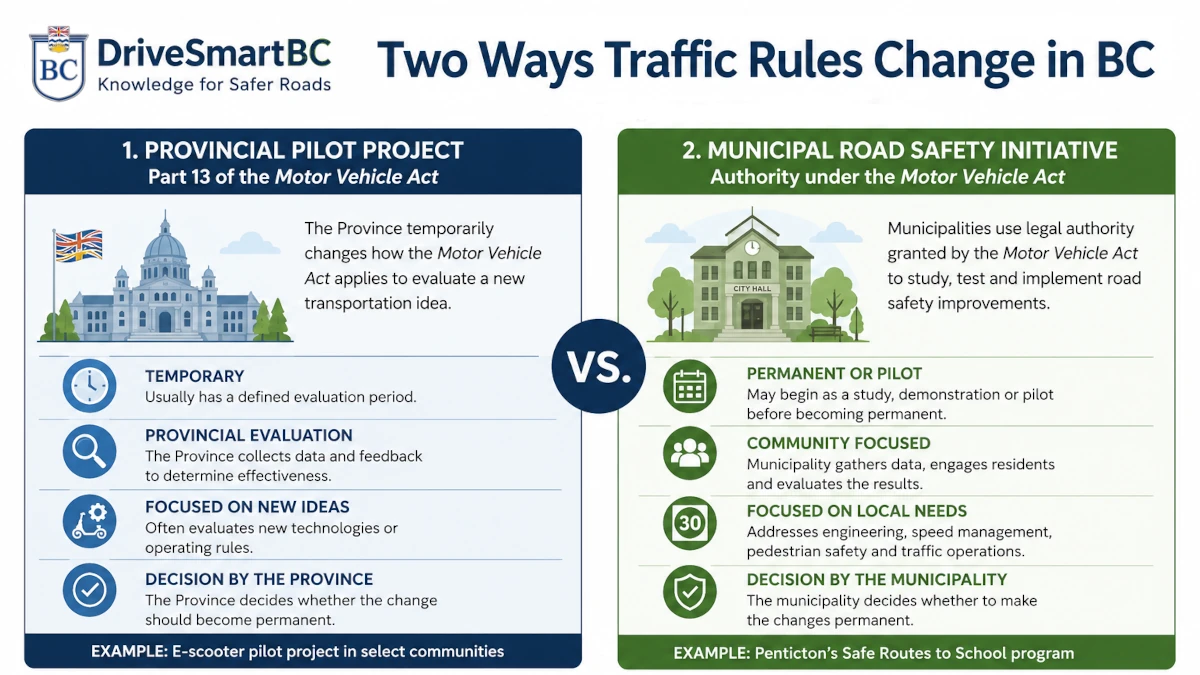
Although they may appear similar to drivers, provincial pilot projects and municipal road safety initiatives serve different purposes and rely on different legal authority.
| Provincial Motor Vehicle Act Pilot Project | Municipal Road Safety Initiative |
|---|---|
| Created by the Province under Part 13 of the Motor Vehicle Act. | Implemented by a municipality using authority already granted by provincial legislation. |
| Temporarily changes how provisions of provincial traffic law apply. | Uses existing municipal authority to improve transportation safety. |
| Usually has a defined evaluation period. | May begin as a study, demonstration project or pilot before becoming permanent. |
| Often evaluates new transportation technologies or operating rules. | Often focuses on engineering, speed management, pedestrian safety and traffic operations. |
One Example: Penticton's Safe Routes to School Program
Penticton provides an excellent example of how municipalities can improve road safety without relying on a Motor Vehicle Act pilot project.
In 2023, the City launched a Safe Routes to School pilot project involving two elementary schools. Rather than changing provincial traffic law, the project examined how students, parents, pedestrians and cyclists travelled to and from school and identified opportunities to make those trips safer.
The project included public engagement, engineering reviews, site observations and collaboration with school communities. Based on the results, the City expanded the program and implemented a variety of permanent safety improvements.
One of the most visible changes was replacing traditional school and playground zone hours with permanent 30 km/h speed limits that apply 24 hours a day, seven days a week.
The planning process began as a municipal pilot project. The resulting speed limits are permanent traffic regulations established by the City—not a provincial Motor Vehicle Act pilot project.
How Could the City Do That?
Many drivers assume that if a municipality adopts traffic rules that differ from what they see elsewhere in British Columbia, the Province must have temporarily changed the Motor Vehicle Act.
In fact, the Motor Vehicle Act grants municipalities authority over many aspects of traffic regulation on highways under their jurisdiction. That authority is found in several provisions of the Act, including sections 124 and 146, depending on the type of traffic regulation involved. For example, municipalities may establish speed limits by bylaw where authorized by the Act, provided the required traffic control devices are installed. Other provisions authorize municipalities to regulate matters such as traffic control devices, parking, one-way streets and numerous other aspects of traffic management.
Did You Know?
The Motor Vehicle Act doesn't just regulate drivers. It also grants municipalities authority to regulate many aspects of traffic on roads they control. That's why some road safety measures can vary from one community to another without requiring a provincial pilot project.
In other words, Penticton did not change the Motor Vehicle Act. It exercised authority that the Act already provides.
Penticton Isn't Alone
Municipalities across British Columbia regularly study, evaluate and introduce new road safety measures without relying on Part 13 of the Motor Vehicle Act.
Penticton is not unique. Municipalities across British Columbia regularly study, evaluate and introduce new road safety measures using authority they already possess.
Vancouver, for example, has piloted lower speed limits around selected schools before expanding those initiatives. Other communities have introduced School Streets, temporarily restricting vehicle access near schools during student arrival and dismissal periods. Municipalities pursuing Vision Zero strategies also use demonstration projects and engineering trials to evaluate traffic calming, protected cycling facilities and pedestrian improvements before deciding whether they should become permanent.
Municipalities implementing Vision Zero strategies also use demonstration projects and engineering trials to evaluate measures such as traffic calming, protected cycling facilities, pedestrian improvements and intersection redesigns before deciding whether they should become permanent.
Although these projects are often described as pilots, they generally rely on municipal authority rather than provincial Motor Vehicle Act pilot project regulations.
From Pilot Project to Permanent Improvement
Municipal pilot projects often answer different questions than provincial pilot projects.
Instead of determining whether provincial legislation should change, they help municipalities evaluate practical questions such as:
- Will this improve safety?
- How will residents respond?
- Does traffic operate more efficiently?
- Are additional improvements needed?
- Should the changes become permanent?
Once enough information has been gathered, municipalities may decide to make the improvements permanent, modify them or remove them altogether.
Why Understanding the Difference Matters
Drivers often hear the word pilot and assume the Province has temporarily changed the law. In reality, British Columbia has two different pathways for introducing transportation improvements.
The Province may establish a Motor Vehicle Act pilot project when it wants to evaluate changes to provincial legislation or emerging transportation technologies. Municipalities, on the other hand, frequently conduct studies, demonstration projects and engineering trials before using authority they already possess to implement permanent road safety improvements.
Both approaches are entirely lawful. They simply rely on different legal authority.
The Bottom Line
Penticton's Safe Routes to School program illustrates that not every transportation innovation requires a Motor Vehicle Act pilot project. While the planning process began as a municipal pilot, the resulting traffic changes were implemented using municipal authority already provided by the Motor Vehicle Act.
Understanding that distinction helps explain why road safety measures can vary from one community to another while remaining fully consistent with provincial law.
Learn More
- What Are BC Motor Vehicle Act Pilot Projects?
- DriveSmartBC articles about pedestrian safety
- DriveSmartBC articles about speed
- DriveSmartBC articles about school zones
The next time you encounter an unfamiliar traffic rule or road design in another BC community, don't assume someone is ignoring the Motor Vehicle Act. The change may be the result of a provincial pilot project—or it may simply reflect a municipality exercising authority the Act already provides to improve safety on its own roads.
- Log in to post comments