
Quick Answer: Most intersection collisions in British Columbia occur not because drivers misunderstand the rules, but because they misjudge speed, intent, and timing. Intersection driving is primarily a prediction problem under time pressure, not a rules recall problem.
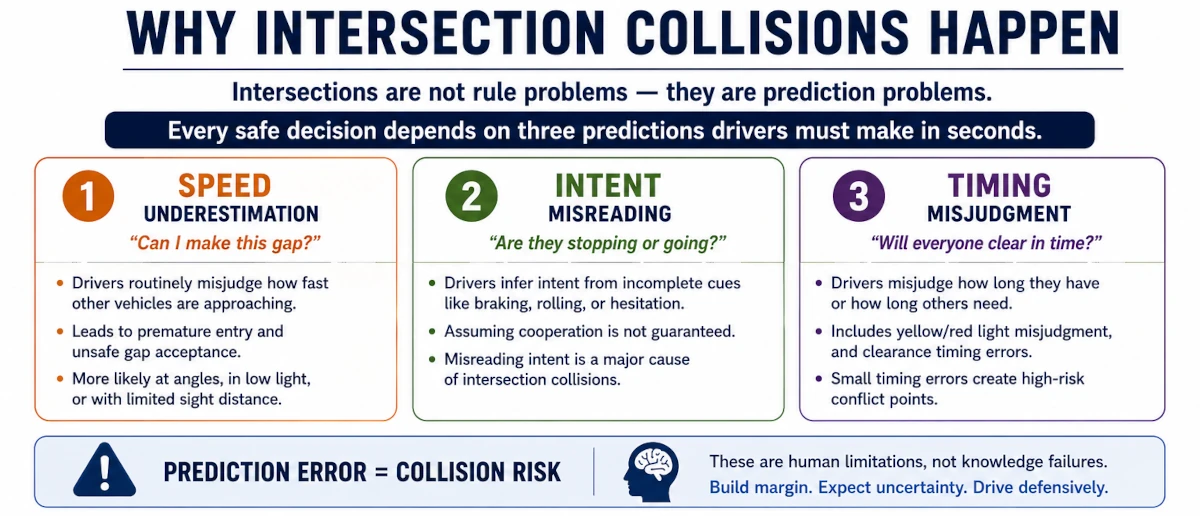
Intersections Are Not Rule Problems—They Are Prediction Problems
Traffic laws at intersections are relatively simple in British Columbia. Right-of-way rules, signal phases, and turning permissions are clearly defined in the B.C. Motor Vehicle Act.
However, real-world driving requires more than rule knowledge. Drivers must continuously assess:
- Approaching vehicle speed and acceleration
- Intent of other road users
- Availability of safe gaps in traffic
- Visibility constraints and occlusions
This makes intersection driving a continuous prediction task under uncertainty.
The Three Core Failure Mechanisms
1. Speed Underestimation Error
Drivers routinely underestimate the speed of approaching vehicles, particularly when distance, lighting, or angles distort perception.
This is a leading cause of premature entry into intersections and unsafe gap acceptance.
This same misjudgment pattern is especially visible at multi-way stop-controlled intersections, where sequencing uncertainty amplifies speed estimation errors.
2. Intent Misreading at Controlled Intersections
At stop-controlled and signalized intersections, drivers must infer intent from incomplete cues such as braking, rolling, and lane positioning.
Errors occur when drivers assume cooperation where none is guaranteed, or misinterpret hesitation as yielding.
Related reading: Left Turn on Red | Turning at Two-Way Stops
3. Right-of-Way Overconfidence
Many collisions occur when a driver is legally correct but assumes other road users will comply in time.
This creates a gap between legal right-of-way and actual safety margin.
Why 4-Way Stops Are Disproportionately Confusing
4-way stops are not difficult because of rules—they are difficult because of sequencing ambiguity under uncertainty.
Drivers must simultaneously determine:
- Arrival order
- Whether others are yielding or proceeding
- Whether hesitation indicates caution or confusion
Related reading: 4-Way Stops
Signalized Intersections Are Not Automatically Safer
Traffic signals reduce legal ambiguity but do not eliminate timing errors.
Common failure modes include:
- Late yellow entry misjudgment
- Opposing left-turn clearance errors
- Assuming full clearance when cross traffic is still clearing
Related reading: Flashing Traffic Signals
Why These Errors Persist Even in Experienced Drivers
These are not knowledge failures. They are perceptual and cognitive constraints caused by:
- Short decision windows (often 1–3 seconds)
- Blocked sight lines at intersections
- High cognitive load in multi-object environments
- Environmental distortion (rain, glare, dusk conditions)
Common Collision Patterns in BC Intersections
Most intersection crashes fall into predictable categories:
- Left-turn vs oncoming through-traffic collisions
- Right-turn conflicts with pedestrians or cyclists
- Stop-controlled side-impact crashes
- Signal transition (yellow/red phase) conflicts
Practical Risk Reduction Principles
Safer intersection driving is based on margin management rather than rule memorization:
- Increase buffer beyond legal minimums
- Assume uncertainty in other drivers’ actions
- Begin deceleration earlier when approaching intersections
- Do not rely on signal compliance as guaranteed behaviour
Summary: Intersection collisions are primarily caused by predictable human misjudgments in speed, intent, and timing—not ignorance of traffic rules.
If you found this explanation helpful, consider sharing it with other road users.
- Log in to post comments
Comments
I'm not sure if late yellow entry misjudgment is usually a misjudgment rather than a misunderstanding or disregard of the law. The law is clear, the "driver of a vehicle approaching the intersection and facing the yellow light must cause it to stop before entering the marked crosswalk on the near side of the intersection, or if there is no marked crosswalk, before entering the intersection, unless the stop cannot be made in safety." (MVA 128.1.a). Most drivers seem to think that a stop is only required when facing a red light. Though in the case of a yellow left turn, most often drivers continue to turn left until an approaching driver starts moving forward.
However, a not insignificant number of drivers (and really any number is significant) think the intimidation of the fear of a t-bone accident will allow them to run a red light. There should be more red light cameras (intersection safety cameras) and their location should not be made public (now your GPS system will tell you that there is red light camera ahead, but regular red light runners can keep running red lights elsewhere). It's not a tax grab, it's an on-road road test with a cost for failing the test.
- Log in to post comments
- Log in to post comments
Yes, there sure is a lot going on at an intersection. One thing I find that makes it even more dangerous is the fact that we, as drivers, are also responsible for pedestrian safety. Watching for their mistakes can add a significant load to the process.
- Log in to post comments
Late yellow entry misjudgment?