
Police enforcement of impaired driving in British Columbia involves both federal and provincial laws. Under the federal Criminal Code, Mandatory Alcohol Screening (MAS) allows a police officer who has an approved screening device while acting in the lawful exercise of their powers, to demand a breath sample from a person operating a motor vehicle, even when the officer has no reason to suspect that the driver has consumed alcohol. This authority is set out in section 320.27(2) of the Criminal Code.
The legal consequences of impaired driving enforcement are not interchangeable. An Immediate Roadside Prohibition (IRP) is an administrative action under the provincial Motor Vehicle Act. A criminal impaired driving charge is a separate matter under the federal Criminal Code. Drivers in the Graduated Licensing Program are also subject to additional restrictions and suspensions.
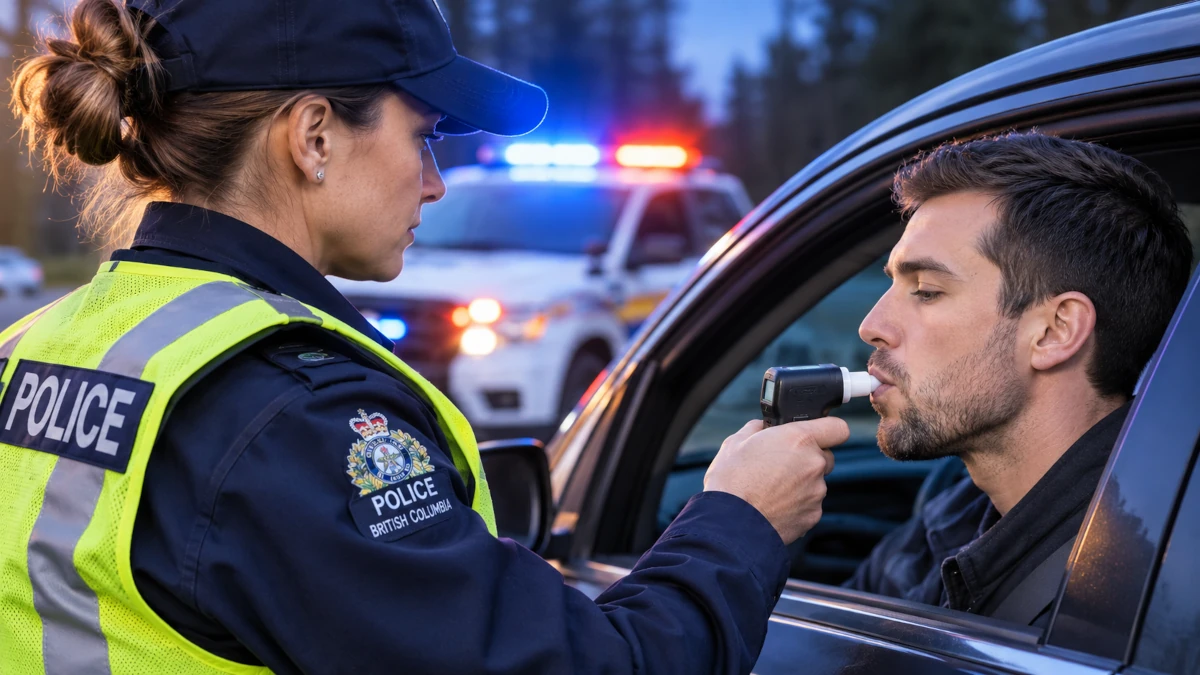
Approved Screening Devices
An approved screening device is a portable instrument used by police to obtain a roadside indication of the amount of alcohol in a person's body. The driver provides a breath sample through a mouthpiece, and the device analyzes the sample.
The roadside devices used in British Columbia are configured to display a WARN result at 60 milligrams of alcohol per 100 millilitres of blood and a FAIL result at 90 milligrams per 100 millilitres.
A WARN or FAIL result may lead to an Immediate Roadside Prohibition under section 215.41 of the Motor Vehicle Act. However, the result alone is not the whole test. For a prohibition based on a breath analysis, the officer must also have reasonable grounds to believe, as a result of the analysis, that the driver's ability to drive is affected by alcohol.
A roadside screening result is not a conviction for criminal impaired driving. It can, however, have serious provincial consequences.
The Right to a Second Breath Test
A driver who receives a WARN or FAIL result has the right to request a second analysis. The officer must advise the driver of this right before serving the notice of driving prohibition. This right is set out in section 215.42 of the Motor Vehicle Act.
The second analysis must be performed using a different approved screening device. If the driver requests and provides a second sample, the lower of the two results governs for the purposes of the Immediate Roadside Prohibition.
This is an important safeguard. The opportunity to request a second analysis is available at the roadside, before the prohibition notice is served.
Immediate Roadside Prohibitions
The length of an alcohol-related IRP depends on the screening result and, for a WARN, the driver's history of previous WARN prohibitions.
- First WARN: 3-day driving prohibition.
- Second WARN within five years: 7-day driving prohibition.
- Subsequent WARN within five years: 30-day driving prohibition.
- FAIL: 90-day driving prohibition.
- Failure or refusal to comply with a lawful breath demand, without reasonable excuse: 90-day driving prohibition.
These periods are established by section 215.43 of the Motor Vehicle Act. The prohibition takes effect immediately when the notice is served. The prohibition period is counted in addition to the day the notice is served. A driver must not drive during the prohibition, even if an application for review has been made.
A driver served with an IRP is also liable for a monetary penalty. The amounts are prescribed by section 43.09 of the Motor Vehicle Act Regulations:
- 3-day prohibition: $200.
- 7-day prohibition: $300.
- 30-day prohibition: $400.
- 90-day prohibition: $500.
The penalty must be paid within 30 days after the notice is served.
Vehicle Impoundment
Vehicle impoundment is another consequence of an IRP. The rules depend on the length of the prohibition. Under section 215.46 of the Motor Vehicle Act, an officer may impound a vehicle when issuing a 3-day or 7-day prohibition if the officer believes impoundment is necessary to prevent the driver from operating it before the prohibition expires. For a 30-day or 90-day prohibition, the officer must arrange for the vehicle to be impounded.
The impoundment period for a vehicle associated with a 3-day or 7-day prohibition is equal to the prohibition period. A vehicle associated with a 30-day or 90-day prohibition is impounded for 30 days. These periods are set out in section 253 of the Motor Vehicle Act.
The vehicle cannot be released until the applicable impoundment period has expired and the towing, storage and other prescribed charges have been paid. These charges are secured by a lien on the vehicle under section 255 of the Act. If someone other than the owner was driving, that person must make reasonable efforts to notify the owner that the vehicle has been impounded.
Other Financial and Program Consequences
The monetary penalty and vehicle impoundment charges are not necessarily the end of the financial consequences. A driver may also be assessed a Driver Risk Premium by ICBC. However, an IRP by itself does not automatically trigger this premium. ICBC identifies two or more roadside suspensions or prohibitions as one of the circumstances that can result in a Driver Risk Premium. Its Driver Risk Premium information explains how the assessment works.
Depending on the driver's record, participation in the Responsible Driver Program or the Ignition Interlock Program may also be required. These are remedial programs with their own eligibility criteria, requirements and costs. They are not automatic consequences of every IRP.
What About a Criminal Impaired Driving Charge?
An IRP is a provincial administrative consequence. It does not, by itself, mean that the driver has been charged with a criminal offence.
Police may also investigate an offence under section 320.14 of the Criminal Code. It is an offence to operate a conveyance while one's ability to do so is impaired to any degree by alcohol or a drug. The section also creates offences involving specified blood alcohol or drug concentrations within two hours after ceasing to operate a conveyance.
Where the investigation provides the necessary grounds, police may make further demands for evidentiary breath or blood samples under section 320.28 of the Criminal Code. A driver may then face criminal charges in addition to provincial consequences. The decision to proceed with a criminal charge is separate from the roadside IRP process.
Refusing or failing to comply with a lawful demand for a breath or bodily substance sample can also have serious consequences. Under section 320.15 of the Criminal Code, failure or refusal to comply with a lawful demand without reasonable excuse is itself an offence. Under the provincial IRP provisions, refusal or failure to comply without reasonable excuse can result in a 90-day prohibition.
Zero-Tolerance Rules for New Drivers
Drivers holding learner and novice licences are subject to zero-tolerance conditions. They must not have alcohol, cocaine or tetrahydrocannabinol (THC) in their body while operating a motor vehicle. These restrictions are set out in section 30.11 of the Motor Vehicle Act Regulations.
The Graduated Licensing Program changed on October 19, 2026. Drivers who graduate to a Class 5 licence under the revised program are also subject to a zero-tolerance restriction for alcohol, cocaine and THC. The restriction applies while operating a motor vehicle under any class of licence and continues until the driver accumulates 12 months of compliant driving history under a Class 5 licence. This requirement is set out in section 30.111 of the regulations.
A prohibition or suspension specified in the regulations interrupts that period. Once the driver is again legally entitled to drive under a valid Class 5 licence, a new 12-month period of compliant driving history must be accumulated.
Certain new residents who receive a British Columbia Class 5 licence are also subject to zero-tolerance conditions. This applies to qualifying drivers under 25 who have at least 24 months but less than 36 months of qualifying driving history outside British Columbia, and qualifying drivers aged 25 or older who have more than 12 months but less than 24 months of such history. The zero-tolerance period continues until the driver meets the applicable total driving-experience requirement. These provisions, including the rules for interruptions to the period, are set out in section 30.112 of the regulations.
These restrictions are separate from the WARN and FAIL thresholds that apply to other drivers. A new driver should not assume that a breath test result below the usual IRP threshold means there will be no consequence.
12-Hour Suspensions
Section 90.3 of the Motor Vehicle Act provides for a 12-hour licence suspension for drivers whose licences carry the applicable zero-tolerance condition. This includes learner and novice drivers, new Class 5 graduates during their restricted period, and qualifying new resident Class 5 holders during their zero-tolerance period.
For alcohol, an officer who makes a Criminal Code breath demand to a driver subject to the zero-tolerance condition may serve a 12-hour suspension if the officer has reasonable grounds to believe, as a result of the analysis, that the driver has alcohol in their body. The officer does not have to believe that the driver's blood alcohol concentration exceeds 3 milligrams per 100 millilitres of blood.
Separate provisions apply to drug screening. Where a driver is subject to the applicable drug restriction, an officer may serve a 12-hour suspension if an analysis using approved drug screening equipment provides reasonable grounds to believe that the driver has a prescribed drug in their body. Failure or refusal, without reasonable excuse, to comply with a lawful demand for a breath or bodily substance sample can also result in a suspension.
These provisions are found in section 90.3 of the Motor Vehicle Act. The approved screening devices, drug screening equipment and prescribed drugs are listed in section 30.101 of the Motor Vehicle Act Regulations.
A 12-hour suspension is not an IRP. It does not carry the same prohibition periods or vehicle impoundment provisions. However, it can have further consequences for a driver in the Graduated Licensing Program and should not be treated as a minor consequence.
The 12-hour suspension is also distinct from the 24-hour prohibition under section 215 of the Motor Vehicle Act. The 24-hour prohibition can apply to any driver when an officer has reasonable grounds to believe that the driver's ability to drive is affected by alcohol or drugs. The grounds and procedures are different.
Can an Immediate Roadside Prohibition Be Reviewed?
A driver served with an IRP may apply to RoadSafetyBC for an administrative review. Under section 215.48 of the Motor Vehicle Act, the application and prescribed fee must be submitted within seven days of being served with the notice. If the officer did not take possession of the driver's licence, the driver must also surrender it to ICBC, unless the licence has been lost, stolen or destroyed and the required statutory declaration is filed.
The review application, payment and booking must all be completed within the seven-day period. The instructions are available through RoadSafetyBC's online IRP review service. Applications can also be made in person at an ICBC driver licensing office, a participating ServiceBC centre or an appointed agent.
The review is an opportunity to challenge the prohibition. A RoadSafetyBC adjudicator considers the driver's statements and evidence along with the police report and other relevant information. A written review is available for all IRPs. An oral review may be requested for a 30-day or 90-day prohibition, but the request and the required fee must be made when applying.
Applying for a review does not automatically suspend the prohibition. The driver must not drive while the prohibition remains in effect. A driver who wishes to challenge an IRP should pay close attention to the deadline and the instructions provided with the notice.
The provincial review process is separate from defending a criminal charge in court. The issues considered and the procedures followed are different.
Learn More
- Log in to post comments