
 This case examines the duty of care that drivers and pedestrians have when the pedestrian is crossing the street outside of a crosswalk. Even when one has the right of way, there is still a requirement to keep a proper lookout and take reasonable precautions in response to apparent potential hazards.
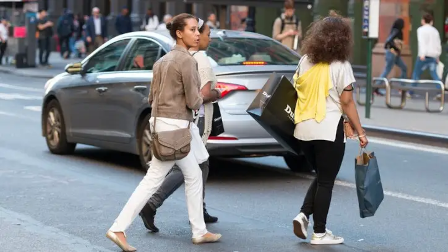
The Pedestrian
Fifteen year old Wiael Hmaied was crossing diagonally across Clarke Road in Port Moody near the Barnett Highway. He was walking against the red light displayed at the nearby intersection, not using a crosswalk, when he dropped his cell phone. He stopped and turned without looking to pick up the cell phone and was struck by a truck driven by Brian Wilkinson.
The Driver
Mr. Wilkinson had approached at a speed slightly over the speed limit and did not take any action when Mr. Hmaied stepped into the roadway. A driver following behind Wilkinson anticipated possible problems and began to slow. He watched as Wilkinson finally did act and brake heavily just before striking Mr. Hmaied.
The Duty of Care
Justice Dickson explains how the Motor Vehicle Act applies to this situation. There are rights of way between vehicle and pedestrian, the duty of a driver and the requirement for a pedestrian to yield the right of way when not using a crosswalk. She says that they supplement the duty of care in common law that all highway users must exercise.
She found Mr. Hmaied and Mr. Wilkinson to be equally liable for the collision.
[34] I conclude that the plaintiff and the defendant both failed to exercise due care in all of the circumstances and that both failures were proximate causes of the Accident. In my view, the parties are equally blameworthy and liability should be apportioned on a 50% basis to each of them.
[35] The defendant had the right of way, but he did not take reasonable precautions in response to the obvious hazard presented by a young person jaywalking across his path of travel. I accept that he could not specifically foresee the plaintiff would drop his cell phone and move back into the middle eastbound lane in order to retrieve it. I do not accept, however, that he was entitled to assume the plaintiff would obey the rules of the road or otherwise behave in a predictable manner as he jogged diagonally across Clarke Road. On the contrary, the defendant knew that the youthful plaintiff was behaving unsafely by jaywalking in the face of oncoming traffic. In these circumstances, other forms of unsafe behaviour were predictably unpredictable and the defendant should have slowed down and changed lanes immediately when he saw the plaintiff. Had he done so, the Accident would not have happened.
[36] The plaintiff also failed to exercise due care for his own well-being. He jaywalked in the face of oncoming traffic and, mid-course, turned back to retrieve his cell phone without checking to see how close the approaching vehicles had come. In so doing, he exposed himself to the risk that he would be struck by an approaching vehicle. That risk was realised and his negligent actions were also a proximate cause of the Accident.
Learn More
Share This Article
- Log in to post comments
Comments
After reading the initial determination of how this pedestrian/vehicle collision occurred, I figured that a 50/50 judgment in terms of fault was probable, so in the academic sense was delighted to find that this was the conclusion.
The pedestrian acted as though he had total right of way, without responsibility for the consequences of his actions; but the driver acted in a very similar manner, only attempting to prevent the collision at the last moment, when it was already too late.
It's well worth reading through the whole transcript. At the end of the day, damages to the pedestrian were assessed at $73k, but because he was as much at fault as the driver, they were reduced to half of that. At risk of sounding cynical, I would guess that he doesn't jaywalk any more. As for the driver? Well he, or his estate, are the poorer for the same amount, because he didn't make the effort to prevent the collision soon enough.
What's really absurd is that they both had sufficient visibility of each other and the potential for collision to easily ensure that it wouldn't ever happen in the first place. But when they ran out of space between them, there was no time left to react in a way that could prevent their colliding with each other.
The one thing that I would wish to argue with the judge is her assertion that the driver should have changed lanes to avoid the collision. This seems to presume that he had the time to ensure there was no vehicle in the adjacent lane, yet only seconds elapsed from when the driver (and the guy following him down that hill) were able to see the pedestrian to when they hit each other. I only mention this because if the driver did change lanes without checking (as required by law) that it could be done safely, then he could have triggered a much more serious crash by shoving the car beside him into the oncoming lanes.
Oh, and she's also incorrect about right-of-way. Nobody ever has that - under law. But there are certainly many times when they don't.
- Log in to post comments
This is an Important Judgment