
The intersection of Bertram Street and Bernard Avenue in Kelowna raises an interesting question: if one crosswalk has a pedestrian signal, does that signal control every crosswalk at the intersection? The answer is no. A pedestrian signal only controls the crossing for which it is installed.
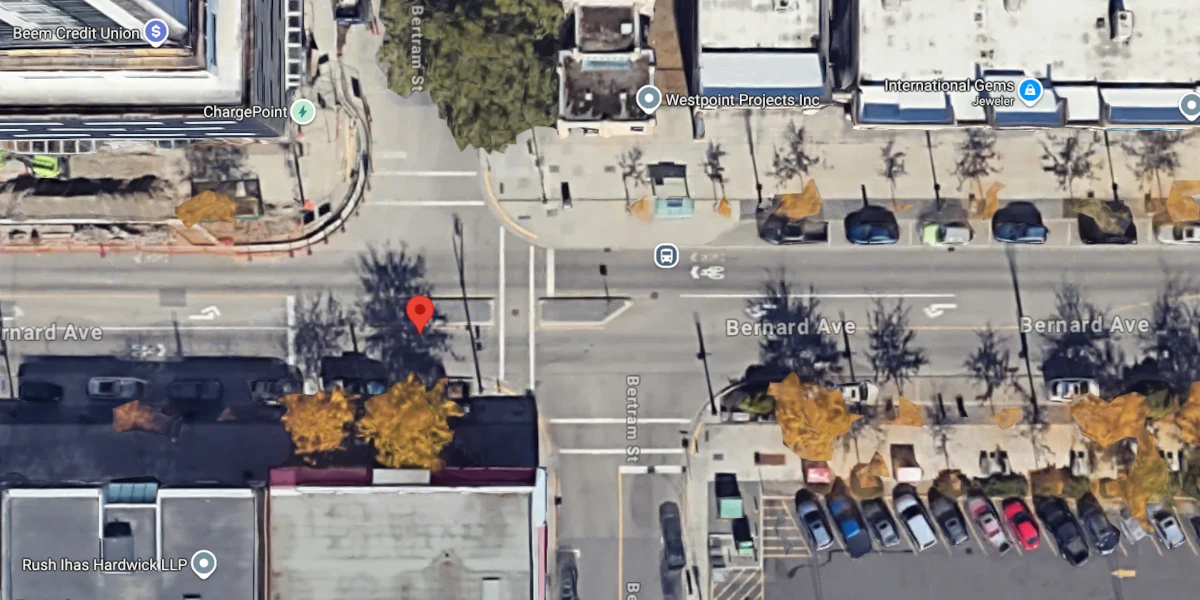
To understand why, we need to look at how the intersection is defined. The Motor Vehicle Act defines an intersection as:
"intersection" means the area embraced within the prolongation or connection of the lateral curb lines, or if none, then the lateral boundary lines of the roadways of the 2 highways that join one another at or approximately at right angles, or the area within which vehicles travelling on different highways joining at any other angle may come in conflict;
Looking at Bertram Street and Bernard Avenue from above, the curb lines of Bertram extended across Bernard do not meet on either side, nor do they fall one within the other. I would contend that this is not an offset intersection, but rather two adjacent T intersections. Bernard Avenue forms the top of the T in each case, with Bertram Street being the north and south legs.
There are five pedestrian crossings involved:
- The south leg of Bertram Street crossing Bernard Avenue northbound
- The north leg of Bertram Street crossing Bernard Avenue southbound
- The shared crossing between the opposite sides of Bertram Street
- Bernard Avenue crossing Bertram Street on the south side of Bernard
- Bernard Avenue crossing Bertram Street on the north side of Bernard
The controls faced by pedestrians at each crossing are different:
- No pedestrian signal control
- No pedestrian signal control
- Pedestrian-controlled signal
- Traffic signal control
- Eastbound pedestrians follow the traffic signal indications; westbound pedestrians cross with caution at their discretion
As a result:
- Pedestrians may cross when safe, exercising caution and yielding as required.
- Pedestrians may cross when safe, exercising caution and yielding as required.
- Pedestrians follow the indications of the pedestrian signal.
- Pedestrians follow the indications of the traffic signal.
- Pedestrians eastbound follow the traffic signal indications; pedestrians westbound cross with caution at their discretion.
It may seem unusual, and it may leave both pedestrians and drivers wondering what applies, but the rule is fairly simple: a pedestrian signal controls only the crossing for which it was installed. A pedestrian waiting to cross a different uncontrolled crosswalk is not required to wait for a signal that does not apply to that crossing.
Drivers still have a responsibility to watch carefully, avoid collisions with pedestrians, and yield to pedestrians who are lawfully in a crosswalk.
- Log in to post comments