
Correct me if I'm wrong, but I think that most people see a traffic cop as someone who writes speeding tickets and hangs around Tim Hortons. This is a very narrow view of the job, but I did not realize just how narrow it was until I participated in a project to define my job as a front line RCMP traffic constable.
That experience gave me a much better appreciation of just how broad the job really was. Traffic enforcement was certainly an important part of it, but writing tickets was only one part of a much larger responsibility.
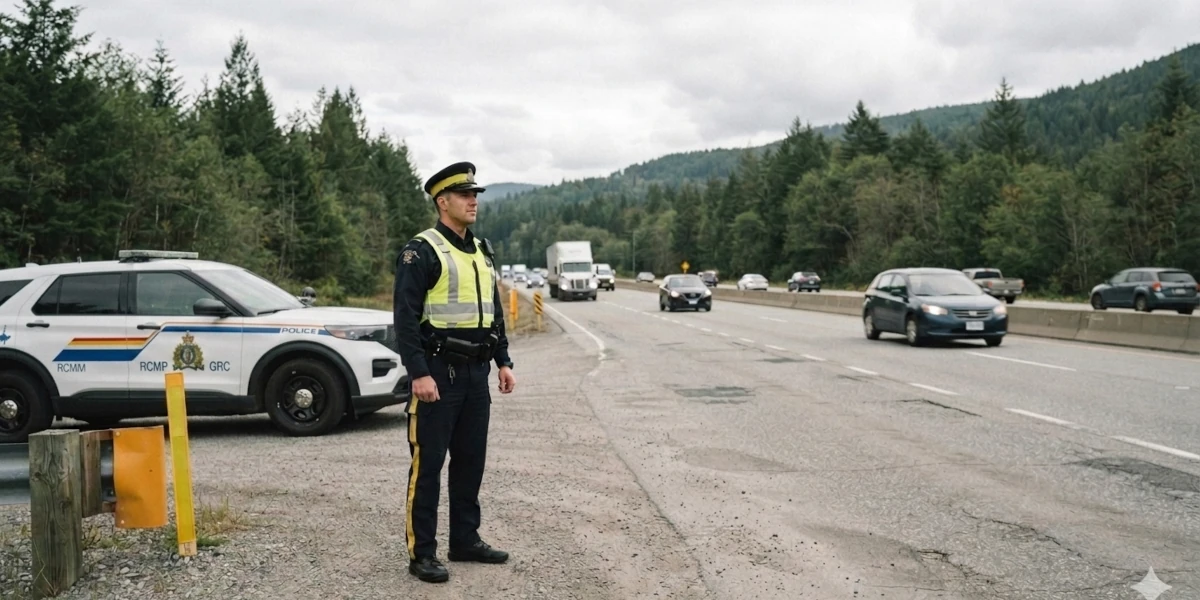
Defining the Traffic Constable
Six experienced traffic constables from the four western provinces met at K Division Headquarters in Edmonton. We spent three days taking part in a functional job analysis led by Dr. James McGinnis of the Research Branch of the Human Resources Directorate of the RCMP.
The purpose was to identify what a front line traffic constable actually had to do and what knowledge and skills were required to do the job successfully.
We brainstormed together, working through the many different tasks that we were expected to perform. The meeting room walls were soon covered with sheets of paper, each listing a single task description.
The task bank eventually identified 13 specific areas of knowledge and skill. They ranged from communication skills needed for report writing, planning and court testimony to conducting a high-speed pursuit safely. These were considered the minimum requirements for successfully performing the job.
You can read the RCMP Traffic Constable Functional Job Description that resulted from this work.
More Than Writing Tickets
Writing traffic tickets was part of the job, but it was not simply a matter of pointing a radar gun at a vehicle and writing down a speed.
Effective enforcement required us to determine where enforcement would be useful, what behaviour needed to be addressed and why a particular enforcement activity was appropriate. The objective was to influence the behaviours that contributed to collisions, not simply to produce a stack of tickets.
The Traffic Services Management Information Tool (TSMIT) database provided information to help with this. Enforcement could be directed toward the places, times and behaviours where it was most likely to make a difference.
That distinction is important. A traffic constable's job was not simply to find people breaking the law. Traffic enforcement was one of the tools available to address unsafe behaviour and improve road safety.
Knowledge of the Law
There was also a considerable amount of law to know.
In our society, travel by vehicle is the norm for almost everyone, including criminals. Familiarity with federal and provincial traffic-related statutes was essential, but that was only the beginning. The Criminal Code, immigration, customs, drugs, taxation, wildlife, dangerous goods and many other areas of law could become relevant during a traffic stop or investigation.
A traffic constable therefore needed much broader legal knowledge than someone might expect from an officer whose primary responsibility was traffic enforcement.
Other Skills and Responsibilities
The job also required the ability to communicate effectively, prepare reports, give evidence in court, investigate offences and make sound decisions, sometimes under considerable pressure.
Some traffic situations could be routine, while others could become dangerous very quickly. The task bank included the knowledge and skills required to conduct a high-speed pursuit safely.
Our functional job analysis did not attempt to cover every traffic specialty. Areas such as collision reconstruction and commercial vehicle inspection, for example, required additional specialized training. Neither did the exercise attempt to describe the work involved in teaching these traffic skills to other officers.
Learning the Job
Thinking back, it took me about a year to understand the basics of traffic enforcement and another year to really become comfortable with what I needed to do.
That may seem like a long time for a job that some people think consists primarily of sitting beside the road with a radar gun, but there was a great deal more to learn and apply than simply knowing the speed limit or recognizing a traffic offence.
As in all jobs, there was always something to learn. Some of it was provided formally, some was passed on by working with others and some came from simply doing research and educating yourself.
If there was any traffic on the road, the job was never boring.
Friendly Rivalry
There has always been a friendly rivalry between the general duty constables and those of us on traffic. I smiled when I read that the task bank indicated that traffic constables were expected to have the knowledge required of a general duty constable as well as the additional knowledge and skills identified for traffic enforcement.
Back at you guys!
The Bottom Line
My three days participating in the functional job analysis changed the way I thought about my own job. It also reinforced something that is easy to overlook when the only part of traffic policing that the public sees is an officer stopping a vehicle and writing a ticket.
A traffic constable needed to understand the law, communicate effectively, investigate offences, make decisions, testify in court, deal with dangerous situations and use enforcement strategically to address behaviours that put people at risk.
The ticket was sometimes the visible result of all of that work. It was rarely the whole job.
Learn More
- Log in to post comments
Comments
Never put much thought into it. As with any job one does when you move into a specialised field you are required to have all the knowledge of the regular basic level entry work and the necessary knowledge to perform the duties of your specialised position.
I noticed on page 32 that one is to sign off that it is 95% of the duties of a front line traffic constable. And there lies one of my main complaints over the years. One of my first jobs was enforcing one of the Acts in B.C. When I signed on that line I swore an oath that I would uphold all sections not just what I considered important. And that is not what I see being done by highway patrol officers or local officers patrolling the streets of any community.
I also observe traffic officers blatantly breaking the law. On a multi-lane highway how often do you see the officer following the current law in B.C. of "Keep Right Except to Pass"? I know why they are running in the lane furthest to the left but should they not be setting an example by following the law? Yesterday I was travelling on a section of road with a speed of 100K. I was cruising at my normal 120K and had a vehicle catch up to me and pass. I would put its speed between 125 to 130+ by the rate he caught up and pulled away. No lights or anything activated and was also operating with the DRL turned off. Everything I have read indicates that unless emergency equipment activated they are to obey the speed limit same as everyone else. Turning off DRL's is supposed to be for surveillance work, not running down the highway.
Got off on a tangent there. I'm sure some of us recognise that there is far more to being a highway patrol officer than writing tickets for speeding. Although I am not sure how many from the complaints I read on this site regarding lack of speed enforcement. Quickly reading through the job description I thought a lot was common sense and apply to regular duty as well. Unless a person is working a labour job where the task is repetitive most jobs require a knowledge of what you are doing and the communicative skills to articulate it. And when your job is to enforce the laws of the country it is to enforce all laws not just a few.
Appreciated being able to read what the task force came up with.
- Log in to post comments
Knowledge in a Specialized Field