
Most drivers experience frustration on the road from time to time. Congestion, delays, and the mistakes of other road users can test our patience. The danger begins when frustration turns into deliberate intimidation, threats, or violence.
Road rage can involve anything from aggressive driving intended to frighten another motorist to a face-to-face confrontation. You cannot control another driver's behaviour, but you can take steps to avoid escalating a situation and protect yourself if one develops.
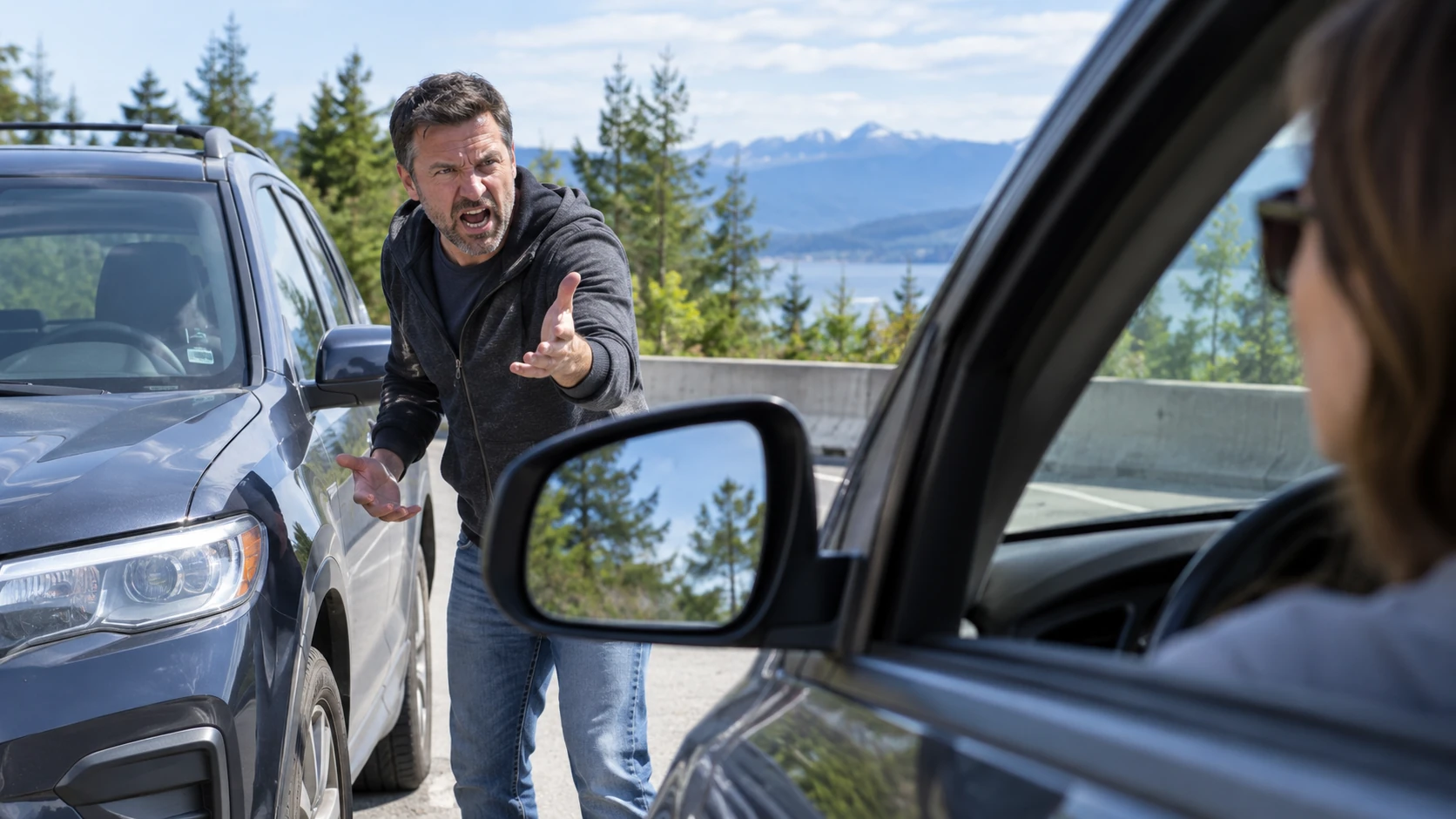
What Is Road Rage?
The terms aggressive driving and road rage are often used interchangeably, but they can describe different behaviours.
Aggressive driving includes deliberate actions that disregard the safety or consideration owed to other road users. Examples include tailgating, weaving through traffic, cutting off other vehicles, and making hostile gestures.
Road rage is generally used to describe more serious behaviour involving an attempt to intimidate, threaten, injure, or deliberately damage the property of another person. It may begin with an angry gesture or an argument but escalate into dangerous driving, threats, assault, or property damage.
These descriptions are useful distinctions rather than universally agreed legal definitions. Whether particular conduct constitutes an offence depends on what happened and the applicable law.
Why Does Road Rage Happen?
Several circumstances can contribute to frustration while driving:
- Congestion, road construction, and unexpected delays.
- Feeling rushed or running late.
- Stress arising from work or personal circumstances.
- Impatience with another driver's speed or decisions.
- Assuming that another driver's mistake was deliberate.
These circumstances can contribute to aggressive behaviour, although they do not excuse it. For further information about driver aggression and ways to address it, see the Government of Alberta's guidance on driver aggression. Every driver remains responsible for choosing how to respond to frustration.
It is also easy to misinterpret another person's intentions. A driver who changes lanes without warning may have made a mistake rather than deliberately trying to obstruct you. Treating every discourteous or unexpected action as a personal challenge can turn an ordinary traffic problem into a confrontation.
How Can You Avoid Contributing to Road Rage?
You cannot guarantee that another driver will behave reasonably, but you can reduce the likelihood that your own actions will contribute to an escalating situation.
- Allow enough time. Plan for delays and leave early enough that a slow journey does not become an emergency in your mind.
- Drive predictably. Signal your intentions, maintain a safe following distance, and avoid abrupt or unnecessary manoeuvres.
- Accept that mistakes happen. Other road users will sometimes make poor decisions. Retaliation does not correct them.
- Do not try to enforce the rules yourself. Avoid deliberately blocking another driver, matching their speed to prevent passing, or attempting to teach them a lesson.
- Use your horn appropriately. A horn can warn of danger. Using it repeatedly to express anger may escalate a disagreement.
- Keep your gestures neutral. Avoid insults, hostile gestures, and behaviour that could be interpreted as a challenge.
- Recognize your own frustration. If anger is affecting your driving, find a safe place to stop and take a break.
Good driving habits do not guarantee that you will avoid a road-rage encounter. They do, however, help you remain in control of your own decisions.
What Should You Do if Another Driver Becomes Aggressive?
If another driver tailgates you, gestures angrily, or attempts to provoke you, your priority should be to avoid escalation and maintain a safe driving environment.
- Do not retaliate. Avoid angry gestures, shouting, repeated horn use, brake-checking, or any attempt to frighten the other driver.
- Do not engage in an argument. You do not have to prove that you were right or persuade the other driver to agree with you.
- Give the other driver room. If you are being tailgated, avoid sudden braking. Allow the driver to pass when there is a safe opportunity.
- Continue to drive predictably. Do not speed, make abrupt lane changes, or take unnecessary risks to get away.
- Do not pursue the other driver. Never follow someone to demand an explanation, obtain an apology, or settle a disagreement.
The principle is simple: forget the disagreement and drive on. Being right about what happened is less important than arriving safely.
What if the Driver Follows or Confronts You?
A situation becomes more serious when another driver follows you, deliberately blocks your vehicle, gets out to confront you, or threatens you.
If you believe you are being followed or deliberately targeted:
- Do not lead the person to your home. If you can do so safely, change your destination and head toward a place where you can obtain assistance.
- Consider going to a police station. If you are being followed, choose a suitable location where police assistance may be available rather than stopping somewhere isolated.
- Keep your doors locked and windows closed. If another person approaches your vehicle aggressively, do not get out to argue.
- Leave when it is safe. Do not attempt to escape by driving into dangerous traffic or making a manoeuvre that could cause a collision.
- Call 911 if you are in immediate danger. Tell the call taker what is happening and follow the instructions provided.
If you are stopped in traffic and cannot safely leave, remain inside your locked vehicle. Avoid arguing through an open window or getting out to confront the other person.
If someone attempts to enter your vehicle, threatens violence, displays a weapon, or uses a vehicle to endanger you, treat the situation seriously. Your immediate safety matters more than collecting evidence or identifying the person.
When Should You Call Police?
Not every instance of discourteous driving requires an emergency response. The appropriate response depends on the behaviour and the level of danger.
Call 911 when there is an immediate threat to safety. Examples include an assault, a threatening confrontation in progress, a person attempting to enter your vehicle, or dangerous driving that presents an immediate risk to the public.
For dangerous driving or other incidents that do not require an immediate emergency response, contact the appropriate police service through its non-emergency reporting process.
The BC RCMP's tips for calling emergency services provide further information about contacting emergency services. Follow the call taker's instructions and give clear, factual information about the situation.
If you can safely note the details, useful information may include:
- The vehicle's licence plate, make, model, and colour.
- The location and direction of travel.
- The time of the incident.
- A factual description of the driving, threats, or other behaviour you observed.
Do not follow a vehicle, use a phone while driving to record details, or put yourself at risk to obtain a licence plate number. If you have a dashcam recording, preserve the relevant footage before it is overwritten and provide it to police if requested or appropriate.
Police in Richmond have also issued advice to road users following reported road-rage incidents. The Richmond RCMP road-rage warning provides a local example of the risks associated with these encounters.
What Should You Do After an Incident?
Once you are safe, take a few minutes to record what happened while your memory is fresh.
Write down the time, location, direction of travel, vehicle description, and a factual account of the incident. Preserve any relevant dashcam footage before it is overwritten. If witnesses are available, their contact information may be useful to investigators.
Report threats, assaults, dangerous driving, or deliberate property damage to police as appropriate. If your vehicle was damaged, photograph the damage and contact ICBC to discuss whether a claim may be appropriate.
Do not put yourself in danger by returning to the scene, searching for the other driver, or confronting potential witnesses while the situation is still unfolding. Police can determine what further investigation may be necessary.
Can Road Rage Have Legal Consequences?
Road rage is not a single, specific offence in British Columbia. Depending on the circumstances, the conduct involved may violate traffic laws or constitute a criminal offence.
For example:
- Careless driving: Section 144 of BC's Motor Vehicle Act addresses driving without due care and attention, without reasonable consideration for other persons using the highway, and at a speed excessive for the conditions.
- Uttering threats: Section 264.1 of the Criminal Code addresses knowingly uttering, conveying, or causing a person to receive certain threats, including threats to cause death or bodily harm.
- Dangerous operation: Section 320.13 of the Criminal Code addresses operating a conveyance in a manner that is dangerous to the public, having regard to all the circumstances.
- Mischief: Section 430 of the Criminal Code may apply to conduct such as wilfully damaging another person's property.
Whether an offence has occurred depends on the facts and the legal requirements of the particular provision. An angry exchange or rude gesture does not automatically amount to a criminal offence, but threats, assaults, dangerous driving, and deliberate damage can have serious consequences.
Anyone who has been threatened or harmed should report the incident when appropriate and preserve available evidence. Police can investigate and determine whether an offence may have been committed.
Remember: Forget It, Drive On
You cannot control how every person behaves on the road. You can control whether you retaliate, pursue an argument, or take unnecessary risks in response.
Allow other drivers to make mistakes without turning them into personal disputes. If someone becomes aggressive, disengage and concentrate on driving safely. If a situation develops into a threat, protect yourself and seek help rather than trying to resolve it face to face.
Arriving safely is more important than winning an argument with a stranger.
Learn More
- Don't Spit on Other Drivers! — a BC case illustrating how an aggressive driving encounter can escalate into an assault.
- Parking Lot Road Rage — an example of anger between drivers and the value of not escalating a confrontation.
- The "Me First" Driver — how self-centred and aggressive driving behaviour can create risks for other road users.
- Log in to post comments