
 One of the most common questions about highway driving is also one of the most counterintuitive: why should a driver who is obeying the speed limit move aside for someone who is speeding? When introducing the "Keep Right, Let Others Pass" legislation, the Province explained that the objective was to improve traffic flow and reduce risky passing manoeuvres on higher-speed highways—not to change the enforcement of speed limits.
Imagine you're driving on a multi-lane highway at exactly the posted speed limit. You're in the left lane, overtaking slower traffic. Suddenly, another vehicle appears in your rear-view mirror, closes the gap quickly, and begins following much too closely. The driver wants to pass.
Your instinct might be to stay where you are. After all, you're already driving at the legal limit. Why should someone who is speeding have any expectation that you'll move over?
In British Columbia, the law generally requires you to move to the right when it is safe to do so. At first glance, that seems to reward illegal behaviour. In reality, it is intended to reduce risk for everyone on the highway.
What the Law Actually Says
British Columbia's "keep right" requirement isn't found in a single rule. It comes from two related sections of the Motor Vehicle Act that work together.
Section 150(2) — Slower Traffic Keeps Right
Section 150(2) requires a driver who is proceeding at less than the normal speed of traffic, at the time and place and under the existing conditions, to drive in the right-hand lane available for traffic or as close as practicable to the right edge of the roadway. There are exceptions for overtaking another vehicle and for preparing to make a left turn.
Section 151.1 — Keep Right, Let Others Pass
Section 151.1 builds on that principle for higher-speed multi-lane highways. It applies where there are two or more lanes travelling in the same direction, the posted speed limit is at least 80 km/h, and traffic is moving at least 50 km/h. Under those conditions, a driver in the leftmost lane must leave that lane when another vehicle approaches from behind, provided it is safe to do so. The law includes exceptions for overtaking another vehicle, allowing traffic to merge, preparing for a left turn or exit, and moving over for an official vehicle.
The important point is this: neither section says the approaching driver must be travelling at or below the speed limit before you move over. The obligation to keep right and the obligation to obey the speed limit are separate legal requirements. A speeding driver may still be violating the law, but that does not remove your obligation to comply with the lane-use rules when they apply.
Removing the Conflict
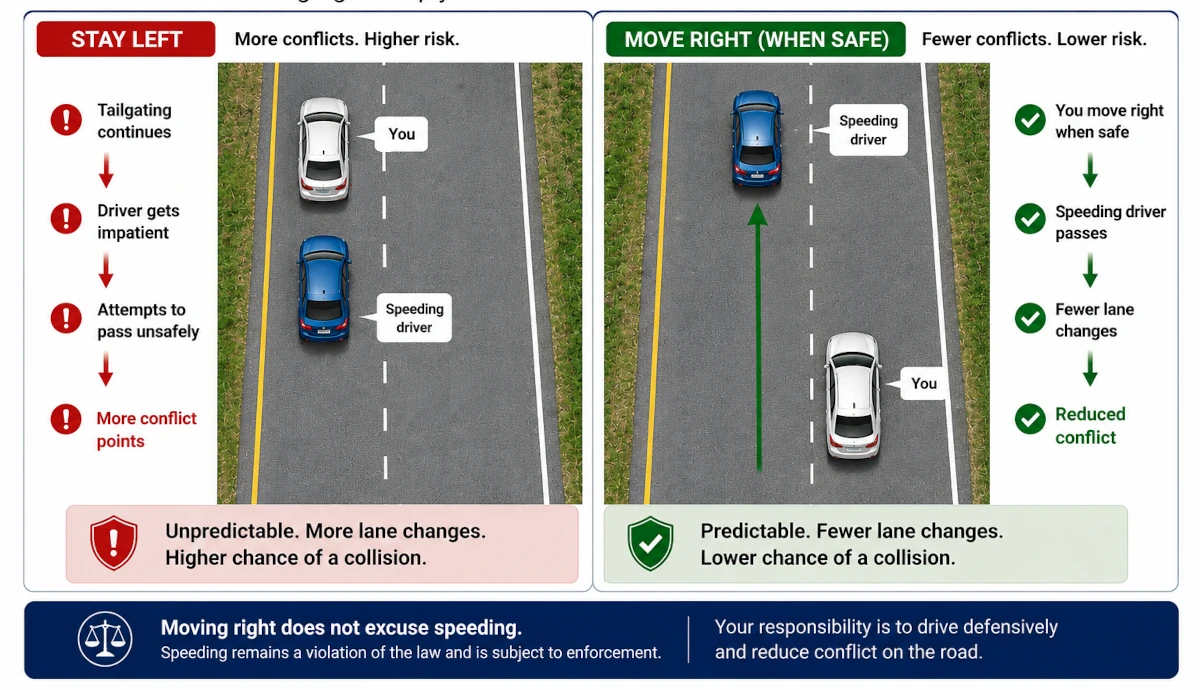
Choosing not to move over rarely slows the speeding driver for very long. Instead, it often changes how they pass. An impatient driver may begin tailgating, weave through slower lanes, or attempt a pass on the right. Every additional lane change creates another opportunity for a collision.
By moving to the right when it is safe, you are not approving of the driver's speed. You are simply removing yourself from a developing conflict. The speeding driver remains responsible for obeying the law and may still encounter police farther down the road. Your responsibility is to drive defensively and avoid contributing to an increasingly hazardous situation.
Why This Seems Contradictory
The apparent contradiction arises because two different traffic laws are operating at the same time. One law regulates how fast you may drive. Another regulates where you should drive. Although they appear to conflict, they serve different purposes. One regulates speed; the other reduces conflicts between vehicles travelling at different speeds.
Traffic laws often recognize that drivers do not all behave perfectly. Rather than assuming everyone will obey every rule, they are frequently written to minimize the consequences when someone does not.
What Traffic Engineers Have Learned
Although lane discipline and speed limits are separate legal issues, both have been influenced by changing ideas about road safety.
For many years, engineers commonly relied on the 85th percentile speed when evaluating appropriate speed limits. The idea was straightforward: most drivers naturally choose a speed they perceive to be reasonable for the road, and the speed travelled by 85 percent of drivers was considered one useful measure when setting limits.
Today, that approach is no longer viewed as sufficient by itself, particularly on urban streets. Many transportation agencies now place greater emphasis on surrounding land use, pedestrian activity, cycling facilities, crash history, and the potential severity of collisions.
This shift reflects the principles of the Safe System Approach and Vision Zero, which recognize that people make mistakes and that roads should be designed to reduce both the likelihood and the consequences of those mistakes.
Highways Are Different From City Streets
The distinction between highways and urban streets is important.
On city streets, reducing vehicle speeds usually takes precedence over facilitating overtaking. Road design often encourages slower operating speeds through narrower lanes, traffic calming measures, and lower speed limits.
On controlled-access highways, the primary concern is different. There are few intersections or vulnerable road users, but vehicles travel at much higher speeds. Here, reducing unnecessary lane changes and allowing overtaking traffic to pass in the left lane helps keep traffic flowing more predictably and reduces conflicts between vehicles travelling at different speeds.
Safety Over Principle
It is understandable to feel that moving aside for a speeding driver somehow rewards bad behaviour. It does not.
Moving right is a defensive driving decision, not a moral judgement. It separates two vehicles before an unsafe situation escalates into tailgating, aggressive passing, or road rage. The speeding driver remains accountable for breaking the law. Enforcement is the responsibility of police—not other motorists.
In the end, the law asks you to move over not because the speeding driver has earned the right to the lane, but because separating two vehicles is usually safer than allowing the conflict to continue. Yielding the lane doesn't excuse speeding—it simply reduces the risk that one traffic violation will lead to another.
If this article answered a question you've had about highway driving, please consider sharing it using the buttons below. Better-informed drivers help make our roads safer for everyone.
- Log in to post comments
Comments
There is one problem I have with the lane keeping approach and I think it's substantial.
When I'm on the highway passing another vehicle, I regularly find myself in the following situations:
1. The vehicle I'm passing is going slightly under the limit (say 95 in a 100 zone), or they realize they are traveling slowly and speed up as I'm passing.
2. A vehicle traveling well over the limit (say 120 or 130+) is suddenly behind me.
3. I proceed to complete my passing maneuver, but when I finally have enough room to safely pass, the vehicle behind me cuts in (usually regardless of the state of my signal light) and darts ahead of me.
The problem is that the speeding driver is also generally too impatient to wait for me to pass when safe and takes the unsafe passing opportunity before I get a chance to move over.
- Log in to post comments
Speed surveys to determine 85th percentile speed are the best tool for setting speed limits, because they objectively determine the design speed of the subject roadway. If the 85th percentile speed is 81 km/h, the fair and appropriate speed limit is 90 km/h. After all, this is what motorists have already paid for through their taxes. Roads are extremely expensive to build, especially when the geometry - lane widths, curve radii, superelevations (banking) - are designed for high speeds. If we want people to drive more slowly, build roads to a lower geometric standard and save everyone the money. Motorists are human beings who will respond quite predictably to environmental cues. They will almost always drive at speeds consistent with roadway design.
This applies on any roadway, not just highways. So what about urban streets with a wide range of road users? I think the answer is quite simple: designers need to pick the desired traffic speed, and design the roads accordingly. Keep them narrow, tighten intersection geometry to shorten crosswalks and lower vehicle turning speeds, limit sight lines with landscaping, etc. - all of which will naturally attenuate driving speeds as we work with normal human behaviour. The essential point is that the posted speed limit should be the upper limit of what a typical motorist would naturally drive while not paying particular attention to their speed.
This would have some interesting results that people would need to wrap their minds around. Streets designated as school zones with a 30 km/h limit would likely have a two-lane cross-section not more than 6 metres wide (which is the narrowest road you can have under the National Building Code). In Europe, neighbourhood streets posted at 30 are often only about 4.5 to 5 metres wide. In this context, you don't stare at the speedometer, you naturally drive a slow and measured pace that matches the roadway design while paying attention to what is going on around you.
To conclude, Vision Zero sounds good, until you realize that for many advocates it involves simplistic solutions like blanket 40 or even 30 km/h speed limits on roads that are over-designed for even 50 or 60, while blaming motorists for driving in a manner that is entirely consistent with the design of those roadways.
- Log in to post comments
"Moving right is a defensive driving decision, not a moral judgement. It separates two vehicles before an unsafe situation escalates into tailgating, aggressive passing, or road rage. The speeding driver remains accountable for breaking the law. Enforcement is the responsibility of police—not other motorists."
Agreed. Let the other person go, stay well back. And if someone is passing you on a two-lane and the gap is tight, deliberately brake to slow down once they are fully in the passing lane. That way you don't inadvertently increase your own speed. (Don't slow too early; they may be leaving a fairly tight gap and you could throw off their timing.) You are not in a race, and if an accident happens, you don't want to be part of it. And courtesy is foundational to safe driving.
- Log in to post comments
Regarding moving over to allow others to pass seems elementary but for some, (ie) left lane bandits, it is not about driving the speed limit in the left lane, it is about control. Yes in my opinion FLBs are control freaks!
Another couple went with us to Spain in 2000. My friend was driving on one of their excellent dual motorways when the vehicle in front of us was a dodder in our lane. The speed limit there was 120k. My friend pulled into the left lane to pass and as our rental was somewhat under powered and as we were Driving up a slight hill it took us a wee bit longer to pass.
There was another car approaching fast in the left lane that was blinking its headlights quickly, in other words get the hell out of my way. Oh by the way at that time we were doing 140K!
Seems left lane bandits and speeders are universal!
- Log in to post comments
Pulling over when safe.