
Who goes first at a 4-way stop? The basic rule seems simple: first to stop, first to go. However, when two or more drivers stop at about the same time, things become more complicated. Do you know who has the right of way?
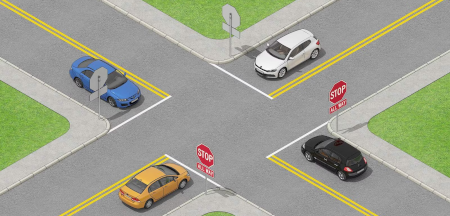
The Law at 4-Way Stops
The requirement to stop at a stop sign is found in Section 186 of the Motor Vehicle Act (MVA). Slowing down and rolling through the intersection without stopping only creates confusion about who should proceed. Don't do it!
Four-Way Stop Rules
The provincial driver's manual, Learn to Drive Smart, explains four-way stops briefly on page 46:
The first vehicle to arrive at the intersection and come to a complete stop should go first.
If two vehicles arrive at the same time, the one on the right should go first.
If two vehicles are facing each other and have arrived at the intersection at about the same time, the one making a left turn should yield to the one going straight through.
Those rules cover the most common situations, but they don't answer every possible combination of vehicles at a four-way stop.
Two Vehicles Stop at the Same Time
Suppose two drivers stop at about the same time across from one another. One wants to turn right and the other wants to turn left. Who goes first?
Section 174 of the MVA establishes the general rule that a driver turning left must yield to approaching traffic that is close enough to be a hazard. In this situation, the driver turning left should yield and the driver turning right goes first.
If both drivers intend to turn left, or both intend to turn right, they should normally be able to proceed at the same time, provided there is enough room in the intersection and their paths do not conflict.
What If You Are Not Sure?
This might be a good time to share something my father taught me when I was learning to drive: the only thing you can be certain about when you see a flashing signal light is that the bulb is still good. The chance might be slim, but drivers sometimes signal one thing and do another.
The same principle applies at a four-way stop. If there is any doubt about who should proceed, it is better to yield to the other driver, even when you believe you have the right of way.
Don't Forget Pedestrians
Pedestrians can add another complication. If you have yielded to another driver but that driver cannot proceed because of pedestrian traffic, make sure it is safe before proceeding. Don't assume that the other driver will remain stopped.
Make Eye Contact
Make eye contact with other road users when possible. It's the things we don't see that cause problems, and knowing where another road user is looking—or not looking—can help us anticipate what is going to happen.
Arrive Second
One final strategy can make a four-way stop easier: if you think you are going to arrive at the same time as another vehicle, slow down and arrive second instead. It costs you only a second or two, and you may more than regain that time by eliminating the pause while both drivers try to decide who should go first.
Video
Learn More
- Log in to post comments
Comments
"The complication is always caused by those who will not wait their turn."
I disagree. I regularly arrive at 4 way stops "second" or even 3rd or 4th. My practice is to come to a complete stop, then direct my attention to the next vehicle in line to proceed.
Close to 50% off the time the driver who's next is looking back at me, waving me through (most recently they were also to my right, so even if there was ambiguity about who stopped first, they still had the right of way).
The driver waving me through is causing just as much, if not more hazard, than the impatient driver who jumps the gun.
Here's why:
- There's no guarantee that I can see the other driver. Light levels, height of the sun and windshield glare often tender the other driver all but invisible. That movement I'm detecting from the driver could be the waving me through, but it could just as easily be then fixing their hair.
- Other drivers may see the waving and interpret it as being for them. Now we have the potential for multiple drivers proceeding at once.
- Everyone is waiting for this driver whose next. If they don't go, everyone is now confused about who's turn it is.
- Any hesitation from the driver being waved to increases the likelihood of an impatient driver jumping the gun, or the waving driver to change their mind and proceed after all.
My conclusion:
Wait your turn AND take your turn when it comes.
- Log in to post comments
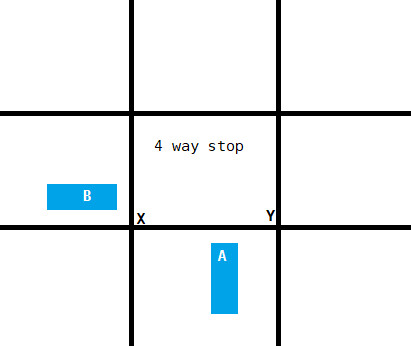
Driver A stops first at the 4 way stop, but there are pedestrians crossing in front of him (i.e they are crossing from X to Y). Just as the pedestrians finish crossing, Driver B arrives and stops, hasn't entered the intersection yet, who has the right of way? Thanks for your help.
- Log in to post comments
Thanks so much. I'm assuming it would be the same if Car A turns right and Car B wants to go straight as well. Is that correct?
- Log in to post comments
Yes. If Car A stopped first, Car A should proceed first, provided it is safe to do so. The direction each vehicle intends to travel does not change the order when one vehicle has clearly stopped first. If two vehicles arrive at about the same time, however, turning direction can matter.
- Log in to post comments
My wife failed test exam, unfortunatelly examiner was unfair.
Her car was first @3 stops way. She avoided accident using safe driving according to rules and law.
Action: Made full stop at stop sign, made sure it’s safe to move out, pulled out slowly and found another car approaching aggressively. Had to stop to make sure another car stopped (after the sign already) to avoid an accident.
Examiner response comes into contradiction with rules and common sense. She said that my wife should go ahead without stopping; it’s your right of way.
From the BC’s safe driving guide: “Make full stops at stop signs, and make sure you stop in the correct position. When it’s safe to move out, pull out slowly, scanning the intersection”
From the BC’s safe driving guide: “If there is any doubt about who has the right of way, or if there is any chance of a crash, it’s always better to yield the right of way to the other person”
Experience: Some drivers just do not see stop sign and ignore it. Safety first!
- Log in to post comments
Causes of Complications