
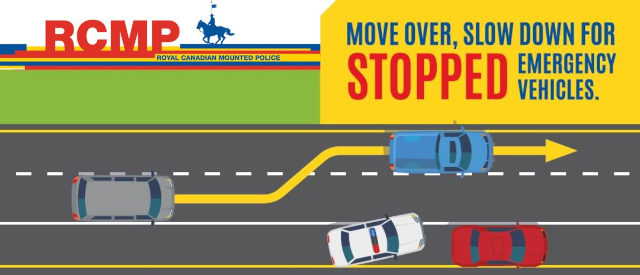
British Columbia's Slow Down, Move Over law is designed to protect emergency responders, tow operators, road maintenance workers and others working beside our highways. Drivers are required to reduce speed and, where it is safe to do so, move into a lane farther away from the stopped vehicle displaying flashing lights.
Many drivers assume that once they have complied with the Slow Down, Move Over law, they have done everything the law requires. A recent BC Supreme Court decision in Stene v. Roberts shows that while complying with the Slow Down, Move Over law is essential, every driver must still exercise reasonable care. The court also confirmed that simply because a collision occurs while obeying the law does not automatically make the following driver negligent.
What Happened?
The collision occurred on Highway 17 in Surrey near the Port Mann Bridge, where a tow truck was stopped on the westbound shoulder displaying flashing amber lights. The lights were visible to approaching drivers for at least one kilometre.
Mr. Roberts moved into the left lane well before reaching the tow truck and reduced his speed to 70 km/h in accordance with the Slow Down, Move Over requirements.
Mr. Stene was travelling ahead in the right lane. Rather than changing lanes early, he continued toward the tow truck, slowing as he approached. When he was only about 100 to 150 feet from the tow truck, he moved into the left lane and slowed even further.
Mr. Roberts immediately applied his brakes but did not have enough distance to avoid striking the rear of Mr. Stene's vehicle.
Why Mr. Roberts Was Not Found Negligent
The lawsuit alleged that Mr. Roberts had failed to keep a proper lookout, was travelling too fast for the circumstances and failed to drive with reasonable care.
Justice Tucker examined several important questions:
- Did driving 70 km/h comply with the law and remain reasonable in the circumstances?
- Should Mr. Roberts have anticipated that another driver would make a last-minute lane change?
- Did he react appropriately once the hazard became apparent?
The Court's Decision
The court found that Mr. Roberts had complied with the Slow Down, Move Over law by reducing his speed and moving into the left lane well before reaching the tow truck.
Justice Tucker also concluded that there was nothing about the circumstances that should have alerted Mr. Roberts to expect another vehicle to make a sudden lane change immediately before reaching the tow truck.
"There was nothing in the circumstances to alert Mr. Roberts that a vehicle would or even might suddenly pull into the left lane on short notice."
Justice Tucker found that Mr. Stene's late lane change created the hazard that led to the collision. Because the lane change had not been completed safely, Mr. Stene never became the dominant vehicle in the left lane and instead entered it as a hazard to traffic already established there.
The court further held that travelling at 70 km/h while passing the tow truck was not excessive in the circumstances. Although reducing speed even further would also have been reasonable, the judge concluded that it was not negligent to continue at the required speed limit.
"Mr. Roberts did not breach his common law standard of care by driving at 70 kilometres per hour."
Once Mr. Roberts saw the Mercedes enter his lane, he reacted immediately by braking. The court found that he had exercised due care and attention, but there was simply insufficient distance remaining to avoid the collision.
Ultimately, Justice Tucker concluded that the collision resulted from Mr. Stene's unsafe lane change immediately before reaching the tow truck rather than any negligence on Mr. Roberts' part. The claim against Mr. Roberts was dismissed.
What Drivers Can Learn
This decision does not suggest that slowing to the posted requirement will always be enough. Every roadside incident is different, and prudent drivers often slow further when traffic, weather or visibility make that the safer choice. The court simply concluded that, in these particular circumstances, travelling at 70 km/h was reasonable.
Instead, the case reinforces several important driving principles:
- Move over as early as it is safe to do so.
- Reduce speed smoothly rather than braking abruptly at the last moment.
- Leave extra following distance because other drivers may react differently.
- Avoid making last-second lane changes near emergency or roadside service vehicles.
- Remember that complying with the Slow Down, Move Over law is only one part of your overall duty to drive with reasonable care.
Good planning is one of the best ways to avoid collisions around roadside incidents. Drivers who recognize the hazard early, change lanes when safe, and make gradual speed adjustments give everyone around them more time to react safely.
One of the safest habits when approaching flashing lights is to begin planning well in advance. Early lane changes and gradual speed reductions are easier for surrounding drivers to anticipate than sudden braking or last-minute manoeuvres near the roadside vehicle.
Learn More
- Log in to post comments