
Right-hand-drive (RHD) vehicles are legal in British Columbia, but driving one presents some differences that are worth understanding when most of the traffic around you is travelling on the right side of the road.
RHD vehicles are generally built for markets where traffic travels on the left side of the road. In those countries, placing the driver on the right side of the vehicle puts the driver closer to the centre of the road. Japan and the United Kingdom are examples of countries where RHD vehicles are the normal configuration.
British Columbia is different. We drive on the right, and vehicles normally have the driver on the left. When an RHD vehicle is imported from a left-driving country, its steering wheel and driver controls remain on the right.
That difference has prompted questions about the safety of RHD vehicles.

Why are right-hand-drive vehicles allowed in B.C.?
There are two separate questions when a vehicle is imported: Can it be imported into Canada, and can it be registered in B.C.?
Transport Canada generally allows vehicles that are at least 15 years old, based on their month and year of manufacture, to be imported without having to meet the Canadian Motor Vehicle Safety Standards that apply to newer vehicles. This is an age-based import provision, not a special exemption for right-hand-drive vehicles.
Transport Canada explains the requirements for importing older vehicles into Canada.
Importing a vehicle does not automatically make it eligible for registration. In B.C., most imported vehicles must pass a provincial safety inspection before they can be registered.
ICBC provides information about importing a vehicle into British Columbia.
So, being right-hand-drive does not by itself make a vehicle illegal in B.C.
Does the driver's position matter?
It can.
The important issue isn't simply which side the steering wheel is on. It is how the driver's position affects visibility and vehicle positioning when the vehicle is being driven on roads where traffic keeps right.
Consider passing on a two-lane highway.
In a conventional left-hand-drive vehicle, the driver is close to the centre line and can usually see past the vehicle ahead more easily before moving into the opposing lane.
In an RHD vehicle, the driver is farther from the centre line. A vehicle immediately ahead can block more of the driver's view of approaching traffic.
That doesn't make passing impossible. It means the driver needs to compensate by leaving enough following distance to obtain an adequate view before beginning the manoeuvre.
Similar considerations can apply to left turns, lane changes and other situations where the driver's position affects visibility.
What does the research say?
There is one particularly important piece of B.C. research.
In 2007, researchers examined the safety of older RHD vehicles in British Columbia using ICBC data. They used three different methods to compare RHD and left-hand-drive (LHD) vehicles.
All three produced the same general finding: the RHD vehicles studied had a significantly higher risk of at-fault crash involvement than comparable LHD vehicles. The researchers reported an increase of more than 40 percent.
Read the published research on the safety of right-hand-drive vehicles in British Columbia.
The study also examined crash severity and found no statistically significant difference between the RHD and LHD groups.
That distinction is important. The study found increased crash involvement in the population studied. It did not establish that RHD vehicles are inherently unsafe or that crashes involving them are more severe.
But the research is old
The study examined vehicles and insurance records from the early 2000s. It is now almost 20 years old.
I have not found a subsequent B.C. study that provides a comparable, current measurement of crash risk for today's RHD fleet.
The 2007 finding is therefore useful evidence, but it should not be presented as a current percentage for every RHD vehicle on B.C. roads. The vehicles studied were also predominantly older imports, and different RHD vehicles can have very different visibility, dimensions and driving characteristics.
If you drive an RHD vehicle
The practical lesson is to understand where the driver's position changes your view and compensate for it.
Take extra care when passing. Leave enough following distance to see well beyond the vehicle ahead before deciding whether a pass is safe. If you cannot see far enough ahead, wait.
Be deliberate about lane changes. Set your mirrors carefully and develop a consistent shoulder-checking routine. Don't assume that mirror adjustments that worked in an LHD vehicle will provide the same view in an RHD vehicle.
Pay attention to left turns. The driver is farther from the centre of the roadway, so make sure you have a clear view of approaching traffic before committing to the turn.
And remember that experience does not eliminate the physical difference. Becoming accustomed to an RHD vehicle does not move the driver closer to the centre line or provide a better view past a vehicle ahead.
So, are RHD vehicles safe?
There isn't a simple yes-or-no answer.
An RHD vehicle that has been properly imported, inspected, registered and maintained can be legally driven on B.C. roads. At the same time, the available B.C. research found greater at-fault crash involvement among the RHD vehicles it studied, although it found no evidence of increased crash severity.
The useful conclusion for a driver is that the position of the driver creates some visibility and vehicle-positioning challenges that are different from those experienced in a conventional LHD vehicle.
If you drive one, understand those differences and compensate for them. If you're considering importing one, check both the federal import requirements and B.C. registration and inspection requirements before you buy.
- Log in to post comments
Comments
I live in NS but have a friend who is attempting to get a RHD Toyota safetied in BC.
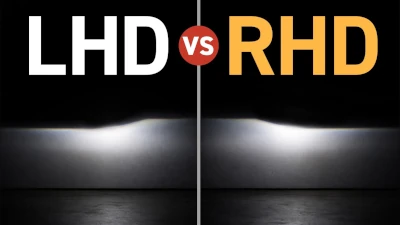
The garage proprietor advised him that he will have to order a LHD lighting system to be suitable. This sounds like complete BS to me as i'm all but certain there should be enough adjustability in the factory set up regardless of which configuration it was originally built.
Has anyone else had an experience with this.
- Log in to post comments
If you think about it for a moment, there is good reason for this.
Sit in the driver's seat of your North American vehicle. Where is the light aimed by the lenses of your headlights? Across in front of you and up to the right to illuminate the right side of the road and to keep the light out of the eyes of drivers to your left.
Now, put your RHD vehicle on the "wrong" side of the road and where does the light from the headlights go? Across in the front of you and out to the left, right into the eyes of oncoming traffic.
Having to replace the lenses to suit the environment of LHD just stands to reason, doesn't it?
- Log in to post comments
Like others, I have heard that RHD vehicles have been known to be involved in more collisions in BC, proportionately, to LHD vehicles.
We've now heard that, "ICBC lies", "ICBC has included all claims stats, not just collisions"..... etc.
We haven't heard supporting references to those contentions.
Statistics have always been suspect.
The statement attributed to 19th Century British Prime Minister, Benjamin Disraeli:
"There are three kinds of lies: lies, damned lies, and statistics"
Statistic can be interesting, logical, misleading sometimes even funny. So yes we should always be caucious.
Did you know that statistically, worldwide, fewer babies are born in February than any other month ?
If one foot is frozen in a block of ice and the other in boiling water, on average (statistically) you are comfortable.
However sometimes statistics indicate something is wrong and when that something involves a motor vehicle collision, that could injure a loved one, we need to pay attention.
As I understand it, the reason there are so many imported RHD vehicles coming from Japan is because Japan has very stringent rules on aging vehicles, and their obsolete becomes our economic.
The analysis of statistics is a very intricate and exacting science. For a multibillion dollar insurance company it would seen strange in the extreme that a basic element of including non-collision claims in statistics showing the frequency of collisions involved a certain class of vehicle, very strange indeed.
Surely for auto makers, it must be very costly to build vehicles that are controlled from two different sides of their product. If, as some say, there is no decrease in safety when a RHD vehicle is operated in a LHD vehicle world we would expect auto makers pushing for one design.
I seriously think there is a reason why LHD vehicles are designed to be operated on the right side of the road and visa versa.
Why our politician haven't included one simple stipulation that all vehicle operated in BC must be LHD, with the exception of specially licensed vehicles for specific purposes is beyond me.
By the way, if you crash your RHD vehicle and it's a total loss, ICBC will not sell it as "rebuildable", no matter how salvageable, it will be designated "irreparable".
Oh,,, and the fewer babies in February ? It's the shortest month, fewer days to give birth, logical.
- Log in to post comments
Info on equipping a RHD vehicle for BC