
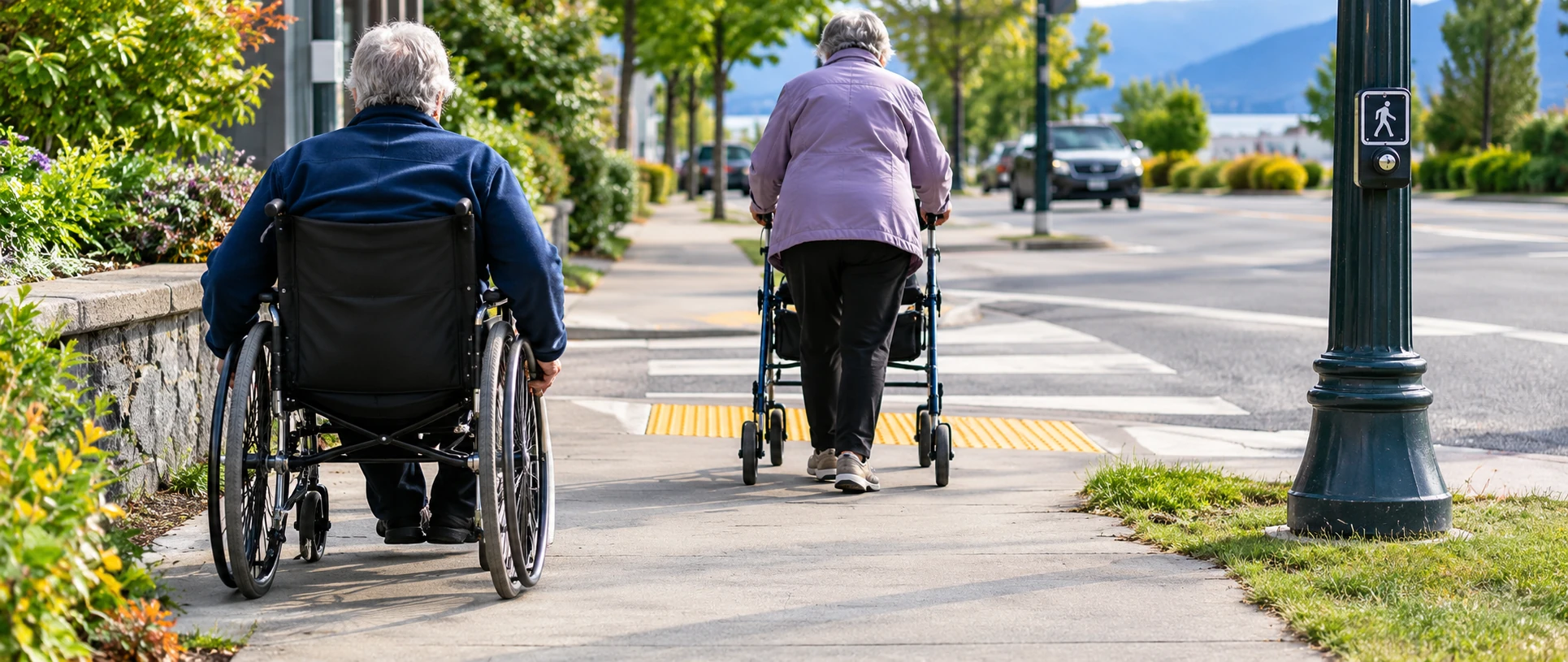
A sidewalk may be present, but that does not necessarily mean everyone can use it easily or safely. Uneven pavement, loose gravel, narrow passages, poles, overgrown vegetation and difficult road crossings can make an ordinary walk challenging for someone using a walker, wheelchair, cane or mobility scooter.
A pedestrian accessibility audit is a systematic way to examine a walking route, identify problems and document how they affect people using it. You do not need to be an engineer or accessibility specialist to make useful observations. The important things are to look carefully, record what you find and report concerns to the authority responsible for the location.
A walk audit can examine a single sidewalk, an intersection or an entire route between destinations. It can also help a neighbourhood group identify recurring problems that may be less obvious when each location is considered separately.
Choose a Route to Examine
Start with a route people need or want to use. It might connect a residential area with a grocery store, medical office, community centre, bus stop or park. You could also examine the route between an assisted living facility and nearby services.
Consider the needs of different pedestrians. A route that works for someone who walks without assistance may present significant difficulties for someone using a walker or wheelchair. A person with limited vision may have different concerns from someone with limited mobility or a hearing impairment.
Where possible, invite people with different mobility and accessibility needs to contribute their observations. They may identify barriers that other people would overlook. Nobody should feel obliged to attempt a route or crossing that they consider unsafe.
For a structured approach, the AARP Walk Audit Tool Kit worksheets provide printable and fillable forms for examining sidewalks, streets, crossings, public transit access and other features. You can choose the worksheets that suit your route rather than completing the entire collection.
What Should You Look For?
Walking surfaces
Examine the condition of the surface and whether it provides a continuous, usable route. Look for:
- Cracked, broken, uneven or deteriorated pavement.
- Potholes, raised edges and abrupt changes in level.
- Loose gravel, sand, mud or other material that makes movement difficult.
- Standing water, slippery surfaces or drainage problems.
- Missing sections of sidewalk or places where pedestrians must walk on a road shoulder.
- Snow, ice, leaves or other seasonal conditions that restrict access.
Consider how each condition affects different users. A small crack may be an inconvenience to one person but a significant obstacle to someone using a wheelchair, walker or cane. Loose gravel may make it difficult to maintain balance or push a mobility aid.
Record the location and extent of the problem. Avoid assuming that every irregularity requires the same remedy; the responsible authority can assess the appropriate response.
Obstructions and available space
Look for objects that block or narrow the usable walking area. These may include utility poles, signposts, newspaper boxes, waste bins, vegetation, parked vehicles, construction equipment or temporary barriers.
Ask yourself:
- Can a person using a wheelchair or walker pass without difficulty?
- Is there enough room to get around an obstruction without entering the roadway?
- Does an object block the view of approaching traffic or make a crossing difficult to reach?
- Could a person with limited vision walk into an obstacle that is difficult to detect with a cane?
- Does construction or maintenance work provide a safe, accessible alternative route?
Record whether the obstruction is temporary or appears to be permanent. If a temporary obstruction forces pedestrians into traffic or creates another immediate danger, report it promptly rather than waiting until the entire audit is complete.
Intersections and road crossings
Crossings can be particularly challenging for people with mobility, vision or hearing limitations. Examine the approach to each crossing as well as the crossing itself.
- Are curb ramps or other accessible transitions provided where needed?
- Are the transitions usable, or are they obstructed, damaged or too uneven to negotiate comfortably?
- Can pedestrians see approaching traffic, and can drivers see pedestrians waiting to cross?
- Do parked vehicles, vegetation or street furniture obstruct sightlines?
- Are pedestrian signals present where expected, and can their indications be understood?
- At signalized crossings, does the available crossing time appear sufficient for people who walk slowly?
- Are turning vehicles or the layout of the intersection likely to create difficulties for pedestrians?
Record what you observe rather than declaring that a crossing meets or violates a particular standard. Signal timing, crossing design and other technical questions may require assessment by the road authority.
Accessibility, comfort and continuity
A route may be usable in one place but difficult or impossible to complete because of a barrier farther along. Consider the whole journey, not just individual sections of sidewalk.
Look for gaps between sidewalks, abrupt changes in surface, difficult transitions between public and private property, and places where pedestrians must take a detour. Note whether accessible routes to bus stops and public destinations are available.
Other features may affect whether people can comfortably use a route, including lighting, places to rest, shelter and the condition of paths through parks or other public spaces. These may not present an immediate hazard, but they can still influence whether a person can make the journey independently.
The Public Health Agency of Canada's Age-Friendly Communities: Canada guide includes a checklist of features associated with pedestrian-friendly communities. It provides a broader perspective on accessible sidewalks, crossings and public spaces.
Document What You Find
Clear documentation helps the responsible authority understand the problem and decide what action may be appropriate. A vague report that a sidewalk is unsafe is less useful than a report identifying the location, the specific condition and its effect on pedestrians.
For each concern, record:
- Location: Give the street address, nearest intersection, side of the street or another clear description. A map pin can help.
- Problem: Describe the condition or obstruction and, where practical, its approximate size or extent.
- Effect: Explain how it affects people walking, using mobility aids or navigating the area with limited vision or hearing.
- Date and conditions: Note when you observed the problem and whether weather, lighting or construction affected it.
- Photographs: Take an overview showing the location and a closer image showing the problem, if you can do so safely.
Photographs can make a report easier to understand, but do not put yourself or anyone else at risk to obtain them. Avoid standing in traffic, blocking a sidewalk or crossing unsafely to take a picture. Where possible, avoid including identifiable people in photographs.
Describe what you observed rather than guessing at the cause or prescribing a technical solution. For example, explain that loose gravel makes it difficult to push a walker along a section of sidewalk, rather than assuming that a particular construction method is required to correct it.
If you are examining a longer route, keep a simple list of findings and mark their locations on a map. Grouping observations by street or intersection can make the results easier to review and report.
Decide How Urgently to Report a Problem
Not every accessibility concern requires the same response. These practical categories can help you decide how to proceed; they are not official hazard classifications.
- Potentially immediate danger: A collapsed section of sidewalk, an obstruction that forces pedestrians into moving traffic, or another condition that appears to create an immediate risk. Report it promptly to the responsible authority. If there is an immediate threat to life or safety, contact emergency services as appropriate.
- A significant accessibility barrier: A blocked route, unusable curb ramp or missing connection that prevents some pedestrians from reaching a destination independently. Report the location and explain who is affected.
- Maintenance or improvement concern: Deteriorating pavement, loose gravel, inadequate lighting or a lack of resting places. These problems may not require an emergency response, but they can still make a route difficult or inaccessible.
If you are uncertain about the urgency, explain the condition and its consequences when making your report. The authority responsible for the location can assess the issue and determine the appropriate response.
Report the Findings to the Right Authority
Responsibility depends on where the problem is located. A municipality, the provincial government, a park operator or another organization may be responsible for maintaining the route.
- Municipal streets and sidewalks: Report individual maintenance problems to the municipality's public works, engineering or operations department. For persistent or widespread accessibility barriers, or concerns that may require policy changes or additional funding, consider writing to the mayor and council. Include specific locations and explain how the conditions affect pedestrians.
- Provincial highways: For maintenance concerns on provincial highways, consult the BC highway maintenance contractor contacts.
- Parks, trails and other public spaces: Contact the organization that manages the property. Responsibility for a path or trail may differ from responsibility for the adjacent street.
- Uncertain responsibility: Start with the municipality or property manager and ask who is responsible if the issue falls outside its jurisdiction.
Include the location, a clear description, the effect on pedestrians, photographs if available, and any relevant date or conditions. For multiple findings, provide a map or numbered list so the authority can identify each location.
Keep a copy of your report and any reference number you receive. If the issue remains unresolved, follow up using that reference and ask whether the concern has been assessed or referred to another authority.
Reporting a problem does not guarantee an immediate repair. The authority may need to inspect the location, determine responsibility, assess the risk and consider available resources. A clear, well-documented report gives it a useful starting point.
What Happens After the Audit?
An audit does not have to be a large community project. One person can document a single problem, while neighbours or community organizations can combine observations to identify barriers along a frequently used route.
When several people contribute, their different experiences can help build a more complete picture. A route that seems straightforward to one pedestrian may present significant difficulties for someone using a walker, a wheelchair or a cane.
The purpose is not to conduct a formal accessibility inspection or determine whether a legal standard has been breached. It is to identify practical barriers, explain their effects and bring them to the attention of the people responsible for the route.
A systematic audit can turn a general concern about walking conditions into specific, actionable information. That is a useful first step toward making everyday journeys more accessible for everyone.
Learn More
- Log in to post comments