
Why would police tell the public where speed enforcement is taking place? Doesn't that defeat the purpose of catching drivers who are speeding? It is a reasonable question, particularly when motorists slow down as they approach a reported radar location and then accelerate again once they have passed it.
The answer has more to do with changing driver behaviour than with catching individual speeders. Police enforcement has two purposes: dealing with drivers who break the law and encouraging everyone else to obey it.
Two Purposes of Speed Enforcement
When a police officer stops a driver for speeding and issues a violation ticket, the immediate objective is to deal with that particular offence. This is specific deterrence. The driver receives a consequence intended to discourage a repeat offence.
There is another objective that reaches much further. General deterrence is intended to influence the behaviour of drivers who may never be stopped by police. If motorists believe that speeding is likely to result in a traffic stop and a ticket, they may decide that exceeding the speed limit is not worth the risk.
Publicising speed enforcement helps create that expectation. The intention is not necessarily to catch everyone who is speeding at a particular location. It is to encourage more drivers to obey the speed limit, including those who never see a police officer.
Does Publicising Enforcement Work?
There is research supporting the idea that publicising enforcement can improve road safety.
The U.S. National Highway Traffic Safety Administration describes high-visibility enforcement as a combination of targeted police enforcement and public communication. Enforcement is directed toward locations with a demonstrated speeding or collision problem, while publicity increases the likelihood that drivers will know about the enforcement and adjust their behaviour.
In a 2022 study published in the Journal of Public Economics, researchers examined announced one-day speed monitoring operations in Germany. The operations were accompanied by publicity campaigns. Traffic crashes and casualties decreased by approximately 8% while the operations were underway. Unfortunately, the improvement did not continue after enforcement ended.
This is an important distinction. Publicity combined with actual enforcement can influence driver behaviour, but the effect depends on maintaining a credible possibility of being caught.
A 2026 study published in the Journal of Experimental Criminology examined the effect of speed enforcement alerts from navigation applications such as Waze. Researchers measured the speeds of 9,052 vehicles at 33 locations in Queensland, Australia. Following the appearance of an enforcement alert, average speeds at those locations decreased by approximately 5.2 km/h.
This study demonstrates that crowdsourced enforcement warnings can produce an immediate reduction in vehicle speeds at the reported location. It did not measure how drivers behaved after passing that location, so it cannot establish whether they maintained the lower speeds or accelerated again. The researchers do, however, discuss the potential for drivers to use enforcement alerts to avoid detection rather than comply consistently with speed limits.
Why Not Keep Enforcement Locations Secret?
It might seem that police would catch more speeders if enforcement locations were kept secret. That may be true in some circumstances, but catching the greatest possible number of drivers is not the only measure of successful traffic enforcement.
Consider the difference between a driver who travels at the speed limit because they know police might be watching and one who only slows down when a police vehicle becomes visible. The first driver is demonstrating the behaviour enforcement is intended to encourage. The second is simply avoiding detection.
There is also a practical limitation. Police cannot be everywhere at once. Making enforcement visible and publicising traffic safety initiatives allows a relatively small number of officers to influence the behaviour of a much larger number of motorists.
What I Learned From Traffic Enforcement
When I was very junior in my service, I shared the opinion that publicising radar locations defeated the purpose of speed enforcement. After 25 years of police service, including 20 years of traffic enforcement, I came to a different conclusion.
Some drivers will look at their speedometers wherever they are and slow down if they are exceeding the limit. Others will only slow down when they approach a reported police location. Still others will continue speeding regardless of how much enforcement or publicity they encounter. They are the drivers who seem to be asking police to stop them.
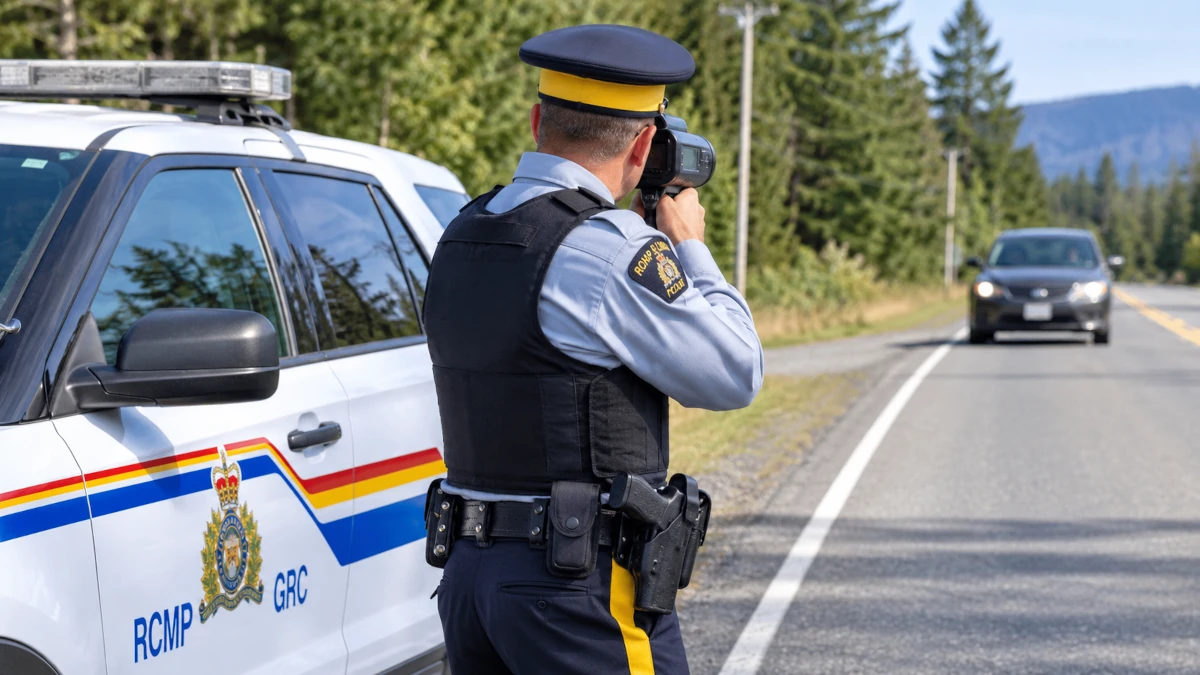
I once approached speed enforcement from a different direction. I parked my fully marked police vehicle at the side of the road and used the vehicle as cover while measuring speeds with laser. I was able to issue almost as many tickets using this highly visible method as I had using more subtle techniques.
It was a useful reminder that visibility does not necessarily prevent effective enforcement. Some drivers will respond to the warning, while others will ignore it and provide an opportunity for enforcement action.
What About Motorist Reports?
There is a difference between police publicising an enforcement campaign and motorists reporting the location of an individual police vehicle.
Radio traffic reports may include information supplied by motorists or other sources about the presence of police speed enforcement. Navigation applications also allow users to report enforcement locations in real time.
These reports can alert other drivers to the presence of police, potentially allowing them to avoid a speeding ticket. However, the important distinction remains between temporarily slowing down to avoid detection and choosing to obey the speed limit throughout a journey.
From a road safety perspective, the important question is not whether a driver knows where a police officer is sitting. It is whether that driver chooses to obey the speed limit throughout the journey.
The Objective Is Safer Driving
Traffic enforcement is not a contest to see how many tickets an officer can write. The ultimate objective is voluntary compliance with traffic laws and a reduction in collisions and injuries.
Publicising speed enforcement may give some drivers an opportunity to avoid being caught at a particular location. It may also persuade others to reconsider their speed and drive within the law.
I would rather have drivers slow down because they know police might be watching than continue speeding simply because they believe they can get away with it. If publicising enforcement helps accomplish that, it has served a useful purpose.
Learn More
- Log in to post comments