
 Speeds considered excessive by residents are considered reasonable by these same persons when they are driving in another neighborhood. This observation is taken from a publication titled Speed Control in Residential Areas by the Institute of Transportation Engineers (ITE). It goes on to say that residents’ complaints are usually accompanied by a proposed solution to the speeding problem...stop signs.
Playing the Guilt Card to Town Council
My curiosity on the subject was piqued by a site visitor who drew my attention to a newspaper story describing exactly this situation in their village. One resident even played the ace by saying "My problem lies in the fact that one day, in the no so distant future, a vehicle may strike and kill a pedestrian, child, pet or what have you," However, like the ITE, two of the village counsellors knew that using stop signs in this situation could actually make the problem worse.
Stop Signs Can Make a Speeding Problem Worse
Contrary to what you might think, stop signs do not positively control speed. They are frequently violated and actually increase speeds between signs as drivers make up for time lost in stopping or only slowing down for the stop signs. This exacerbates the speeding problem and introduces the new problem of disobeying the stop sign. We're now worse off than before we tried to fix the problem by putting up the stop sign.
Use Traffic Calming Measures Instead
Traffic calming measures, installed as part of an area wide traffic management plan will be more successful. It will also prevent a shift of the problem from one street to another as drivers find new routes to avoid stopping. The three E's, Enforcement, Education and Engineering need to be joined by Community Involvement to produce success. Perhaps the residents would be better served by creating their own Living Streets program.
Learn More
Share This Article
- Log in to post comments
Comments
I wanted to bring your traffic calming into question. Why? Because the City of Kelowna uses them but not on major routes mainly because of the public blowback they would rightfully receive.
Here is a photo, provided by the City of Kelowna, regarding traffic calming on Lakeshore Drive. I use Lakeshore in the exact area where they plan to install traffic calming.
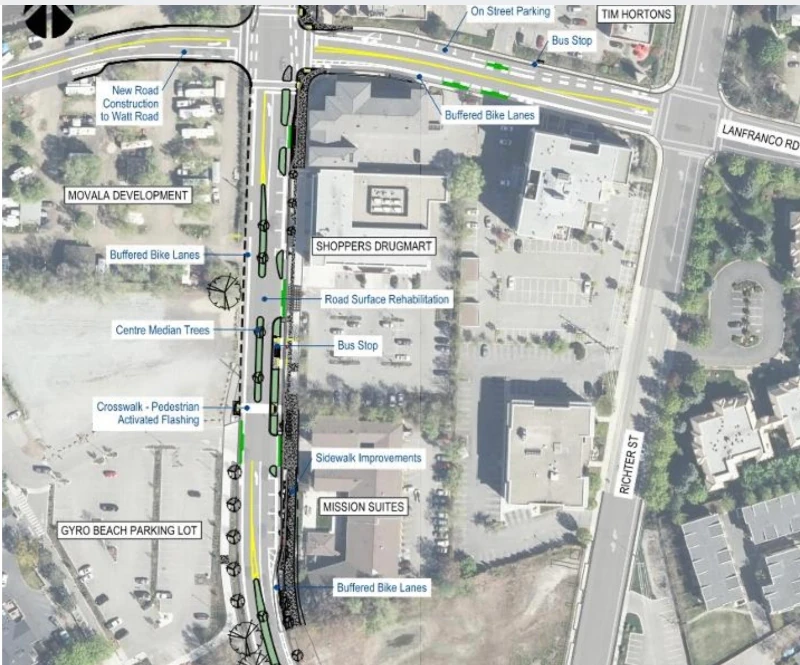
The problem is that area is not a speeding zone. Traffic moves about 40K from the corner of Richter to Lanfranco. I actually tested the speed going to Shoppers Drug Mart after the City indicated traffic calming. My top speed over that stretch was.. gulp… 38K. The next week it was 41K. The next day it was 39K. Hardly worthy of traffic calming in my opinion. The road was wall to wall traffic during those times, as it always is.
Are there areas where people drive above posted? Of course but using traffic calming on that stretch of Lakeshore is just plain stupid.
By the way Lakeshore always has very heavy traffic as it is one of the only 2 roads that lead from Mission area to Upper Mission. It also is the roadway to Kelowna General Hospital and Kelowna’s downtown.
I have never ever seen a speeder on that Street. Compounding the disaster that traffic calming would make is on that stretch is there is no area for motorists to move over to the right if an emergency vehicle, with lights flashing sirens wailing is coming up behind. They also couldn’t go around the traffic calmers as there is no way to do that.
- Log in to post comments
Yes, stop sign placement should always (ideally) be based on traffic engineering warrants, not on political responses to public pressure.
What makes more sense is to holistically examine roadway design, and to update the design to a chosen design speed. If it's a downtown area with cars, pedestrians, and cyclists, you might want a design speed of 30 km/h. This would result in the minimum carriageway width of 6 metres (the Building Code minimum for fire lanes based on National Fire Protection Association guidelines), tighter radii on corners (to force slower turns), and strategically placed on-street parking, trees and street furniture placed to shorten sight lines, etc., to naturally manage motorist speed. If we get it right, speed enforcement will virtually never be needed. But no speed bumps; a properly designed street (or parking lot) should never need one.
The essential point is that every road has a design speed, whether it's deliberately chosen or not, and we should be working with normal human behaviour to achieve the outcomes we desire. If 5-10% of motorists are exceeding the speed limit, the solution is enforcement. If a more significant proportion is exceeding the speed limit, the solution is even more simple: the speed limit is too low, is unfair, and needs to be raised. The working assumption needs to be that a majority of motorists will drive at a reasonable speed - democracy in action. But if that results in unacceptably unsafe conditions for other road users, the roadway design speed needs to be reduced through engineering (and landscape design) interventions so that it matches the desired traffic speed.
- Log in to post comments
City of Kelowna Uses Stop Signs as Traffic Calming