
A green light gives you the right of way, but it does not remove your responsibility to watch for hazards. A decision of the Supreme Court of British Columbia illustrates how a driver can be held partly responsible for a collision even when a pedestrian crosses against a red light.
In Murdoch v. Biggers, 2012 BCSC 747, Carol Murdoch was struck by a vehicle while crossing Blanshard Street at Saanich Road in Victoria. The court found that Ms. Murdoch was primarily responsible for the collision, but that the driver, Jennifer Biggers, also shared responsibility because she failed to keep a proper lookout.
The Collision
The collision happened on September 25, 2008, at a busy intersection where southbound traffic on Blanshard Street enters Victoria. The weather was fair, visibility was good, and the road was dry.
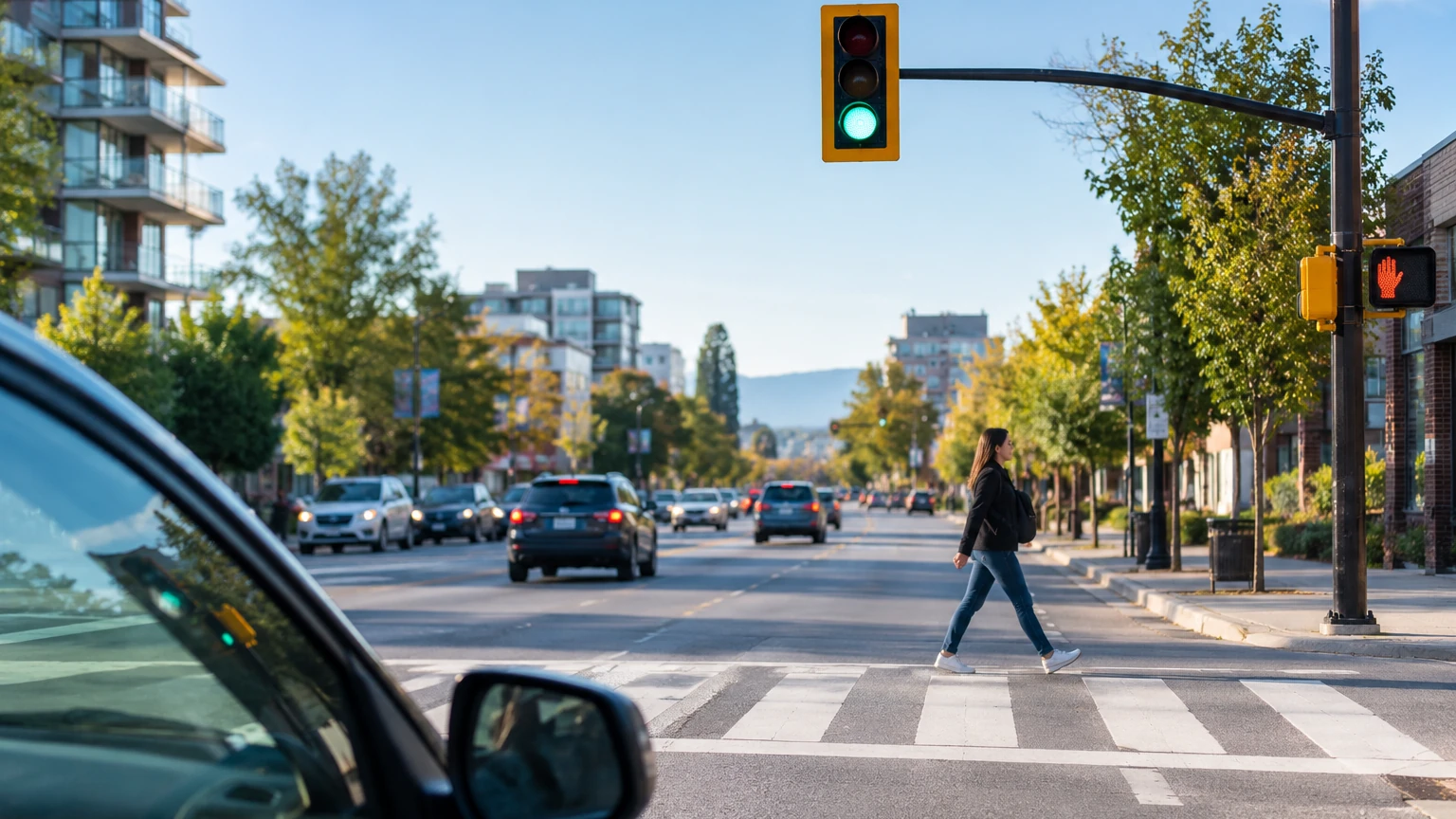
Ms. Murdoch was trying to catch a bus. She crossed Saanich Road to the southwest corner of the intersection, then ran across Blanshard Street toward the southeast corner. She entered the crosswalk from a triangular traffic island even though the traffic signals and pedestrian controls prohibited her from crossing.
Ms. Biggers was driving southbound in the easternmost of the three southbound lanes. She had stopped behind several vehicles at a red light. When the light turned green, she began moving forward.
Ms. Biggers first saw Ms. Murdoch running between moving vehicles to her right. She braked, but her vehicle struck the pedestrian. The events happened within a few seconds.
What the Judge Found
There was conflicting evidence about precisely how the collision occurred. Ms. Murdoch believed Ms. Biggers had stopped for her, while Ms. Biggers said her vehicle had not come to a complete stop before impact. The judge accepted that the two had made eye contact, but found that Ms. Biggers' vehicle was still in the process of stopping and was barely moving when the collision occurred.
The judge also found that Ms. Murdoch entered the crosswalk against the signals and that the first two lanes of traffic were able to stop for her. The evidence did not establish that the impact occurred outside the crosswalk, as some witnesses had suggested.
Madam Justice Power recognized that Ms. Biggers had a statutory right of way because she was proceeding on a green light. Ms. Murdoch, by contrast, had breached statutory duties by disobeying the traffic controls, the red light and the pedestrian controls.
However, having the right of way did not settle the question of the driver's responsibility. The judge had to consider whether Ms. Biggers had taken reasonable care in the circumstances.
The Importance of a Proper Lookout
The intersection was particularly busy and congested. The judge found that this called for special caution as Ms. Biggers approached the crosswalk, even though she had a green light.
Drivers in the two lanes to Ms. Biggers' right had been able to see Ms. Murdoch and stop for her. A driver behind Ms. Biggers also saw the pedestrian, and another witness noticed something happening in a rear-view mirror.
The judge concluded that Ms. Biggers had failed to keep a proper lookout. She had not noticed Ms. Murdoch entering the crosswalk or the vehicles in the adjacent lanes stopping for her. Had Ms. Biggers been keeping a sufficient lookout, the judge found, she would have been able to stop and avoid the collision.
The decision did not mean that a driver must automatically give way to a pedestrian who crosses against a signal. It turned on the circumstances at this particular intersection and the judge's finding that a proper lookout would have enabled the driver to avoid the collision.
How Responsibility Was Shared
The judge described Ms. Murdoch's decision to enter the crosswalk against the signals in heavy traffic as very reckless. Her conduct created a significant risk of harm and contributed substantially to the collision.
In comparison, the driver's negligence was her failure to keep a better lookout in circumstances where she had the right of way.
The court apportioned responsibility for the collision as follows:
- Ms. Murdoch, the pedestrian: 75%
- Ms. Biggers, the driver: 25%
The decision demonstrates that a road user who causes a dangerous situation can bear most of the responsibility without necessarily bearing all of it.
You can read the full reasons for judgment in Murdoch v. Biggers, 2012 BCSC 747.
The Lesson for Drivers
A green light is not a reason to stop paying attention. As you approach and enter an intersection, continue watching for hazards and pay attention to what other road users are doing.
In particular, if vehicles in adjacent lanes stop when your light is green, do not assume they have stopped for no reason. They may be responding to a pedestrian or another hazard that you have not yet seen.
This case does not excuse pedestrians from obeying traffic signals, nor does it require drivers to anticipate every possible action by another road user. It shows that the right of way and the duty to take reasonable care can exist at the same time.
When the light turns green, look before you go.
Learn More
- Log in to post comments