
Vehicle lighting does more than help us see and be seen. The colours and positions of lamps and reflectors communicate information to other road users. Changing a bulb, lens or lighting assembly without considering the regulations can make a vehicle illegal to use on a highway in British Columbia.
Why Vehicle Lighting Colours Matter
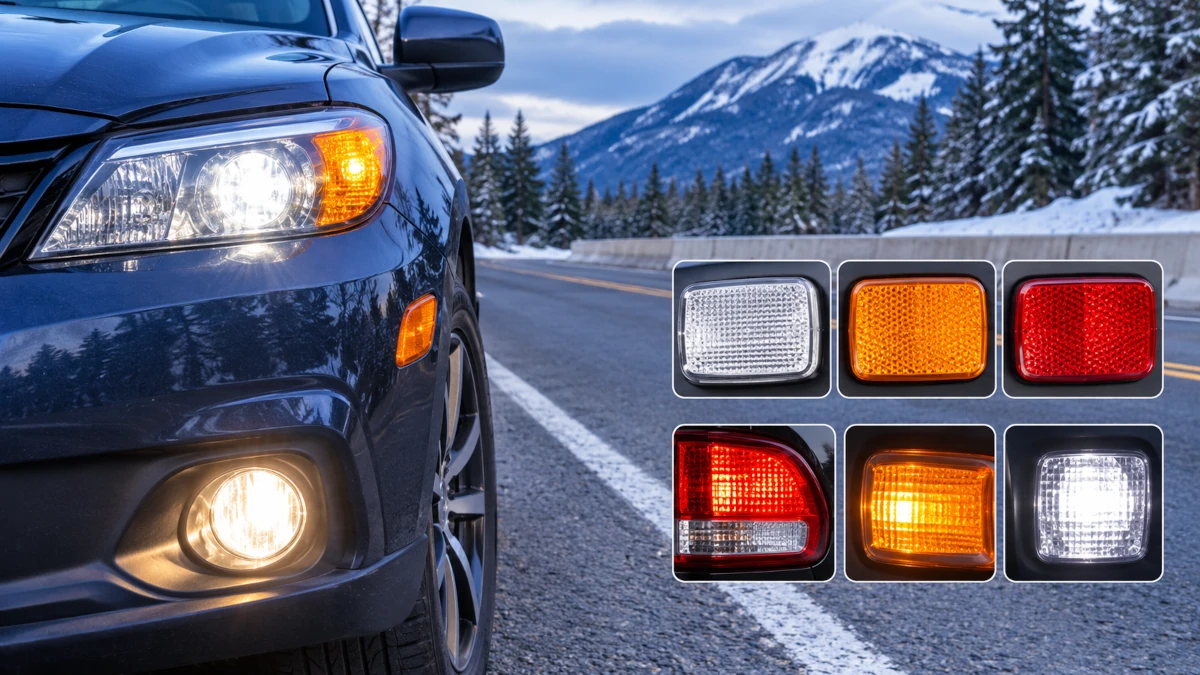
Standardized colours help drivers recognize the purpose of vehicle lights and understand what other vehicles are doing. White and amber lights are generally used at the front, while red lights identify the rear of a vehicle. Side lamps and reflectors help show a vehicle's position and orientation.
Permitted Colours for Vehicle Lamps
Division 4 of the Motor Vehicle Act Regulations (MVAR) specifies the lamps a vehicle may be equipped with, where they must be mounted and the colours they must display. The following table summarizes the common requirements:
| Lamp | Permitted colour |
|---|---|
| Headlamps | White |
| Auxiliary driving lamps | White |
| Front parking lamps | White or amber |
| Fog lamps | White or amber |
| Front turn signal lamps | White or amber |
| Rear turn signal lamps | Red or amber |
| Tail lamps | Red |
| Stop lamps | Red |
| Backup lamps | White |
| Licence plate lamps | White |
| Front side-marker lamps | White or amber |
| Rear side-marker lamps | Amber or red |
These are the common lamp types and colours, not an exhaustive list of every lighting requirement or exception in the regulations. Some lamps have additional requirements for their number, location, visibility and operation.
Reflector Colours
Reflectors are subject to their own colour and placement requirements. In general, amber reflectors may be mounted at the front or on the sides of a vehicle. Red reflectors may be mounted at the rear or on the sides toward the rear. Other colours are not permitted in these positions under the general requirements of MVAR 4.21.
Replacing an amber reflector with a green one, for example, does not comply with these requirements.
Changing Bulbs and Lenses
A lamp is a complete assembly, not just the bulb inside it. Its housing, lens, reflector and light source are designed to work together to produce the required colour, distribution and intensity of light.
Installing an LED replacement bulb designed to fit a socket originally intended for an incandescent bulb is not a legal highway-use conversion in British Columbia. The same applies to HID conversion bulbs or kits installed in a headlamp assembly that was not designed and approved for that light source.
LED and HID lighting can be legal when supplied as complete lamp assemblies designed and approved for that purpose. In those assemblies, the light source is part of the approved design; it is not a retrofit bulb intended to replace an incandescent or halogen bulb in an existing assembly.
This is not simply a question of whether the replacement bulb produces enough light or appears to fit. MVAR 4.02(2) requires a vehicle on a highway to be equipped with lamps equivalent to those provided by its original manufacturer under the applicable requirements of the federal Motor Vehicle Safety Act. Division 4 of the BC regulations establishes the provincial lighting requirements, including conformity with applicable federal standards such as Canada Motor Vehicle Safety Standard 108 (CMVSS 108). Replacing a light source with one for which the original lamp assembly was not designed can compromise that conformity.
Changing a lens or bulb can create a similar problem. A clear lens is not necessarily illegal by itself, but the completed lamp must still display the required colour and meet the applicable requirements. A red tail lamp, for example, must display red light; changing its lens and fitting a bulb that does not produce the required colour will not meet that requirement.
Decorative and Aftermarket Lighting
Adding lighting to a vehicle is not simply a matter of choosing a colour and finding somewhere to mount it. Under MVAR 4.02(1), a vehicle used on a highway may only be equipped with and use lamps, reflectors and other illuminating devices authorized by Division 4 or authorized in writing by the director.
This is why decorative lighting, including some neon and other aftermarket lighting, can create a legal problem. A lamp that is not authorized for highway use does not become legal simply because it is mounted underneath the vehicle or is intended to be decorative.
The regulations also specifically address off-road lamps. An off-road lamp is one designed for a use other than those specified in Division 4. Under MVAR 4.25, off-road lamps on a vehicle used on a highway must be concealed with opaque covers. This requirement applies whether the vehicle is being driven or parked on the highway.
Check Before You Buy
Aftermarket lighting is widely advertised, and a product being offered for sale does not necessarily mean it is legal to install and use on a vehicle driven on BC highways. Product descriptions and claims about brightness or compatibility are not a substitute for compliance with the regulations.
Pay attention to warnings on product packaging and in installation instructions. If the manufacturer or seller advises you to check with local authorities before installing or using the lighting, take that warning seriously. It may be an indication that the product is intended for off-road use or that its legality for highway use is uncertain. Don't assume that a product is legal simply because it is offered for sale.
Before spending your money, check with your local police or a qualified vehicle inspection facility if you are not certain that the equipment is legal. Ask specifically about the equipment you intend to install and how you intend to use it. It is better to find out before installation than to discover at the roadside that the lighting does not comply.
Learn More
- Coloured Lights Tell Us Something About Vehicles
- Unsafe Headlight Conversions
- What Are Off Road Lights?
- Vehicle Lighting Inspection and Approval Protocol (PDF, 2009) — An illustrated inspection guide prepared for the BC Ministry of Transportation.
- Log in to post comments