
Opening a vehicle door seems like a routine action, but it carries a legal responsibility. Section 203(1) of British Columbia's Motor Vehicle Act requires that you must not open a vehicle door into moving traffic unless it is reasonably safe to do so. A recent BC Supreme Court decision shows that this duty remains even when the approaching road user also shares responsibility for the collision.
The Collision
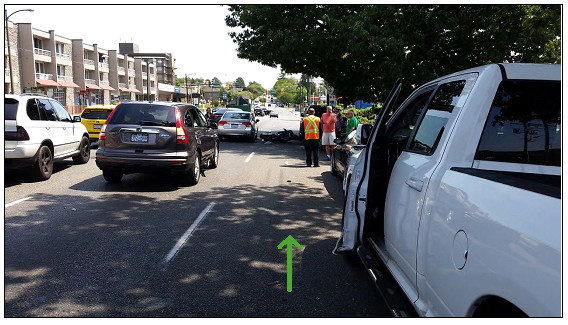
A contractor had parked his work truck along Southwest Marine Drive in Vancouver. After completing some paperwork in the cab, he prepared to get out. At the same time, a motorcyclist was riding through the gap between the parked vehicles and the adjacent lane of slow-moving traffic. As the driver's door swung open, the motorcycle struck it. The rider was thrown from the motorcycle and suffered significant injuries.
The court heard evidence that the truck driver claimed he had checked before opening the door. However, the judge found that the truck's mirrors had already been folded in, leading to the conclusion that the driver had not properly checked them before opening the door. The court concluded that the motorcycle should have been visible and audible before the door was opened.
The Law
"A person must not open the door of a motor vehicle on the side available to moving traffic unless and until it is reasonably safe to do so."
This requirement is found in section 203(1) of the Motor Vehicle Act. It applies whenever a door is opened into traffic, regardless of the type of vehicle that may be approaching.
Justice Branch found that the truck driver breached this duty:
"I find that Mr. Chan opened his car door when it was unsafe to do so, contrary to the duty imposed upon him by s. 203 of the Act."
The judge also referred to several earlier decisions confirming that failing to properly check mirrors before opening a vehicle door can make that action negligent.
The Rider Was Also Negligent
Although the truck driver was negligent, that was not the end of the case. The court found that the motorcyclist also failed to take reasonable care for his own safety. He chose to ride through the available gap between parked vehicles and adjacent traffic, travelled too quickly for the circumstances, and positioned his motorcycle closer to the parked vehicles instead of remaining near the centre of the available space.
Because both parties failed to exercise reasonable care, responsibility for the collision was divided equally. Each was found to be 50% at fault.
This is not the first BC court decision involving an open vehicle door and a collision. In Open Driver's Door Crash, the court reached a different conclusion after finding that the approaching driver could have avoided the collision.
The Lesson
This decision is an important reminder that opening a vehicle door is not a routine action that can be done without thought. Before releasing the latch, check your mirrors, shoulder check, and be alert for anyone approaching from behind. That includes not only cars, but motorcycles, cyclists, and other legitimate road users who may be travelling beside your vehicle. Never assume that because your vehicle is parked, nothing can be approaching from behind.
The importance of checking before opening a door is also discussed in our article Is It Safe to Open Your Door?
The fact that another road user may also have contributed to a collision does not excuse opening a door when it is unsafe to do so. Every person leaving a parked vehicle has an independent legal duty to ensure that opening the door can be done safely.
References
Related Articles
- Log in to post comments
Comments
1) I was under impression that motorcyclists are supposed to follow the "car size". If there is a little space left where they can squeeze because of the size, it doesn't mean they should be able to do so. Like they are not supposed to ride in the middle of two lanes of traffic or on the shoulder in the traffic jam (even though technically they can without hitting anybody).
So how is it different here? The stopped car occupied the lane and the motorcyclist simply should not be there.
2) Once I was in the situation when I was driving in the leftmost lane on Kingsway (3 lanes one way). There was a motorcycle driving right behind me. I wanted to change the lane into the middle lane, turned the right turn signal and started changing the lane.
I changed it about 50% or so when I realized that another car from the rightmost lane was also changing the lane right into me.
I decided to return to the left lane, I did that very fast to avoid the collision with the car so I did not turn the left turn signal or didn't even look in the left mirror or shoulder check. At the same time when I was halfway in the middle lane, the motorcyclist decided to pass me. Half lane was enough for him because of the size.
Was it another car, they'd have to wait until I fully vacate the lane as they wouldn't have enough space to pass, but motorcycle is smaller.
When I returned back to the left lane, the motorcyclist had to cross the double yellow line into the upcoming traffic lanes to avoid the collision with me (luckily it was empty). Then there was a small episode of a road rage, he was mad at me and I was mad at him.
Now reading this story makes me think, who would be at fault if there was a collision between me and that motorcycle?
- Log in to post comments
Both sections of the Motor Vehicle Act dealing with passing require that the pass be made in safety. Just because a space opens up does not mean that it is safe to occupy it.
ICBC calls it See, Think, Do: look around you and develop a picture of your current situation, think about what will happen if it changes in any way and finally do what you intend if it is safe.
Similarly, the sections regarding changing lanes include the same requirement for safety.
Finally, section 144 imposes an overall duty not to drive carelessly.
Too often road users assume an entitlement and run into trouble because of that assumption.
Liability is seldom 100% and you will see that as you read through the case law reported on this site.
- Log in to post comments
In 2015 Patricia Keenan was killed while riding her bicycle when the person in a car opened their door into her path. As far as I know there was never a ticket issued, there was a civil suit filed by her family on behalf of her 10-year-old son but I was not close enough to know how that came out.
I've filed three complaints about people who've close-passed me along a block where there is no cycling infrastructure, only parked cars on the side. I take the lane because it's the safest place to be yet people refuse to move fully into the other lane to pass me and then complain that I was disrespecting them because I wasn't tucked into the door zone of the parked cars. Bike lanes are built by the city in the door zone of car parking and some people in cars wonder why a person on a bike might not be riding right in the middle of the bike lane!
No one wants to die and no one wants to kill another person but the way we treat each other on the roads leads to that too often.
- Log in to post comments
The law has recently changed. Section 157.1 says that you have to leave 1 metre if 50k or under and 1.5 metres if over 50k. Now that applies to people in motor vehicles but should not the reverse also apply?
If a person is riding a bicycle, motorcycle or those electric skateboard things should they not be required to leave the same distance between themselves and a person in a motor vehicle? This would effectively stop the lane splitting that operators of those type of vehicles feel it is safe to do so.
If not I assume to be in compliance of the law a driver of a motor vehicle should immediately stop moving till after the cycle item has past?
- Log in to post comments
A motorcycle is a motor vehicle and a cyclist has the same rights and duties as the driver of a motor vehicle. Both have to allow the passing distances mandated by section 157.1.
Pedestrians are defined as:
(b) a person who is in or on a device that
(i) is only capable of being propelled by human power, and
(ii) is, or is similar to, a wheelchair, a stroller, a skateboard, a kick scooter, roller skates, in-line roller skates, skis or a sleigh;
(c) a person who is in or on a designated personal mobility device that is prescribed for the purposes of this definition;
There is no requirement for pedestrians to leave the gap when passing a vulnerable road user.
- Log in to post comments
Motorcycles