
A DriveSmartBC reader asked what rules apply when a vehicle is towed from a business parking lot. The question involved a large commercial lot serving several businesses and a vehicle that was towed shortly after it was parked.
There are two questions: could the property occupier have the vehicle towed? And, if so, what rules apply to the towing and storage charges?
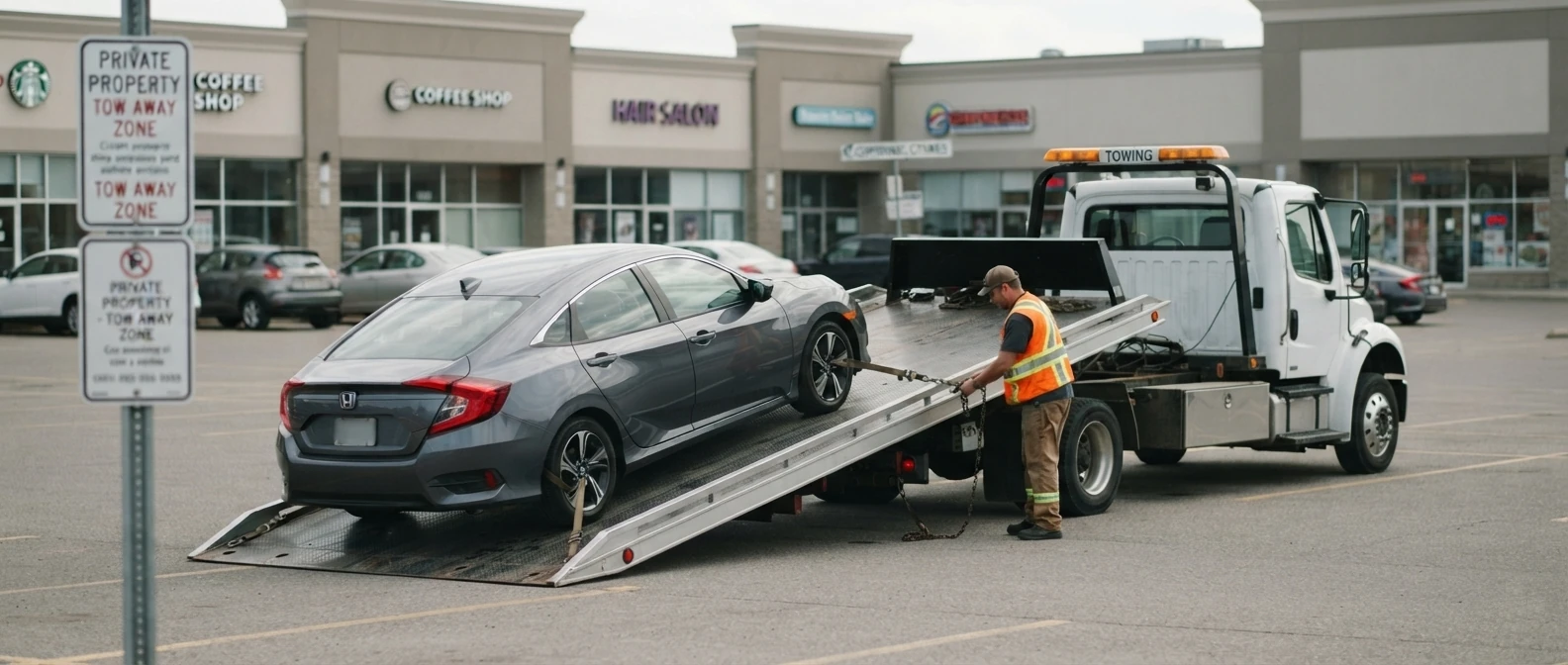
Can a vehicle be towed from private property?
Yes. Section 192 of the Motor Vehicle Act addresses vehicles left without the occupier's consent on private property.
In a municipality, on treaty lands or on Nisg̱a'a Lands, the provision applies when a vehicle is left without the occupier's consent. On private property outside those areas, it applies when the vehicle has been left for more than 72 hours.
For a driver, there is a simple way to think about parking on private property: you are a guest.
Private parking is a privilege
A business provides parking for its customers and others it has chosen to accommodate. If you use that parking, respect the conditions the property owner has established.
Park where you are permitted to park, use spaces for their intended purpose and leave when you are finished with your business. Don't assume that an empty space is available simply because you can park in it. It may be reserved for customers of a particular business, employees, deliveries, accessible parking or another specific purpose.
Signs are one way the property owner communicates those conditions, so read them before you park. But the larger point is not simply to look for a sign. Private property belongs to someone else, and your permission to use it can have conditions.
What does "without the occupier's consent" mean?
A business may make its parking available to customers without making every space available to everyone. The circumstances, signs, markings and other information provided by the property owner can help establish who is permitted to park and under what conditions.
A sign does not create the authority to tow by itself. Section 192 provides the legal framework, while the circumstances determine whether the vehicle was left without the occupier's consent.
Section 192 does not require a particular warning sign before a vehicle can be towed from private property. That does not make signage unimportant. A property owner who restricts parking should make the restrictions reasonably clear, and municipal bylaws, strata rules, parking agreements and the circumstances of a particular property may also affect the situation.
If there is a genuine dispute about whether parking was authorized, it may become a civil matter rather than something the police can simply decide at the roadside.
What about towing and storage charges?
Section 192 provides a lien against the vehicle for reasonable advances made or charges incurred in connection with towing and storing it. It also provides that the remedies under Part 6 of the Commercial Liens Act may be used in relation to that lien.
Since June 30, 2025, the Commercial Liens Act has provided the current lien framework for qualifying services, including storing and towing. It replaced the Warehouse Lien Act.
The legislation does not establish one province-wide price for every private-property tow. A lien also does not mean that every charge made by a towing company is automatically reasonable.
Can the towing company keep the vehicle until it is paid?
Generally, yes. Where the towing company has an enforceable lien and possession of the vehicle, the Commercial Liens Act permits the lien holder to retain possession while the amount secured by the lien remains unpaid.
The amount secured by a lien is the agreed amount for the services or, where no amount was agreed, the market value of the services provided.
That does not mean the towing company can charge whatever it wants or keep a vehicle regardless of the circumstances. The Act allows a person claiming an interest in the vehicle to ask the court to resolve a dispute about the validity of the lien, the amount secured by it or the lien holder's right to take or retain possession.
If you want your vehicle back, ask for an itemized statement showing the towing and storage charges. If you dispute the tow or the amount claimed, the Commercial Liens Act provides remedies for resolving the dispute.
What should you do if your vehicle has been towed?
Find out who authorized the tow and where the vehicle was taken. Ask the towing company for an itemized statement of the towing and storage charges.
Photograph the parking area and relevant signs if you can. This may be useful if the signs were missing, difficult to see or appeared to permit the parking you were doing.
If you cannot resolve a dispute over the tow or charges, you may need legal advice. Private-property parking and towing disputes can involve civil law rather than a traffic offence.
What about municipal bylaws?
Municipalities can have their own parking rules, so the procedure is not necessarily identical throughout British Columbia.
Kelowna provides a useful example. The City says that parking in private lots, including commercial properties, is managed by the strata or property management company and that infractions in those areas should be reported to the strata council or business rather than the City.
This illustrates the distinction between municipal enforcement and the management of parking on private property. It does not replace the provincial rules in section 192 of the Motor Vehicle Act.
The practical lesson
When you park on private property, remember that you are a guest. Use the privilege with proper manners: park where you are permitted, respect the conditions, don't occupy spaces intended for someone else and leave when your business is finished.
If your vehicle is towed, you are entitled to ask questions. Find out who authorized the tow, where your vehicle was taken, what you are being charged for and the basis for the tow.
Private-property towing is governed by law, not simply by whatever a property owner or towing company chooses to do. Section 192 of the Motor Vehicle Act provides the basic framework for removing vehicles from private property, while the Commercial Liens Act provides the current lien framework for qualifying towing and storage services.
Learn More
- Log in to post comments