
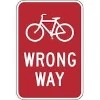
 "Walk against traffic, ride with it." This simple rule of thumb has been taught to school children for generations. Yet, it remains one of the most common traffic safety errors observed on British Columbia roads today. Whether out of a false sense of security or a simple misunderstanding of the law, cyclists who ride against the flow of traffic are placing themselves in immense danger.
Understanding the legal requirements and the mechanical reality of how drivers scan for hazards reveals why riding on the wrong side of the road is a recipe for disaster.
The Law: Cyclists Are Operators of Vehicles
Under British Columbia's Motor Vehicle Act (MVA), a bicycle is not merely a sidewalk accessory—it is treated legally as a vehicle when operated on the roadway.
Section 183 of the MVA outlines the rights and duties of a cyclist. It explicitly states that a person operating a cycle on a highway has all the rights and duties of a driver of a vehicle. Crucially, Section 183(2)(a) mandates that a person operating a cycle must ride as near as practicable to the right side of the highway.
Riding on the left side, facing oncoming traffic, is a direct violation of the law. Doing so can result in a violation ticket and a fine. More importantly, it strips away the predictability that keeps all road users safe.
❌ WRONG WAY (Against Traffic)
1. Intersection Blind Spots
Drivers turning right look strictly to their left for traffic gaps. They will accelerate directly into a cyclist approaching from their unexpected right side.
2. Crushed Reaction Times
Head-on speeds combine. A 50 km/h car and a 15 km/h bicycle create a closing speed of 65 km/h, removing any window to avoid an obstacle.
3. Unpredictable Movement
You are moving against standard traffic patterns, making it impossible for other motorists and pedestrians to anticipate your path.
✅ RIGHT WAY (With Traffic)
1. Maximum Road Visibility
You sit directly within the mirrors, windows, and primary scanning angles of drivers ahead of you and behind you.
2. More Reaction Time
Traveling in the same direction drops relative closing speeds dramatically, giving motorists a massive window to scan, see, and pass safely.
3. Predictable & Law-Abiding
By acting like a vehicle, you earn the predictability and protection afforded to standard traffic under BC regulations.
The Illusion of Safety
Many wrong-way cyclists argue that they prefer to see oncoming traffic so they can react to approaching cars. This logic is a dangerous illusion.
- Compressed Reaction Times: When you ride with traffic, a vehicle approaching from behind at 50 km/h passes a cyclist travelling at 15 km/h with a relative closing speed of just 35 km/h. If you ride against traffic, those speeds combine. The closing speed skyrockets to 65 km/h, leaving both the driver and the cyclist with a fraction of the time to react to a sudden hazard.
- The E-Bike Factor: The explosion of electric bicycles (e-bikes) has amplified this danger. E-bikes easily maintain speeds of 20 to 32 km/h. A wrong-way e-bike closer to the centre line cuts reaction windows down to near zero, giving motorists virtually no time to avoid a head-on collision.
The Intersection Blind Spot
The absolute highest risk for a wrong-way cyclist occurs at intersections and driveways.
Human drivers scan for threats based on where they expect those threats to come from. When a motorist stops at a stop sign or a driveway looking to turn right, they immediately look to their left to check for a gap in oncoming vehicle traffic.
Because they are turning right, they do not expect a fast-moving vehicle to be coming from their right, travelling the wrong way down the street. The driver will see a gap in traffic from the left, press the accelerator, and turn directly into the path of the wrong-way cyclist who was riding in their blind spot.
Modern Infrastructure Exceptions
The only legal exception to the "ride on the right" rule occurs when a municipality installs dedicated, designated infrastructure.
Cities across BC are increasingly installing segregated two-way bike lanes on one side of a street. While these lanes legally permit you to ride against the flow of the adjacent motor vehicle lane, they do not eliminate the intersection hazard. Drivers turning across these paths still routinely fail to look both ways for cyclists, meaning riders in these lanes must exercise extreme caution at every driveway and cross street.
Ride Predictably, Ride Legal
Traffic safety relies entirely on predictability. This core safety principle is heavily reinforced by the BC Cycling Coalition's Bike Sense Guide, which emphasizes that cyclists fare best—and gain the most respect from motorists—when they behave like a vehicle and ride predictably with the flow of traffic.
When you ride on the left, you become an unpredictable hazard. By obeying Section 183, staying to the right, and moving in the same direction as traffic, you ensure that drivers can see you, anticipate your movements, and keep everyone on the road safe.
Help keep BC roads safe! Share this guide with a cyclist or driver you know:
- Log in to post comments
Comments
As an avid road cyclist, I use clearly marked bike lanes, but spend the majority of my riding on the road and take responsibility for my driving with the same onus as when I use my vehicle. I do not drive on the shoulder, against traffic, on sidewalks, in crosswalks, pass vehicles on the right, or drive between lanes of traffic, etc. I do not wear headphones, do wear a helmut, stop at stop signs and red lights, and use hand signals. Everyday, pedestrians and drivers are inconvenienced and annoyed by crass, uncaring, unknowing, or oblivious cyclists out doing their thing, whatever it may be. Likewise, pedestians and cyclists are endangerd and put off with bad drivers, and both cyclists and motorists affected by pedestrians who cannot follow simple rules. Unfortunately, as a cyclist, I am in a minority, as many, many cyclists do not follow the rules of the road, seem confused when apprised of same, and get very upset when told that what they are doing is illegal. They often say why don't police stop me if I am doing something wrong? Good question!
It seems that we continually invent and enact new laws, usually with very little fanfare or explanation. What do all the markings on downtown Vancouver streets really mean, to cars and to bikes? I am pretty smart and I am totally confused by alot of them. However, with all these laws, new and old, one can witness hundreds of infractions a day, by drivers, cyclists, and pedestrians, without seeing anyone ticketed. Pain in the wallet is an effective tool in enforcing the law, helps reduce the costs of police officers, and, when the laws are obeyed, makes driving safer for all, regardless of the means utilized. Laws are enacted for a reason, but, if these laws are not enforced, is there really any rationale?
If we stop enforcing laws will the problems go away? NO! If we vigilently enforce them, will the problems go away? Not completely perhaps, but, to a far greater extent, than presently. Perhaps we need, like motor vehicles and boats, to have a mandatory operator licensing for all users, with a minimal level of education required to attain said license and a requirement to carry this license (ID) when riding. The costs to provide said education and licensing would be offset by the cost to obtain same. Enforcement of existing laws would reduce the current abuse or lack of knowledge, pay for itself with revenues, and create safer situations for all, ultimately reducing costs in other areas such as medical, accident investigation, etc., while reducing stress for many others and making transportation safer for all.
- Log in to post comments
I do ride on the wrong side. The reason I do this is because I'm deaf and can't hear the cars behind me. I have nearly been hit by a car from behind because sometimes the driver is on the cell or looking into their purse or changing radio station and not watching the road and steers into the shoulder, etc like that. So that's when I decide that I would be safer to ride on the wrong side just so I can observe traffic and be able to steer out the way.
In fact; this habit started when I was little...I got hit by a car from behind and since then it has scarred me for life and that experience started the habit of doing this. So...in all honestly...I feel safer to ride on the wrong side unless I'm riding on the shoulder with a fence between me and traffic then I would ride on the right side.
- Log in to post comments
This might be counter-intuitive, but you are actually safer to ride with the traffic than against it. Trust me, I understand your fear, but it is also scarry for the person in the car or truck, because when you are coming at the car you are doing something that is unpredictable. Unfortunately, this is likely unconvincing to you, but seriously in a car vs. bicycle situation... car wins!
I also see a lot of bicyclists that apparently do not know the laws, even that bike helmets are mandatory. A little bit of enforcement might work, but I think that education is best. That education should come from other bicyclists.
- Log in to post comments
This is every cyclists worst nightmare, and although I have no hearing impairment I have been brushed by three side mirrors and the wakeboard rack on a powerboat so far this year. In one case the driver stopped to apologize to me, but, in the other cases, I have no idea what their distraction was.
I take the full meter allotted so in case of stupidity I at least have somewhere to go. I can't imagine being deaf, but, would not want to be riding against traffic either.
Another problem that cyclists face is dark tinted windows on the windshields and front windows of vehicles preventing us from making eye contact with drivers, one of the only ways that we can ensure that they are aware of us and understand our intentions, and we theirs.
It is worse in the US than in Canada, but, supposedly illegal everywhere, just another unenforced law.
- Log in to post comments
Uninformed Cyclists