
A DriveSmartBC reader has asked what happens when a driver approaches a stop sign on a road covered with snow and ice, applies the brakes and the vehicle slides through the intersection.
The circumstances described were extreme. There had been more than 40 centimetres of snow in the preceding 24 hours. The road was unplowed and heavily rutted, the vehicle was travelling downhill, and the driver said they were approaching the stop sign at about 10 km/h.
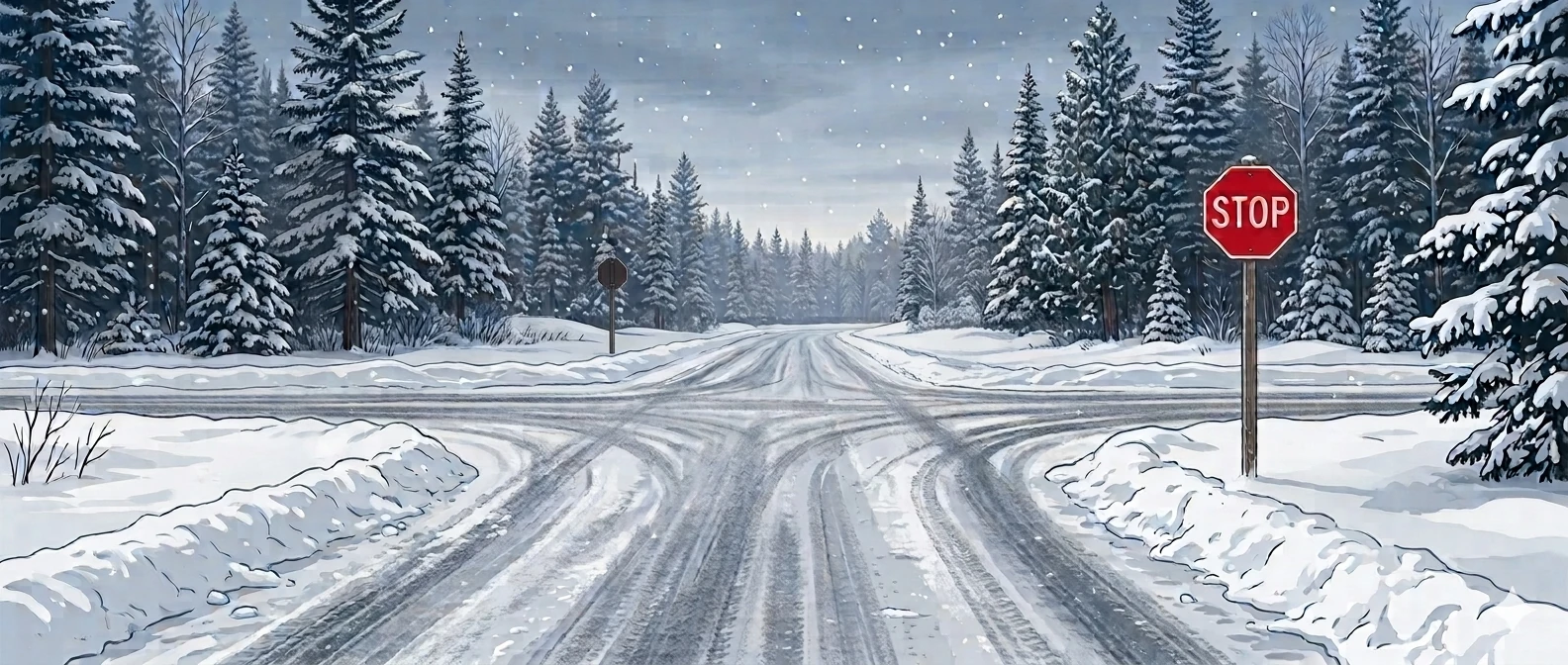
According to the driver, the wheels locked, the vehicle began to slide and the driver released the brakes to avoid continuing to slide. The vehicle then entered the intersection at about 5 km/h. An RCMP officer was watching the intersection and issued a ticket for failing to stop.
So, can slippery conditions excuse failing to stop at a stop sign?
The Law Requires a Stop
Section 186 of the Motor Vehicle Act says that, when facing a stop sign, a driver must stop at the marked stop line, if there is one. If there is no marked stop line, the driver must stop before entering the marked crosswalk. If there is neither a stop line nor a marked crosswalk, the driver must stop before entering the intersection, at the point where the driver can see approaching traffic on the intersecting highway.
The BC Motor Vehicle Act Regulations describe the STOP sign itself as requiring a driver to come to a complete stop and proceed only when it is safe to do so.
There is no general exception in the stop-sign rule for snow, ice or other slippery conditions. That means a driver cannot simply decide that conditions make stopping unnecessary.
But Conditions Matter Before You Get There
That does not mean that the condition of the road is irrelevant.
The Motor Vehicle Act also prohibits driving at a speed that is excessive relative to the road, traffic, visibility or weather conditions. On a snowy or icy approach to a stop sign, the driver has to account for the available traction and the distance required to stop.
In other words, the fact that a driver is travelling at or below the posted speed limit does not necessarily mean that the speed is appropriate for the conditions. A vehicle travelling at 10 km/h on dry pavement may be easy to stop. The same speed on a steep, icy surface may not be.
The practical lesson is to begin slowing well before the stop sign and approach at a speed that gives you a reasonable opportunity to stop. If the road is so slippery that braking is unpredictable, that is a reason to be more cautious, not less.
What if the Vehicle Starts to Slide?
This is where the situation becomes more complicated.
A driver who discovers that the vehicle is sliding despite braking may have to make an immediate decision about how best to control the vehicle and avoid a collision. That does not change the requirement to stop at the stop sign, but it does affect what actually happened and why.
There is an important distinction between saying, "I tried to stop but the vehicle would not stop," and saying, "I slowed down and entered the intersection without coming to a complete stop."
Those are different accounts of the event. In a ticket dispute, the evidence about the driver's speed, when braking began, what the vehicle did, whether it actually stopped and what the officer observed can all matter.
It is also worth remembering that people naturally remember events from their own perspective. When we receive a ticket, it is tempting to concentrate on the circumstances that explain why something happened while overlooking the decisions that led up to it. A useful way to examine the situation is to reconstruct it as objectively as possible:
- How fast was the vehicle actually travelling?
- How far from the stop sign did braking begin?
- How slippery was the surface?
- Was the vehicle under control before braking began?
- Did the vehicle actually come to a complete stop?
- Where did it stop, if it stopped?
- What did the driver see?
- What did passengers or other witnesses see?
- What did the police officer observe?
What if the Stop Line is Covered by Snow?
Heavy snow can create another problem: the marked stop line or crosswalk may not be visible at all.
Section 186 provides a hierarchy for deciding where to stop. If the marked stop line cannot be identified because it is covered by snow, a driver should not assume that the absence of a visible line permits them to proceed farther into the intersection.
The safest approach is to treat the intersection as though there is no marked stop line and stop before entering the path of cross traffic. In other words, if you cannot determine where the painted line is because it is covered by snow, stop somewhere that clearly keeps your vehicle out of the cross traffic path and then proceed only when it is safe.
This is particularly important when snowbanks, ruts or darkness also make it difficult to judge the shape of the intersection. The important point is that the vehicle must be stopped before proceeding into the intersection, giving the driver an opportunity to determine that it is safe to do so. It is to stop the vehicle before proceeding into the intersection and to give the driver an opportunity to determine that it is safe to do so.
What Happened in this Particular Case?
The original question cannot tell us with certainty exactly what happened.
The driver reported that the vehicle began sliding and could not be stopped as intended. The police officer, who was watching the intersection, issued a ticket. A passenger later recalled that the vehicle may actually have come to a complete stop briefly.
Those accounts cannot be reconciled from the information available here, and there is no point in pretending that we can decide who was correct. The officer had an opportunity to observe the vehicle from outside it, while the driver and passenger experienced the event from inside the vehicle.
What we can say is that slippery conditions do not make a stop sign optional. They make approaching the stop sign correctly even more important.
If you can see that the road is covered with snow or ice, slow down early enough that you have a reasonable chance of making the required complete stop. If the stopping line is hidden, stop before entering the path of cross traffic. And if you find yourself unable to stop, the circumstances leading up to that point are an important part of understanding what happened.
Learn More
- Log in to post comments