
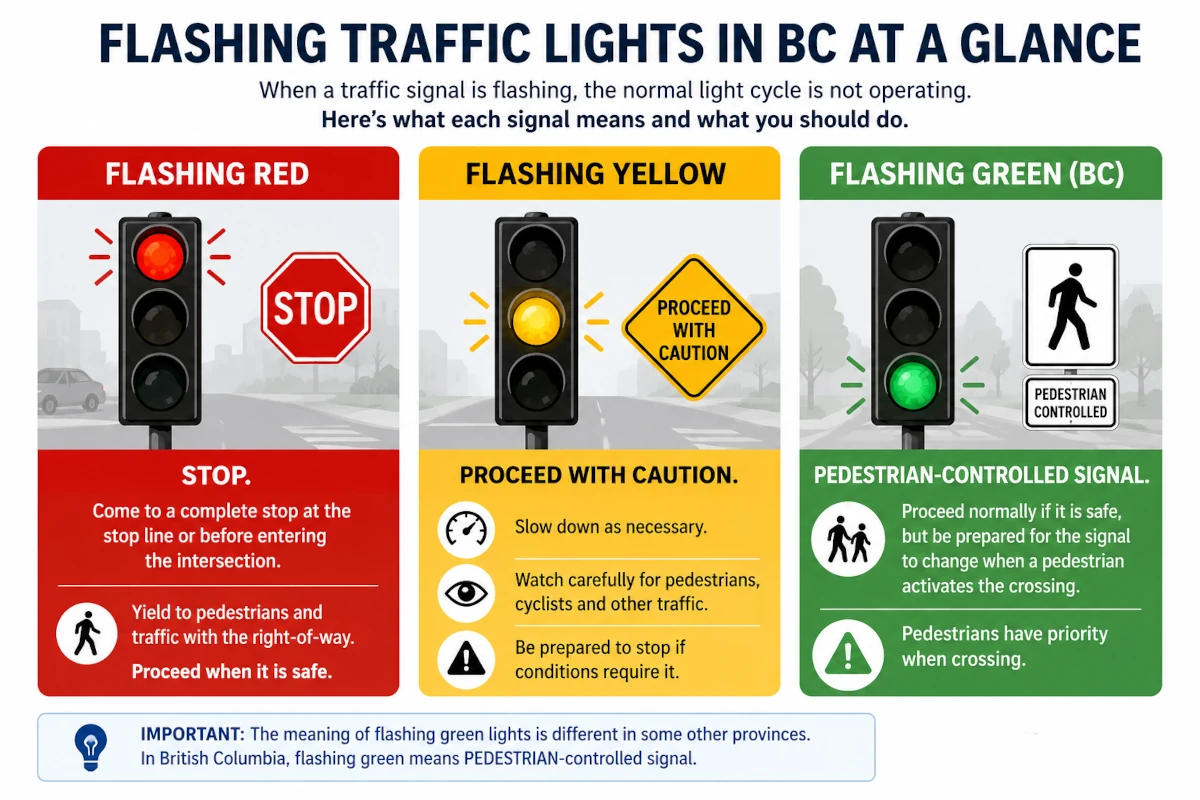
Quick Answer: A flashing traffic signal means the normal traffic light cycle is not operating. In British Columbia, a flashing red light requires you to stop before proceeding when safe, a flashing yellow light means proceed with caution, and a flashing green light identifies a pedestrian-controlled intersection where drivers must be prepared to stop for pedestrians.
Although flashing traffic signals are less common than normal traffic lights, every driver should understand what they mean. Knowing the difference between flashing red, yellow and green signals helps you make safe decisions when normal traffic control has been interrupted or modified.
What Does a Flashing Traffic Signal Mean?
Flashing traffic signals tell drivers that the intersection is operating differently than usual. Instead of following the normal sequence of green, amber and red lights, each flashing signal has a specific meaning that requires drivers to adjust their behaviour.
Each flashing colour has a different meaning, so always identify the signal before deciding whether to stop or proceed.
Flashing Red Traffic Light
A flashing red traffic signal has the same meaning as a stop sign.
- Come to a complete stop at the marked stop line or before entering the intersection.
- Yield to pedestrians and any traffic that has the right-of-way.
- Proceed only when it is safe to do so.
Do not assume cross traffic will stop unless it is also controlled by a flashing red signal.
If you encounter an intersection where the traffic lights are completely dark instead of flashing, read our article on traffic lights that are not working.
Flashing Yellow Traffic Light
A flashing yellow signal warns drivers to proceed with caution.
- Slow down as necessary.
- Watch carefully for pedestrians, cyclists and other traffic.
- Be prepared to stop if conditions require it.
You are not required to stop simply because the light is flashing yellow, but you must be prepared for unexpected hazards.
Flashing Green Traffic Light (British Columbia)
British Columbia is different from many other provinces.
In British Columbia, a flashing green light identifies a pedestrian-controlled traffic signal. Unlike in some other provinces, it does not indicate an advanced green turn signal. Drivers should be prepared for the signal to change when a pedestrian requests to cross. Wondering how the signal knows someone is waiting? Learn more about how traffic signals are triggered.
Drivers may continue through the intersection if it is safe, but they must remain alert because the signal can change to amber and then red after a pedestrian pushes the crossing button. Pedestrians using these crossings follow their own signal sequence. See our explanation of pedestrian signals to understand what they are seeing.
Do not mistake a flashing green light in BC for an advanced green turn signal. In some other provinces, flashing green has a different meaning.
Flashing Green Arrow
A flashing green arrow allows drivers to proceed only in the direction indicated by the arrow. Drivers must still yield to pedestrians lawfully crossing the roadway and to any conflicting traffic as required. Even a green indication doesn't always give you unrestricted right-of-way. Our article A Green Light Doesn't Always Mean Go explains why.
Why This Matters
Flashing signals are used because traffic conditions are not routine. They may appear during equipment failures, overnight operation, construction, emergency situations or at pedestrian-controlled crossings. The flashing light is intended to get your attention and remind you that the normal expectations at the intersection no longer apply.
Two common mistakes are treating a flashing yellow light like a normal green light and assuming that a flashing green gives you priority. Neither assumption is safe. A flashing signal is there because conditions aren't routine. Slow down, look carefully and don't assume other drivers are interpreting the situation correctly.
Most crashes at flashing signals aren't caused because drivers misunderstand the signal. They're caused because drivers assume everyone else is interpreting it the same way they are. A cautious approach gives you time to recognize when another driver has made the wrong assumption.
Flashing Lane Control Signals
Some roads use overhead flashing lane control signals.
- Steady Green Arrow: The lane is open to traffic.
- Steady Red X: Do not drive in the lane.
- Flashing Amber X or Arrow: Leave the lane safely because conditions ahead have changed.
British Columbia Law
The requirements described above are based on the Motor Vehicle Act and the guidance provided in Learn to Drive Smart. Drivers visiting British Columbia should be aware that the meaning of a flashing green signal is unique compared with some other Canadian jurisdictions.
These are some of the questions DriveSmartBC is most often asked about flashing traffic signals.
Frequently Asked Questions
Is a flashing red light the same as a stop sign?
Yes. Come to a complete stop, yield to traffic and pedestrians with the right-of-way, and proceed only when it is safe.
Do you stop at a flashing yellow light?
No. A flashing yellow light means proceed with caution. Slow down if necessary and be prepared to stop if conditions require it.
Why is the green light flashing in BC?
In British Columbia, a flashing green light identifies a pedestrian-controlled traffic signal. Unlike in some other provinces, it does not indicate an advanced green turn signal. Drivers should be prepared for the signal to change when a pedestrian requests to cross.
Is a flashing green light the same everywhere in Canada?
No. The meaning of flashing green traffic signals varies between provinces. Always follow the rules where you are driving.
If this article helped you, please consider sharing it using the social media buttons below to help other drivers better understand British Columbia's traffic signals.
- Log in to post comments
Comments
The flashing green light rule imho should be abandoned, I wondered about it's meaning a few times visiting BC & thanks to this website finally found out.
It is a uniquely BC rule & no Manitoba driver so far was able to explain it's meaning to me, while in Ontario a flashing green light means your left turn is protected, having two oposite meanings ("good to go" vs "possible yield") for the same kind of signal in different parts of the same country is absolutely absurd & as pedestrians are the most vulnerable participants in traffic this rule is simply dangerous.
- Log in to post comments
... if municipalities in BC were forced (by over-riding provincial legislation) to employ flashing green (i.e. pedestrian-controlled) lights the way they were originally intended back when they were introduced circa 1960.
That is, for mid-block use only (NOT at an intersection) where there is a need/demand for pedestrians to cross the road without having to walk to the nearest intersection.
That way, these devices can best accommodate all road users to get where they're going safely and efficiently; once the pedestrians are out of the way, drivers can continue without hanging around needlessly.
Flashing green traffic lights at intersections - where there are Stop signs facing the drivers on the cross street - have devolved into a confusing mess, with almost constant legal infractions both by pedestrians who walk on the main road in defiance of the solid red light; and drivers who belt through the Stop signs when they think they see a brief opportunity to cross or turn onto the main road.
It's all wrong. Where are the cops? Where are the bylaws officers? Where are the Traffic Engineers who understand how this stuff is supposed to work? Sheesh.
- Log in to post comments
An ICBC spokesperson in the video at https://bc.ctvnews.ca/video-shows-drivers-ignoring-vancouver-stop-signs-1.4026663 says that a pedestrian facing a red traffic light without a pedestrian light (at a pedestrian controlled flashing green traffic light intersection) could go, but the BC MVA includes:
Red light
129 (4) When a red light alone is exhibited at an intersection by a traffic control signal,
(a) a pedestrian facing the red light must not enter the roadway unless instructed that he or she may do so by a pedestrian traffic control signal,
I thought that drivers and cyclists should stop at the stop sign then proceed when safe, and the pedestrian facing the solid red traffic light (that doesn't have a pedestrian light) has to wait for the light to change. I asked someone at the City of Vancouver about this some time ago and they argeed with me. Are we missing something?
- Log in to post comments
I am lucky enough to be able to spend winter in Baja, Mexico. Many of the traffic lights here have an additional feature: a "stale" green will flash 4 times before turning amber (takes about 3 seconds). I like this feature very much, as it gives me time to prepare to stop without slamming on my brakes. Alternately, it also lets me know that I have a few seconds before it changes, and can better assess the risk of entering the intersection on an amber. Certainly, there are those poor drivers who will speed up, but I believe there would be more drivers who would lift their foot.
- Log in to post comments
"A driver facing a flashing green light must approach so that they are able to stop, should a stop be necessary, before reaching the crosswalk or the signal as the case may be." Highway code quote???
In Mexico - at least on the Baja, a green traffic light will flash 4 times before turning yellow. To me, this is an excellent way to highlight a stale green. Allows the driver to assess and adjust his speed before the light goes yellow. Certainly, there will be drivers who will tromp on the gas to beat the yellow, but on the whole, it seems a Good Thing, and I for one would welcome this modification of traffic signals in BC. To me, right up there with the quiet campaign to "Keep Right Except to Pass".
- Log in to post comments
"A driver facing a flashing green light must approach so that they are able to stop, should a stop be necessary, before reaching the crosswalk or the signal as the case may be." Highway code quote???
Well, we don't use the Highway Code in Canada, but this sounds like sound advice from the basic 'Road Sense for Drivers' guide which is our equivalent. But if you think about it, that same advice would apply to drivers approaching any green light. Even better advice would be to scan for pedestrians who might have pushed the button to activate the light, approaching a flashing green.
In most BC municipalites, the flashing green will change to a solid green for several seconds before changing to amber, as a preliminary warning. In Vancouver City, it just changes from flashing green to solid amber, but after the light has turned red there will still be a deliberate delay before the pedestrians are shown a 'Walk' signal just in case. Nuts that all municipalites aren't using the same system, of course.
These days, many pedestrian signals (facing pedestrians heading the same direction as the traffic flow) will change from a 'Walk' symbol to a 'Countdown' to assist drivers in anticipating the change of the light from solid green to solid amber. This is great, except that it encourages pedestrians to dash across too late - and illegally - which makes it much harder for turning vehicles to exit the intersection.
Being as Pedestrian signals were only invented to stop pedestrian movement - for the purpose of allowing turning vehicles to get around the corner - I see this as a big step backwards in terms of traffic management.
- Log in to post comments
There are some pedestrian Walk/Don't Walk signals that show a countdown, while an animated pedestrian walks. As the countdown progresses, the 'walker' increases speed until it is running. Quite funny, actually, but effective!
- Log in to post comments
Decades ago, (in Quebec) I was driving on an 80 km/h two-lane highway approaching a rural intersection controlled by traffic lights. A red light to the highway traffic was displayed. Roughly 500 metres in advance of the intersection was a sign warning that the light will remain red until 50 Kmph was noted radar, at which point, the light would turn green. I did slow to 50, and the traffic light changed to green. At the time, I thought that was a terrific idea. I have not noticed that system in place anywhere else. Is this system not allowable, and if not, why not?
- Log in to post comments
I have never heard of this before and just did a quick search without finding anything appropriate.
I have heard of traffic signals being synchronized so that traveling through them at a certain speed will result in arriving at each one during the green phase.
I'm going to guess that there are at least two hurdles to jump, the first being political and the second whether the traffic engineering community supports it or not.
- Log in to post comments
Is there a gap in time between pedestrian light going red and traffic light going green?
- Log in to post comments
Traffic signal timing in BC is described in the Electrical & Traffic Engineering Manual. Signal timing information can be found in section 400.
- Log in to post comments
Thanks. The reason for my question was this. I was actually thinking about left turns and completing the turn while yellow. Would the pedestrian signal be still on when light turns yellow. At that point, could there still be pedestrians and what should one do if there were pedestrians?
- Log in to post comments
The status of the signals does not play a large part in this. If both the left turn driver and the pedestrian are legally within the intersection when the lights change, the driver yields to the pedestrian and the cross traffic yields to the driver.
If the pedestrian is not legally in the intersection, the driver still must exercise caution not to collide with them and cross traffic still has to yield to the left turn driver.
- Log in to post comments
My comment is about standardizing traffic lights. Advanced left turn green arrows are common and at a point the green changes to yellow. In Victoria I would say this is the norm and we as drivers expect this. However there is one intersection that instead of using an Advance left turn arrow, it is a Delayed arrow. I have not one situation like this.
Another point I again saw for the first time the yellow Advanced instead of stopping it changed to flashing yellow before it stopped.
Years ago in New York City I drove from Times Square to 110 Street in Harlem without stopping. Lights were well syched and it was a Sunday morning.
- Log in to post comments
Is there a gap in time between pedestrian light going red and traffic light going green?
- Log in to post comments
The flashing green light rule