
In 2008, Kelowna lawyer Paul Hergott wrote an article titled Drivers Need to Smarten Up When Out on the Road. He began with a blunt observation: “We've got ourselves a serious attitude problem.”
I responded to Paul's article in 2017 with We've Got a Serious Attitude Problem. After years of traffic enforcement, I had seen plenty of examples of drivers making poor choices and apparently having little concern about the consequences.
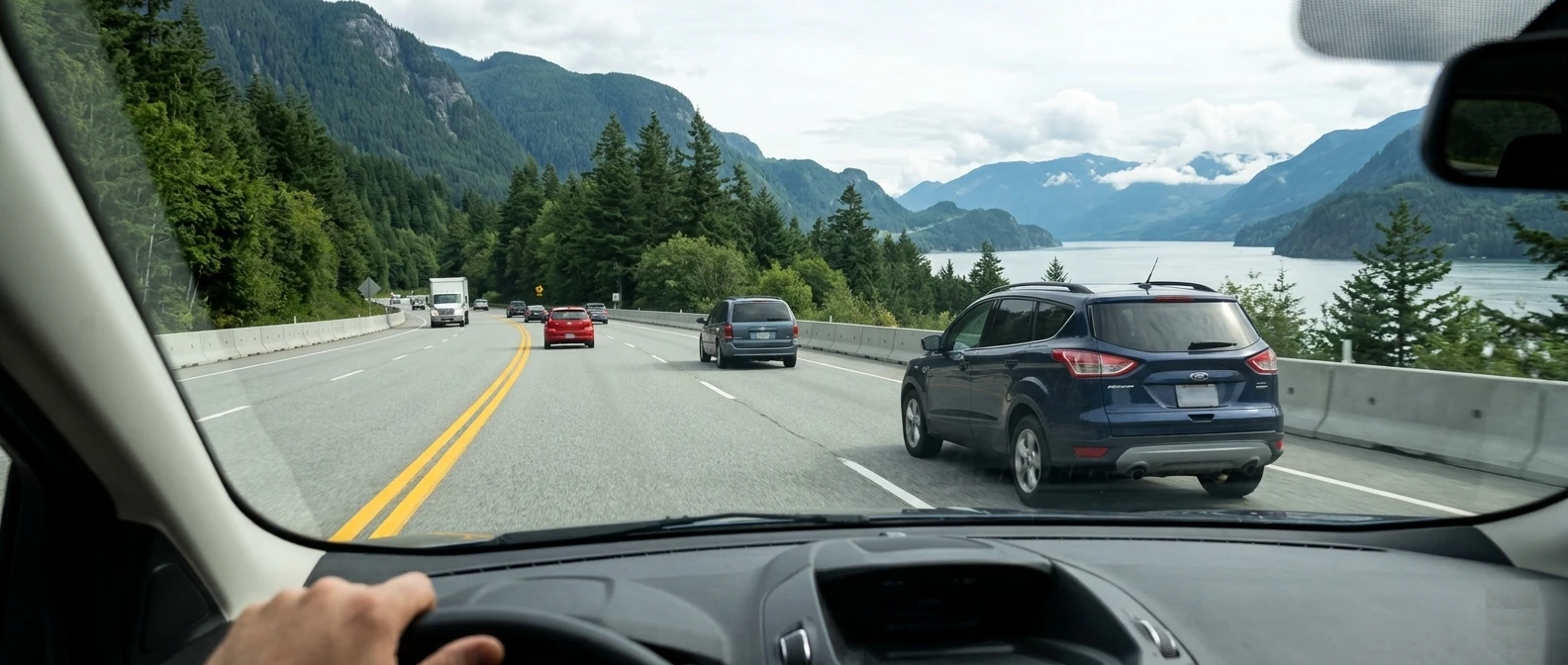
Almost two decades after Paul's original article, and nearly a decade after my response, the question is worth revisiting: is driver attitude really the problem?
Attitude Does Matter
Some unsafe driving is plainly a matter of attitude.
A driver who knowingly speeds, follows too closely, uses a phone while driving or treats other road users as an inconvenience is making a choice. A sense of entitlement, impatience or disregard for others can influence those choices.
A driver can also have all the necessary knowledge and skills and still choose to drive in a way that puts others at unnecessary risk. In that respect, Paul's argument still stands. Attitude matters.
But it is not the whole story.
Not Every Mistake Is an Attitude Problem
Consider a driver who follows too closely. They may be impatient and deliberately choose to drive close to the vehicle ahead. But they may also have developed a habit of following at a distance that feels comfortable without understanding how much stopping distance they actually need.
A driver who misses a traffic signal may have deliberately ignored it, or they may have been distracted and simply failed to notice that it had changed. A driver who crosses the centre line may be careless, unfamiliar with the road, distracted or simply not paying sufficient attention.
None of those explanations excuse the behaviour. They do demonstrate why “bad attitude” is an incomplete explanation for unsafe driving.
Knowledge, Skill and Habits
Driving is a learned skill. Safe driving requires more than knowing the rules. It requires the ability to recognize hazards, anticipate what other road users might do and make appropriate decisions while controlling a moving vehicle.
Good driving also depends heavily on habits. A driver who routinely leaves a good following distance or scans well ahead is less likely to have to make a last-second decision when something unexpected happens.
Unfortunately, unsafe behaviours become habits too. Following too closely, routinely driving faster than conditions warrant or allowing distractions to become part of the driving routine can become normal behaviour.
The driver may not think of themselves as reckless. They may simply believe that what they have always done is good enough.
Where Consequences Come In
There is nevertheless an important role for consequences. Drivers who deliberately or repeatedly break the rules need to understand that their behaviour can eventually affect their privilege to drive.
This is where B.C.'s Driver Improvement Program becomes relevant. The program provides a graduated system of intervention for drivers whose records demonstrate poor or dangerous driving behaviour.
The Driver Improvement Program Policies and Guidelines published by RoadSafetyBC use different intervention thresholds for new and experienced drivers.
For an experienced driver, the penalty-point table begins with 9 to 14 points in the previous two years resulting in a warning letter. At 15 to 19 points, the guidelines provide for a warning and a Notice of Intent, with a potential prohibition range of three to eight months. The ranges increase as the accumulated points increase.
These are guidelines rather than automatic prohibitions. An adjudicator can consider the individual driver's record and other relevant circumstances.
Even with that qualification, the structure raises an important question. The DIP's graduated intervention system gives an experienced driver considerable latitude to accumulate violations before a driving prohibition becomes the normal intervention.
Experience Changes the Threshold
The contrast with new drivers is striking.
For a new driver with no previous prohibitions, the published guideline begins intervention at 2 to 6 penalty points, with a prohibition range of one to six months.
An experienced driver can therefore accumulate substantially more penalty points before reaching the point where the experienced-driver table normally moves beyond a warning.
The guidelines explain that new drivers are at greater risk of being involved in collisions, and the lower thresholds are intended to address that increased risk.
That rationale is understandable. But it does not answer a different question: how much latitude should an experienced driver receive simply because they have more than two years of driving experience?
Experience does not necessarily mean that a driver has developed good habits. A driver who has spent years repeating poor habits may simply have had more time to become comfortable with them.
There Are Other Ways to Intervene
It would be misleading to suggest that nothing happens to an experienced driver until they accumulate 15 penalty points.
The guidelines also provide for intervention when a driver accumulates certain high-risk offences. These include excessive speeding, driving without due care and attention, driving without reasonable consideration and offences involving the use of electronic devices while driving.
A pattern involving two or more specified high-risk offences within one year can result in a potential prohibition ranging from three to twelve months.
So the system is not based solely on counting penalty points. Nevertheless, the accumulated-point thresholds remain worth examining because they determine when a driver's broader history of violations is considered serious enough to warrant progressively stronger intervention.
So, Is It an Attitude Problem?
Yes, sometimes.
But after looking at the issue again, I would no longer describe unsafe driving as simply an attitude problem.
Attitude is one part of the equation. Knowledge, skill, attention, habits, experience and the consequences attached to poor driving all matter too.
Education can address knowledge. Training can improve skills. Good coaching can help establish safer habits. Engineering can reduce opportunities for mistakes to produce serious consequences. Enforcement can remind drivers that the rules are real and that deliberate violations can have consequences.
And when a driver's record shows a continuing pattern of unsafe behaviour, intervention needs to come early enough to have a reasonable chance of changing that behaviour before a serious collision occurs.
Paul's original question was essentially about whether drivers take their responsibilities seriously. I think that remains an important question.
But perhaps an even better question is this:
Are we doing enough to help drivers recognize risk, develop good habits and take responsibility for what happens when they get behind the wheel?
And when a driver's record shows that they are not doing those things, are we intervening soon enough to make a difference?
Learn More
- Log in to post comments
Comments
1- We have a driver attitude problem.
2- We have a driver skill problem as well.
3- We also have an urban planning problem.
4- We also have a public transit problem.
Governmental policies that allow the last 3 problems are a major cause of the first problem.
- Log in to post comments
I can't help but point out a few fallacies here:
"We see driving as a right."
There is nothing wrong with seeing driving for what it is - a right - as there is very little that makes driving not a right. In North America driving is the defacto method of transportation, and this understanding goes into everything: from road design to how far things are apart; from cup holders in cars to drive-through banking. Driving is an integral part of the North American life-style and it is effectively a right - everyone who passes a simple test and is able to afford a car is able to start driving. No authority can unreasonably withhold access to driving to any person.
"drivers who do not follow the rules need to believe that there will be consequences for not doing so."
Who are we kidding? As if the drivers who are not following the rules are regularly saying to themselves:
"I am going to break the section #N.N(n) because there is little chance that I am going to be ticketed for it, and even if I do I can afford it."
That's just wishful thinking my friends - the rules are being broken in ignorance. Very few people choose to outright blow a red light, if any; the lights are blown mostly unintentionally; and drivers who would see themselves from third person perspective would see it as wrong, but this is not an indication that they choose to skirt rules because of their entitlement or the lesser moral statue. They simply made an error of judgement in the moment, which moment came due to the lack of good habits on the roads - like looking far ahead, predicting and keeping distance.
The most massively broken rules I think are speed limits, however that is not because people have a death-wish, quite the opposite - keeping with the flow of traffic, and being on the marginally faster end of the spectrum of traffic has been statistically shown to cause the least accidents. Those who drive 15% below the traffic flow cause accidents, and those who drive above 15% also cause accidents. But those who drive 5%-10% above traffic flow statistically encounter less accidents. Maybe it's because drivers who are speeding just a little have more skills, or maybe it's because they are more engaged and attentive. I think it's a combination of factors, and in Lower Mainland the speed-limits are still under-posted. Speed limits should represent a maximum speed in best of road conditions - they should feel "too fast" for the majority of driving public - in Lower Mainland that is never true for a properly maintained vehicle thus we're seeing the mass infringement every day.
Do you want to die? Unless you are suicidal, the majority would answer - no. This answer is seen in everything we do, some are ignorant of some dangers, but most people are prevalently safe and reasonable in their decision making and every day-actions. Enforcement is largely unnecessary. It is only effective in stopping outright dangerous drivers who are subjecting other road users to harm.
One negative aspect of rule-breaking is that it encourages others to follow the lead. The under posted limits generate disregard for speed limiting signs. If the traffic flows at 110km/h in 70km/h zones, day in - day out, FOR YEARS, what is the real message here? It encourages ignorance and creates conflicts between the drivers "who get it" and drivers who "drive safely".
Engineering, Education & Enforcement are the three components of road safety (accident prevention).
The engineering here is world class - roads are lit, lanes are marked, signs are redundant, traffic lights are reduntant, warnings are sufficient, cat eyes are everywhere. My only advice in that regard is putting in more left and right turn arrows in intersections that obviously need them but have been ignored for years.
Education seems to be lacking in major ways. Nobody is taught the rules as they are written in the law. Most drivers are taught by other drivers who themselves don't know the rules. I think every new driver should receive madatory instruction from qualified instructors who can explain what, where and WHY. Skill development is also completely under-looked, drivers are not encouraged to hone their skills. And I think that ICBC discounts are too generous to license holders because they are given for calendar years of holding a valid license, not for actually driving or improving. I think that the concept of discounts can be used better - for example the 5% discount each year can be contingent on passing an additional road test /or special handling tests - like skid control or emergency avoidance, or for taking a week of driver brush-up / instruction course.
Enforcement is largely unnecessary - road blitzes of squads of officers hiding in bushes, around corners of building or with binoculars are generating more disdain for their purpose and in some ways the enforcers themselves do not believe that they are making the roads safer, just maintaining the charade. Fines should be replaced with offense specific instruction - run a red light - take a week of instruction where they take you through intersections and make you "look up" and tell you to keep your distance. Same for blowing stop signs - tell drivers in examples what the consequences of their choices are - roll a stop sign 10,000 times = 1 dead pedestrian. Drivers should look to STOP when approaching the stop sign/line, not ride right over it to the closest point of visibility (or even beyond).
If we're talking attitudes - I think the driving attitude of today perfectly reflects the attitude of enforcers, ICBC, driving instructors, and the Ministry of Transportation. If anything the pompous charade of "driving is not a right" and "slower is safer" and "undercover enforcement" is creating a negative emotional noise on the roads, and that is counter-productive to actual safety.
Over-all the roads are safer than they have ever been, and tomorrow they will be even better. I think that automated vehicles will bring in a new era of safety by removing the "chore" of driving for those drivers that are disinterested and see driving as A to B, and who do not enjoy the process of driving. Meanwhile the road authorities can keep pushing manufacturers to include safety-tech and warnings in all vehicles, not just the luxury expensive ones. Most new drivers end up cruising in the most basic vehicles, the fact which is constantly under-looked in the "new drivers are bad drivers" mantra.
- Log in to post comments
I find the police/parent metaphor entirely appropriate.
Although Outrageous's comments on the whole make sense, I find his/her thinking too extreme. I don't disbelieve the referred examples of wrongful allegations and their consequences, but am certain that in the great scheme of things, their percentage is low and to be expected, based on a simple Bell curve. Unfortunate, but an unavoidable consequence.
In the past day or so, in a six hour period on a major two-lane thoroughfare in Kelowna, a distracted driver was ticketed every 3.5 minutes on average. The message is not getting across obviously. Therefore, I am still in favour of the temporary confiscation of a distracted driver's cell phone.
- Log in to post comments
That's Not the Only Problem