
 The friction on British Columbia roads, sidewalks, and multi-use pathways is increasing. The influx of website submissions reveals frustration from pedestrians, traditional cyclists, and drivers alike. This is a widespread behavioural problem: a growing wave of rule abuse, reckless operation, and a complete disregard for the shared rules of the road.
Many operators treat electric cycles and kick scooters as if the rules don't apply, exempt from standard traffic laws. This baseline lawlessness creates a hostile environment for vulnerable road users, damages public support for green transit options, and triggers aggressive enforcement that impacts responsible riders. To restore safety, all road users must understand what constitutes legal, respectful behaviour on shared infrastructure.
Behaviour on the Trails: Sidewalks and Pathways Are Not Racetracks
The single most frequent complaint in our submissions queue comes from pedestrians who feel pushed off community nature trails, waterfront pathways, and city sidewalks. Motorized vehicles barreling down pedestrian spaces at maximum speed create a severe risk of catastrophic injury.
- The Sidewalk Ban: Under the B.C. Motor Vehicle Act, operating any cycle—electric or traditional—on a sidewalk is illegal unless explicit local municipal bylaws or official traffic signs permit it. Sidewalks are designed for foot traffic, strollers, and those with limited mobility, not high-speed motorized transport.
- Multi-Use Trail Etiquette: Multi-use pathways require shared responsibility. E-bike operators are legally obligated to yield to pedestrians, control their speed, and give clear audible notice (using a bell or a polite verbal warning) well before overtaking others from behind.
- Local Jurisdictions: While provincial law sets equipment standards, local municipalities hold the ultimate authority over who uses their parks and pathways. Cities across B.C. are actively tightening bylaws to restrict throttle-assisted devices from sensitive pedestrian trails to prevent conflicts.
The Rules of the Road Still Apply
Another layer of conflict occurs at city intersections and roadways, where some e-bike and kick scooter operators switch fluidly between behaving like a pedestrian and behaving like a motor vehicle whenever it suits them. This unpredictability confuses drivers and significantly increases intersection collision rates.
When you are riding an e-bike on a public roadway, you possess the exact same legal rights and responsibilities as a motor vehicle driver. This means operators are legally required to:
- Obey all stop signs, yield signs, and traffic lights without exception.
- Ride single file with vehicle traffic, rather than weaving between lanes or riding side-by-side with other cyclists.
- Utilize standard hand signals to clearly communicate turns, lane changes, or sudden stops to surrounding traffic.
- Equip the cycle with a white front light and a red rear light if riding between sunset and sunrise.
Equipment Abuse: Modifying Cycles into Illegal Motorcycles
The confusion over e-bike capabilities is worsened by aftermarket modifications. Our feedback shows an increase in throttle-driven electric dirt bikes and modified cycles operating in neighbourhood bike lanes.
B.C.’s Motor Assisted Cycle Regulation explicitly states that a legal standard e-bike cannot have a motor exceeding 500 Watts, nor can the motor assist the rider past 32 km/h. Disconnecting motor governors, rearranging pedals to be useless footrests, or installing high-output batteries completely invalidates the machine's status as a bicycle.
The moment an e-bike is modified to exceed these limits, B.C. law treats it as an unregistered, uninsured motorcycle. Operating one of these modified machines on public roads or paths carries steep fines—frequently exceeding 600 dollars—and may result in immediate vehicle impoundment by law enforcement.
Community Accountability: Parents, Riders, and Public Infrastructure
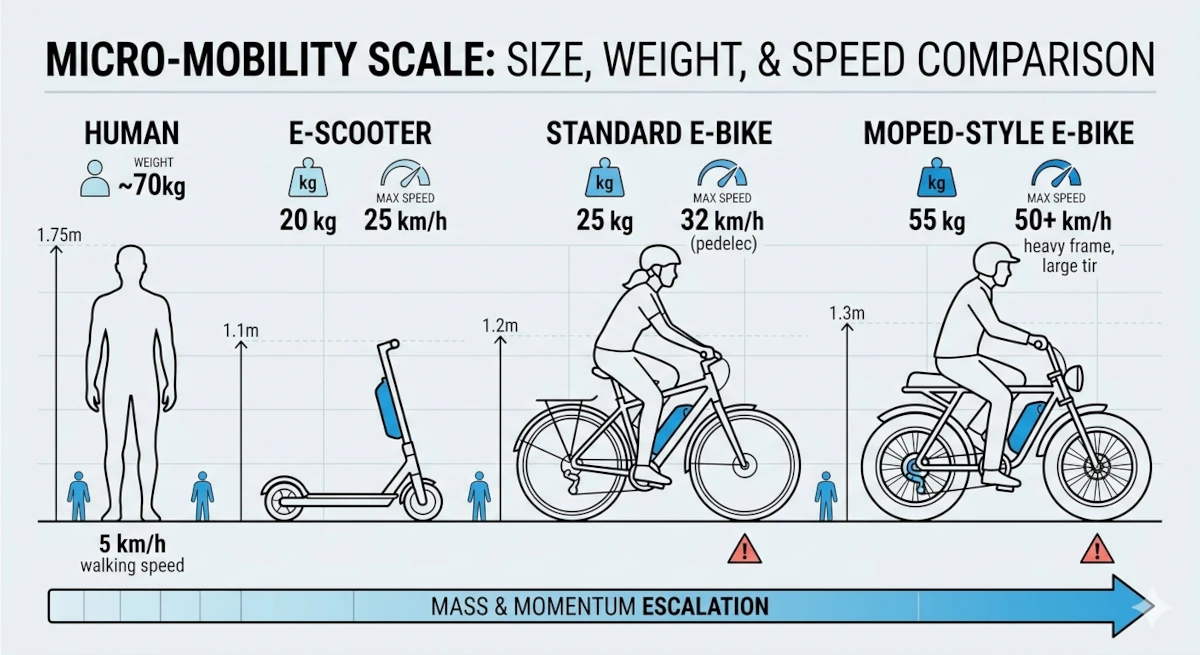
The scale chart below illustrates why pedestrians feel so vulnerable on shared pathways; it maps out the physics of size, weight, and speed variations sharing the space:
Solving this crisis requires a culture shift toward community accountability. Under-age riding is a primary point of friction, with children under 16 frequently observed operating throttle-assisted e-bikes on city streets. B.C. law explicitly states that standard e-bikes are restricted to riders 16 and older, while 14- and 15-year-olds are limited to lower-powered, throttle-free light e-bikes. Parents can be held legally liable and ticketed for knowingly permitting underage children to operate illegal machinery on public highways.
Ultimately, e-mobility devices are incredible tools for senior accessibility, green commuting, and community connectivity. However, the longevity of these options relies entirely on mutual respect. Reckless riding and rule evasion will only lead to heavier restrictions, mandatory licensing, and banned access for everyone.
Electric Kick Scooters vs. E-Bikes: What’s the Difference?
While they look like similar green-transit options, stand-up electric kick scooters (e-scooters) operate under completely separate provincial rules. If you are using an e-scooter instead of an e-bike, keep these four unique restrictions in mind:
- Location Restrictions: Unlike e-bikes (which are legal province-wide), e-scooters are only legal to ride on public roads, bike lanes and multi-use paths within participating municipalities under the B.C. Electric Kick Scooter Pilot Project. Riding one in a non-participating city is an immediate traffic offence.
- No Underage Riders: E-bikes allow 14- and 15-year-olds to ride "light" models. E-scooters have no such exception—you must be at least 16 years old to step onto one. Minor children under 16 are entirely banned from operating them on public infrastructure.
- Lower Speed Caps: The motor on a standard e-bike can assist you up to 32 km/h. Legal e-scooter motors are strictly capped at a maximum speed of 25 km/h.
- Zero Seating: By B.C. legal definition, an electric kick scooter is a standing-only device featuring a platform for standing and handlebars. If an e-scooter features a seat or a sitting surface, it fails the pilot criteria and is treated as an illegal vehicle.
Electric vehicles offer unprecedented mobility freedom, especially for seniors, commuters, and those with physical limitations. However, maintaining this access requires compliance and trail etiquette.
Know the wattage of your motor, respect the age limits for younger riders, and lower your speed significantly when approaching pedestrians on shared pathways. Mutual respect is the only way to keep B.C. paths safe and accessible for everyone.
Help spread the word and clear up the confusion in your community! If you found this breakdown helpful, please use the share buttons below to post it to your local Facebook groups, cycling clubs, or neighborhood forums.
- Log in to post comments
Comments
Glad to see you covering this topic. Agree that it is a significant growing problem but very difficult to effectively ensure compliance when operators require no licensing of themselves or their vehicles, there is no mandated safety training and almost no compliance monitoring by the police or bylaw enforcement (too busy with other societal problems I suspect).
The contributing problem is that we did not build our transportation network with these vehicles in mind, instead we have retrofitted infrastructure into the existing highway/road network with mixed success. As you have pointed out, this is compounded by a diverse number of vehicles being used everywhere with many being unlawful to operate on BC roadways. Also, given that you find bicycles being ridden by “professional” cyclists along with haphazard riders, little children on bicycles, skateboards, scooters, 3 wheeled bikes all using the same bike lanes there is conflict even before you consider 4 wheeled motor vehicles.
It is a mess and will continue to grow as users in all groups increase until such time as a system is put in place to properly regulate ALL users of public roadways and set standards for creating bike lanes and supporting infrastructure.
- Log in to post comments
Why are not E-bikers required to pass a test and get licensed prior to use? While this will not solve anything at least non-users will know some sort of education had been given to those riders and hopefully they will not come across as total idiots which seems more likely now.
I also suggest if you ride, don’t wear a helmet and are in a head injury accident, all medical expenses are borne by the rider. In other words, you chose not to wear head protection so by your choice you are ineligible to have your medical expenses covered by us taxpayers.
- Log in to post comments
I cannot tell you how much I appreciate this. I have asked myself so many questions about this topic which you have kindly clarified.
As a senior and the cost of fuel, I have been considering the purchase of an electric “tricycle” and your newsletter assisted me very much.
My only question remaining is whether I would be required to obtain a license to operate this type of bicycle.
Also, why do so many of the users not wear a helmet? I assumed it was the law and also for safety reasons.
- Log in to post comments
Well at least they are quiet!
I have to wonder about the quality of parenting that allows kids to go and mix it up in traffic.
My guess, most of the riders have no knowledge,or training about the rules of the road,or even the basic concept of safety that is part of obtaining a license.
Here's a video from my dash cam that you can share. This rider has a death wish.
- Log in to post comments
When passing a walking person the rider should call out left or right so you know which side they are passing on.
Terribly dangerous out there for walkers. Lesson requirements should be in place.
- Log in to post comments
A lot of this is familiar to me in bits and pieces from previous newsletters, but it was nice to read it all in one place. My old-man cynicism makes me wonder though, how many of those who most need to be educated are subscribed to your newsletter. In other words, I would imagine there’s a whole lot of preaching to the choir. The e-bike and e-scooter riders who are most troublesome probably don’t care what the rules and regulations are…
And that’s why you rightfully suggest that this "lawlessness creates a hostile environment for vulnerable road users, damages public support for green transit options, and triggers aggressive enforcement that impacts responsible riders.”
Here’s hoping that the situation will not get worse before it gets better.
- Log in to post comments
I am looking forward to the day when those fast altered bikes etc are treated as roadway vehicles and have to have insurance, licence, helmet if appropriate etc. In some places they are like a car on a pedestrian walkway. I have dodged a few, quite a shock and maybe the only times I have shouted and yelled in public (!). That should never have happened. And it is difficult to catch them much less fine or charge them. I am looking forward to safe walking again.
- Log in to post comments
What we need in this province is registration and licensing of all bicycles, EV bikes, EV scooters, regular scooters and pedal bikes.
The registration would be administered by each municipal, cities or regional districts.
A license and registration fee must be implemented at time of purchase. Fees could be levied by age, 18 years and younger, a higher
license fee for plus 18 years through adult years. This would also cut down on theft and make it easier for reclaiming stolen bikes etc.
A small booklet should be provided with each license fee explaining the rules of the road.
Existing cyclist would also have to register their modes of transportation.
I see too many riders (idiots) running red lights and stop signs, vehicles too. They think they have the right of way. Not always.
The system could be implemented very easily with the technology we have today. Also the fees collected by each area could help pay for bike lanes.
Thanks for reading my rant.
- Log in to post comments
I would like to express my urgent concerns regarding traffic safety, specifically the lack of regulation for e-bikes and the problematic design of current cycling infrastructure in Greater Vancouver. The cycle roads was not thought out well. Period.
E-Bike Regulation & Youth Safety: I frequently witness children as young as 10 years old operating high-speed e-bikes in regular traffic lanes, often violating basic road rules such as riding on the wrong lanes or on athletic tracks on schools. Because these vehicles travel at high speeds, they present a serious danger to the riders and others. I propose mandatory online training and an evaluation system for e-bike users and buyers. Furthermore, point-of-sale enforcement should be implemented, requiring retailers to verify that a buyer has completed this safety course before finalizing a purchase.
Pedestrian Protection on Marked Roads: We all know well about the aggressive attitude from cyclists toward pedestrians, exacerbated by confusing road markings. Many local roads lack pedestrian walkways but feature dedicated bike symbols. This setup inadvertently empowers cyclists to scold pedestrians who have nowhere else to walk. Any roadway that lacks dedicated pedestrian infrastructure but features bike markings should legally be designated as a shared-use zone.
Reassessing Bike Lane Infrastructure: Municipalities are making a mistake by modelling Greater Vancouver’s transit infrastructure after small European towns. Our region is geographically vast, and many of these newly built bike lanes remain empty 99% of the time. By aggressively expanding bike lanes without providing matching public education or enforcement, local governments are creating unnecessary danger and gridlock. Many of our roads are barely wide enough for traffic having transit uses using the whole lane to the next lane because the buses are wider.
The current state of our streets feels lawless, and the responsibility lies with our municipalities to properly balance, educate, and regulate all road users. I wish that a group of specialized engineers and lawyers that are independent of municiapalities would take a full review of our traffic changes and regulations.
We all know that users break the law but we also know that our road changes are not well thought out either. Example: putting divider posts where it is very dangerous to do so resulting in having them removed shortly after implementation.
- Log in to post comments
I must say that I have found regular bicyles and dirt bikes to be problematic long before electric bikes and scooters came along.
Many times over the years, while walking on rural paths or multi-use paths, I have found ordinary bike riders to be unthinking or heedless, coming up behind me and passing me at great speed without warning. And dirt bike riders! Their conventional bikes are incredibly noisy and riders show no consideration for anyone around them, whether this is a walker with a dog or another conventional bike rider.
- Log in to post comments
Living in Kitsilano I have noticed the increasing numbers of people using electric unicycles, e-scooters and e-bicycles. As I am reaching age 80 in a few months I find the biggest problem is at intersections where I have to have my head on a swivel to keep track of everyone. While many of our friends use e-bikes we continue to pedal the old fashioned way. Those electric machines sure do fly by on the uphill!
- Log in to post comments
I've noticed a proliferation of electric dirtbikes being operated by (barely) teenagers (usually male) on trails and, oh, wheelying down the center of Marine Drive in White Rock..And Delta isn't part of the pilot project, so the electric kick scooters are illegal here.
The major problem seems to be lack of enforcement.
I was thinking that a few tickets for unlicensed and uninsured motor vehicles (and unlicensed operators) and a few vehicle impoundments might get some attention (but then there's all that paperwork, and the court appearances, lol).
I think with the situation in Surrey, officers may be distracted, and I know staffing is an issue in Delta.
- Log in to post comments
I used to walk the trails in Whistler. Whistler has a huge network of trails and I always enjoyed it. However Whistler trail rules are that all traffic goes one way on one side of the trail and the other direction on the other side.
This used to work reasonably well although many dog walkers, including myself, walk their dogs on their left (as per dog show rules). Now, with the advent of ebikes and escooters there is no way it’s safe to walk on the same side as vehicular traffic.
Many electric vehicles are at speed and you can’t hear them coming up behind you. I’d happily move out of their way if I could see them coming.
The obvious answer to this is to have pedestrians walking facing vehicular traffic, the same as it is on roads. I think all trails that allow pedestrians and motorized traffic should be this way. Not only can the pedestrian see the motorized traffic coming, but dogs are on the side away from motorized vehicles.
Until the rules change I’ll just be on the street, on a sidewalk or at least a shoulder facing the traffic.
- Log in to post comments
I wrote about this in an article titled Which Side of the Trail do I Walk On?
That attracted notice from the CRD Parks people who told me that the article was incorrect and that they had posted signs to the effect that riders and walkers all had to go in the same direction. Because they had put a sign up, that is the way it should be.
I invited them to show me the legal flaws in my article and never heard back.
I inquired with the MOTT and got a response that this was not a highway and was under the control of the CRD.
Subject to someone showing me the error of my ways, I stand by the advice given in the article. I see it as the safest way to proceed and that is why section 182 is in the Motor Vehicle Act.
- Log in to post comments
Global TV news is reporting that the guardian of a 12 year old boy was issued a traffic ticket for a number of offences after the boy stuck a car that was backing out of a driveway in North Vancouver.
- Log in to post comments
Infrastructure is Not Ready