
Question: Do Intersection Safety Cameras improve road safety in British Columbia, or are they simply another way for governments to collect revenue?
Answer: Research from British Columbia and other jurisdictions indicates that automated enforcement reduces red-light violations, excessive speeding and serious intersection crashes. Whether the current system should do more to identify repeat offenders and hold them personally accountable is a separate public policy question.
What Are Intersection Safety Cameras?
British Columbia's Intersection Safety Camera Program uses automated cameras at selected high-risk intersections to detect vehicles that run red lights or exceed the posted speed limit in monitored locations.
These cameras are intended to improve safety by encouraging drivers to approach intersections at appropriate speeds and obey traffic signals. Unlike a police officer, however, the camera cannot normally identify who was driving the vehicle.
Do They Reduce Crashes?
The weight of the evidence suggests that they do reduce serious collisions.
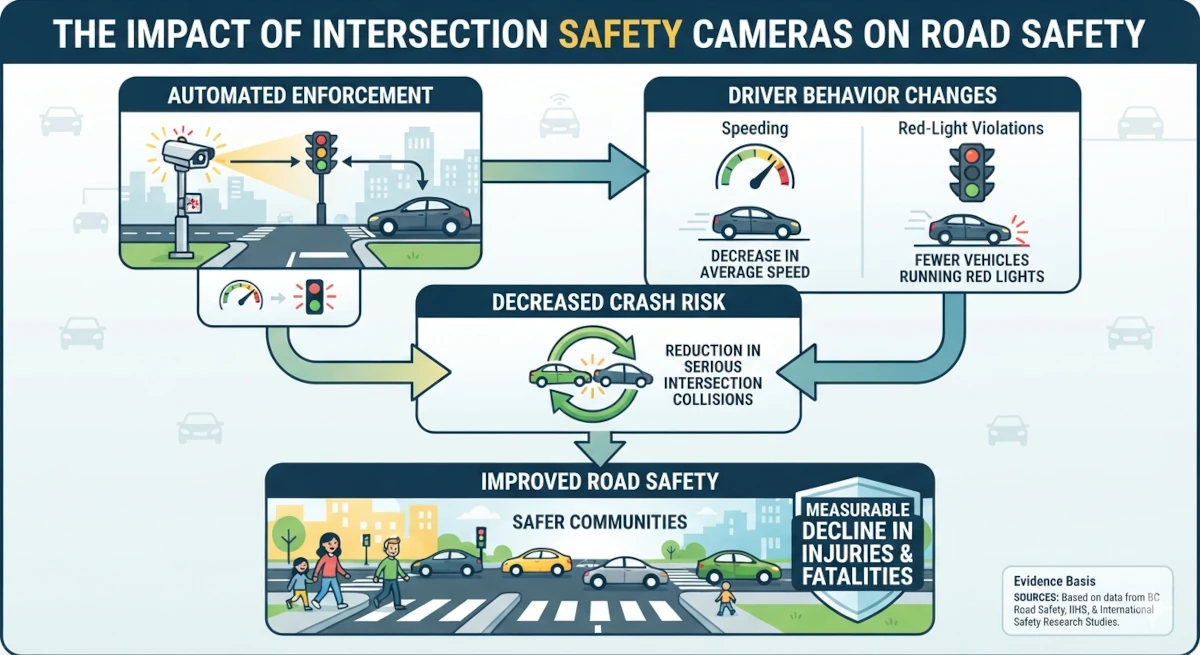
Research conducted in British Columbia and internationally has consistently found reductions in red-light running, excessive speeding and serious right-angle collisions at intersections where automated enforcement is used. While no single safety measure eliminates crashes, intersection safety cameras have generally been shown to influence driver behaviour in a positive way.
Evidence from British Columbia
British Columbia has evaluated automated speed enforcement before. The province's Photo Radar Program was independently studied to determine whether it influenced driver behaviour and improved road safety.
The evaluation also emphasized that public confidence is important to the success of an automated enforcement program. People are more likely to support the technology when they understand that the primary purpose is improving safety rather than generating revenue.
The results of that evaluation are available in the report Evaluation of the BC Automated Speed Enforcement Program.
Although today's Intersection Safety Camera Program differs from the former Photo Radar Program, both are based on the same principle: encouraging drivers to slow down and obey traffic laws through automated enforcement.
What Does International Research Show?
British Columbia's experience is consistent with findings from many other jurisdictions. Research from Great Britain, Australia and North America has generally concluded that automated enforcement reduces excessive speeds, red-light violations and the most serious intersection crashes.
"The findings are unambiguous. Cameras, historically, have saved lives. They continue to save lives. And should they be removed, speeds will rise and accidents with them."
That conclusion, reached by Professor Richard Allsop following research in Great Britain, reflects a broad body of evidence showing that drivers modify their behaviour when they know automated enforcement is present.
The Debate: Safety or Revenue?
Critics often argue that Intersection Safety Cameras are little more than a revenue-generating tool because tickets are mailed to the registered owner and do not result in driver penalty points. Supporters counter that preventing even a small number of fatal or life-altering crashes justifies the program.
These positions are not necessarily incompatible. Automated enforcement may generate revenue because people continue to violate traffic laws, but the measure of success should be whether it improves safety. The important question is whether the overall benefit to public safety outweighs the costs and concerns associated with the program.
Improving the Program
The evidence strongly suggests that automated enforcement can improve road safety. The more useful discussion is how these programs should be designed to maximize safety while maintaining public confidence.
In my view, the strongest criticism of British Columbia's current system is not that it generates revenue, but that it often cannot identify the person responsible for the offence. A driver who repeatedly speeds through camera-equipped intersections or runs red lights may simply pay a series of fines without any effect on their driving record.
If the objective is safer drivers rather than simply safer intersections, identifying repeat offenders and holding them personally accountable would strengthen the program. Financial penalties influence behaviour, but driver improvement measures such as penalty points, driver education and licence review are often more effective for habitual offenders.
Automated Enforcement Is Not the Entire Solution
Intersection Safety Cameras work best as one component of a broader road safety strategy. Police enforcement, engineering improvements, traffic signal timing, public education and responsible driver behaviour all play important roles in reducing collisions.
No single measure will eliminate crashes, but evidence suggests that automated enforcement contributes to safer intersections when combined with these other approaches.
Learn More
- Do Intersection Safety Camera Tickets Add Penalty Points?
- The Effectiveness of Speed Cameras
- How Intersection Safety Cameras Work
- Photo Radar is Effective
- ICBC: Intersection Safety Camera Program
Explore more DriveSmartBC articles to better understand automated enforcement, traffic laws and road safety in British Columbia.
- Log in to post comments
Comments
I finally realized what the cameras take away that changes "everything", something that we've enjoyed for granted, and something that reinforced the honor system in our society: the little known thing such as "freedom from being caught". The reason that changes everything is because it changes the entire balance of power in an adversarial justice system. Suddenly the state knows with machine perfect precision everything to know about your movements, financial transactions, history, opinions and may as well your thoughts.
With modern tech, 99% of drivers are already carrying on-board all of the necessary equipment for remote tracking, evidence documentation and preservation. Unless you don't carry a smartphone on you most of the time, Google already has all the data/evidence necessary to charge every single one of us with every single speeding offense that we've committed over the past 2 years. An average driver breaks some kind of driving law every 3 blocks, and now there's enough dirt on most of us to bankrupt anyone practically on-demand, its an invisible Damocles sword hanging over all our heads.
Recently the talk about "defunding Police" came about, and opinions on it range from Zero Police to Less Police to more non-Police-Police. And it seems to me that the Zero Police is completely and perfectly attainable everywhere with the current level of technology today: a dystopian fusion of films "Enemy of the state" & "Minority Report" & "Idiocracy". China already surveils and fines pedestrians based on facial recognition for spitting, littering, jay-walking. They assign social scores based on individual behavior and prohibit travel and other "luxuries" if individual is not in good standing. Everything is done digitally, well documented, with perfect evidentiary base.
But even in North America, gone are the days when license plates were necessary - if you have a face - you can be uniquely identified. Majority of identification databases, such as passports and driver licenses are already analyzed for facial recognition and an algorithm is built for your face to bounce back positive matches on-demand, i.e. for FBI requests. Most of the tech and costs necessary for 100% per-person tracking are already in-place. We are literally a stroke of a pen away from turning "our" laws into a dystopian 2084 world where everything will be prohibited, unless explicitly allowed.
We keep dealing with "all these problems", but the society is demonstrably becoming unhappier. Suicide rates are up more than double among young people over the last decade. Lots of people are unsatisfied with their lives and don't have high hopes of it getting better. I don't believe that we'll be happy once we cut-off any more freedoms, we'll be even more miserable.
Why don't we instead have cameras that pay drivers (randomly) for positive actions, like stopping at red-light, stopping on stop-signs, letting pedestrians through, etc. We have the technology, and we have too much money (apparently), so why not positive reinforcement instead?
- Log in to post comments
It's worth taking the time to look at that Impacts report; particularly page 301 on the BC Photo Radar Program. As many will recall, it became an important political issue that went from majority support on the part of the public when they introduced it, to the opposite once they ran it for a few years.
Note that the fines were raised from $115 to $460 per incident - it may not have been intended as a 'cash cow', but that's what the government of the day morphed it into; even as the police deliberately switched from a model based on community input/demand for lower speeds on certain roads to setting up their beige minivans on sections of road (such as SW Marine) where traffic flow has always been swift, thus resulting in many more tickets.
At least, back in those days, the vehicle owner receiving the ticket could then nominate who was driving, to ensure that they now bore the responsibility - both the fine, but also the Penalty Points on their Driver License, which is as it should be; whether it's an employee operating a company vehicle, of just a family member using the car.
And, to the best of my knowledge/recollection, when BC introduced Red Light cameras, this same ability to nominate the miscreant was continued. Again, this is how it should be, to have any affect on driver behaviour (never mind the cost). And whatever your politics, there is never an excuse for running a red, you had lotsa time to stop when it went amber, if it was red when you entered the intersection.
But we should definitely be concerned about how this red light camera / speed camera system is being run these days. Secretly, it seems, by RSBC. It's absurd and unjustifiable that only the vehicle owner can get penalized, and only with a fine. Wealthy people aren't that special.
---------------------------------------------------------
A couple of other thoughts.
Why don't we instead have cameras that pay drivers (randomly) for positive actions, like stopping at red-light, stopping on stop-signs, letting pedestrians through, etc. We have the technology, and we have too much money (apparently), so why not positive reinforcement instead?
Outrageous, I always enjoy reading your posts, but this logic confounds me. I'm pretty certain that the idea behind the system is to target incorrect driver behaviour, in a calculated manner, rather than reward random drivers for doing what they're supposed to do anyway (though stopping on stop signs probably ain't what you meant).
Meanwhile, looking at the Traffic Camera warning sign at the top of this article, I wonder why they always use some approximate silhouette of a 4x5 Speed Graphic from the 1940's to depict these modern digital devices?
- Log in to post comments
Outrageous, I always enjoy reading your posts, but this logic confounds me. I'm pretty certain that the idea behind the system is to target incorrect driver behavior, in a calculated manner, rather than reward random drivers for doing what they're supposed to do anyway (though stopping on stop signs probably ain't what you meant).
I think the idea you describe is the intent, no argument there, but its not entirely working to its ultimate conclusion is it? The idea is to give out tickets until everyone gets one and is informed that such action is wrong and stop doing it... but how come the yearly increase in tickets issued is more than the yearly increase in drivers licensed? Probably because people know that the action is "wrong" but do it anyways, because the deemed consequence doesn't happen as often as its being portrayed. Ergo nobody suddenly crashes as soon as they touch their phone, or their vehicle goes over the posted speed limit, and likewise people can run stop signs forever (or red-lights at night in a Porsche SUV when no one is round), its only ever a problem when two or more road participants intersect.
I think my idea has some merit to it. Every time I'm at a gas station someone is always purchasing a heap of lottery tickets in-front of me. The chances that they'll win are astronomically small. But people still buy tickets by the thousands very regularly (encouraged behavior) on an off chance that they would win. Same idea here: always stop at stop signs and maybe someone would win. All lottery sales kiosks proudly display who and when won something from them. Same with this traffic lottery - post happy winners on a card below the STOP sign - saying who and how much they got. Heck, assign "lottery ticket" to everybody who does the encouraged behavior and have public draws.
This will make public surveillance a positive thing in a jiffy! People would even start to clean their license plates to make sure that they will be counted, haha :)
- Log in to post comments
I believe the intersection cameras are very helpful however I cannot believe that photo radar would be less effective and I cannot ever understand that a concerned government would use the removal of photo radar as a political tool to win an election regardless of its true value.
- Log in to post comments
Its an interesting vector we're on